
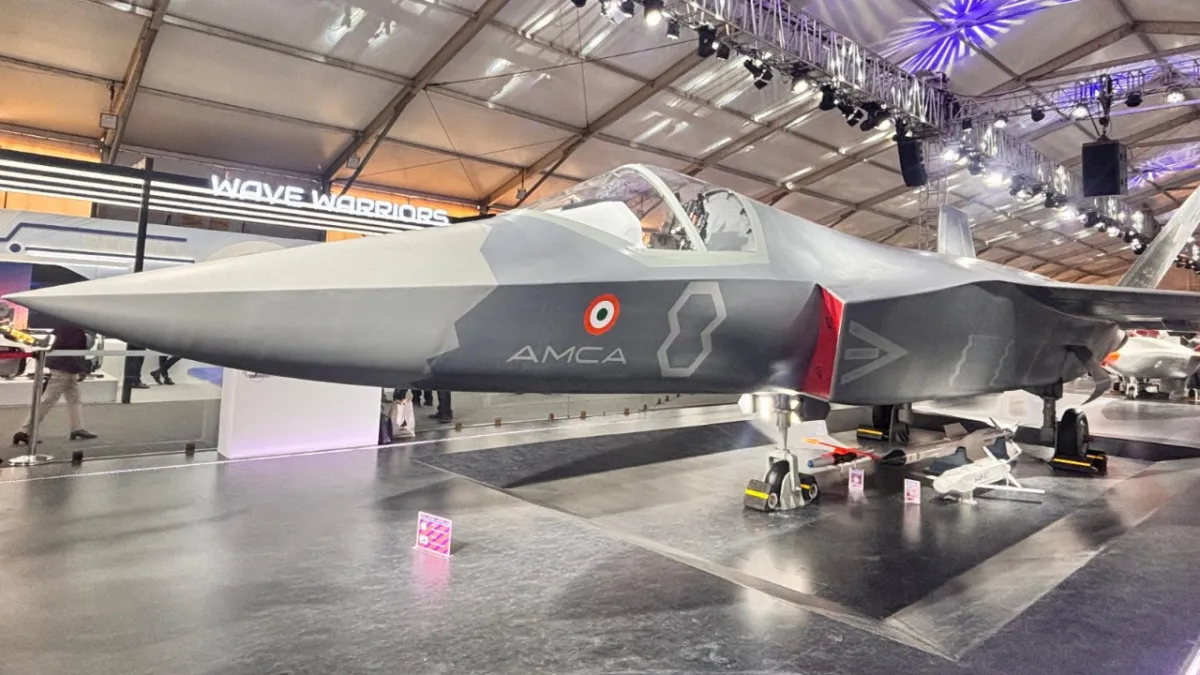
India's air dominance and defence sector is on the brink of a major transformation, with four advanced indigenous aircraft projects expected to redefine the capabilities of the Indian Air Force (IAF) and Navy by 2035. These include the Advanced Medium Combat Aircraft (AMCA), Tejas Mk-2, Twin Engine Deck Based Fighter (TEDBF), and the Netra Mk-2 Airborne Early Warning and Control (AEW&C) platform. Each represents a critical step toward achieving self-reliance in defence production and next-generation air power.
AMCA: India's first fifth-generation stealth fighter
The Advanced Medium Combat Aircraft (AMCA) is India’s first fifth-generation multirole fighter jet, being developed by the Aeronautical Development Agency (ADA) and Hindustan Aeronautics Limited (HAL). It is designed for air superiority, deep strike, and stealth operations.
The AMCA will feature radar-absorbent materials, an internal weapons bay, and a low-observable airframe to reduce radar cross-section. Its twin engines will initially be GE F414s, with plans to integrate a more powerful indigenous engine in later variants. Advanced features include AI-assisted flight controls, a large-area touchscreen cockpit display, and sensor fusion for superior situational awareness.
The aircraft is expected to undertake its first flight between 2030 and 2032, with induction likely by 2035. Once operational, the AMCA will place India among a select group of nations capable of producing fifth-generation fighter aircraft.
Tejas Mk2: The advanced medium-weight fighter
The Tejas Mk-2, also known as the medium-weight fighter (MWF), is an upgraded version of the existing Tejas Mk-1. It aims to bridge the capability gap between light fighters and heavy multirole aircraft such as the Rafale.
The Mk-2 will come with the indigenous Uttam Active Electronically Scanned Array (AESA) radar, a detection range of up to 200 km, and an integrated Infrared Search and Track (IRST) system. It will also feature a unified electronic warfare suite, an advanced digital flight control computer, and a fully glass cockpit with a wide-area display.
Capable of carrying a heavier weapons payload, the Mk-2 will deploy Astra beyond-visual-range missiles, precision-guided bombs, and stand-off weapons. Its first flight is targeted for 2026, with induction expected by 2028, making it a key component of the IAF’s future fleet.
TEDBF: The future of India's naval aviation
The Twin Engine Deck-Based Fighter (TEDBF) is being developed by the Defence Research and Development Organisation (DRDO) for the Indian Navy’s aircraft carriers. It will replace the MiG-29K and serve as a multirole fighter optimised for air defence and strike operations from sea-based platforms.
The TEDBF will have a canard-delta configuration with foldable wings for carrier storage and will be capable of carrying up to 9,000 kg of weapons on 11 hardpoints. Its armament will include Astra and Derby air-to-air missiles, anti-ship missiles such as BrahMos-NG, and guided bombs. The aircraft is designed to achieve speeds up to Mach 1.6 and will have improved range and manoeuvrability.
The prototype is expected to be ready by 2030, with operational induction likely between 2038 and 2040. Once in service, it will strengthen India’s maritime strike and defence capabilities significantly.
Netra Mk2: Next-generation airborne early warning system
The Netra Mk-2 is an advanced Airborne Early Warning and Control System (AEW&C) aircraft developed by DRDO to enhance the IAF's surveillance capabilities. It will be mounted on the Airbus A321 platform, replacing the smaller Embraer-based Netra Mk1.
The upgraded aircraft will feature a dorsal-mounted AESA radar with 300-degree coverage, extended endurance, and greater payload capacity. It will integrate state-of-the-art sensors, communication systems, and electronic intelligence suites, providing real-time tracking of multiple aerial targets and battle management support to fighter aircraft.
The first prototype is expected to fly in the early 2030s, with induction by the mid-2030s. The Netra Mk-2 will play a pivotal role in airspace monitoring, threat detection, and network-centric warfare.
Together, these four aircraft programmes reflect India’s commitment to becoming self-reliant in defence manufacturing. By 2035, the AMCA, Tejas Mk-2, TEDBF, and Netra Mk-2 will form the backbone of India’s next-generation aerial fleet, enhancing its strike range, situational awareness, and deterrence capability across domains.
|
Exclusive first look: HAL's Tejas Mk2 prototype revealed, key upgrades and features unveiled |
