
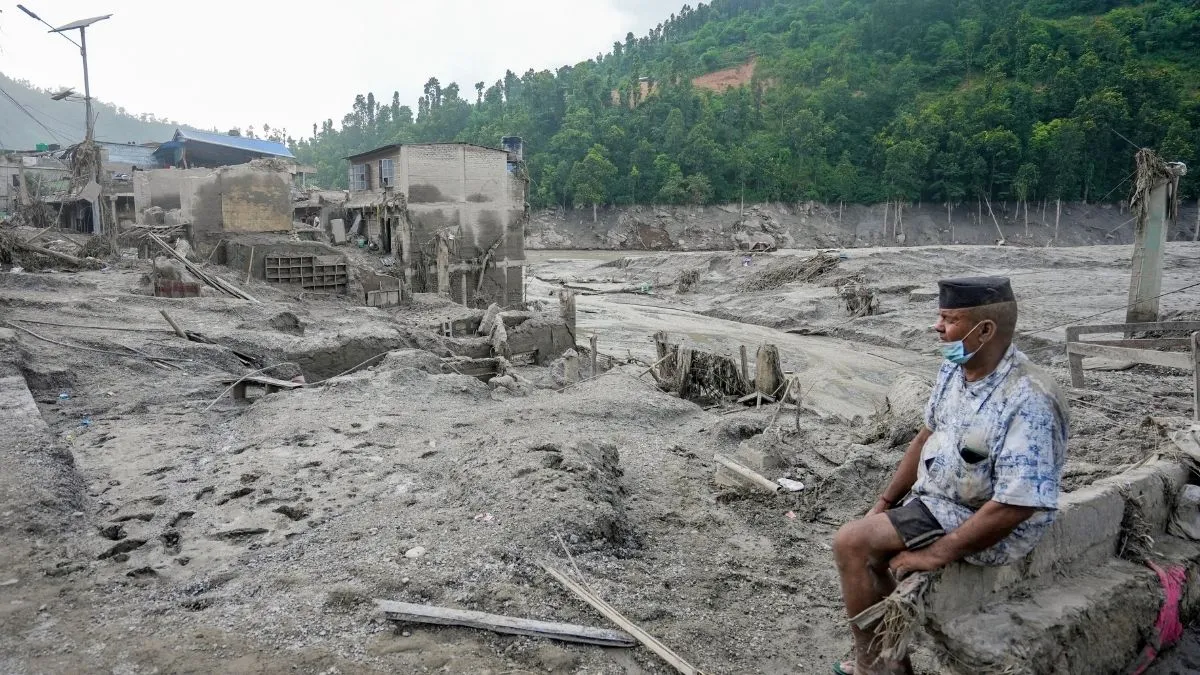
While the deaths have soared above 700 in Nepal following Wednesday's flash floods, the Himalayan nation is struggling with another crisis: space to keep the mortal remains of the victims. Morgues in Nepal are running out of spaces and hospitals are struggling to accommodate the remains of victims.
As the situation continues to remain grim, the landlocked country has announced it would bury the unidentified and unclaimed bodies recovered following the tragedy in airtight bags. The announcement was made by Prime Minister Balendra Shah who stated that his government's priority remains ensuring the safety of citizens.
"Only bodies that cannot be identified will be managed by the government after preserving DNA and other evidence that could help establish their identity," The Kathmandu Post quoted the Nepali prime minister as saying.
DNA samples to be taken before burial
Before an unidentified and unclaimed body is buried in airtight bags, authorities would collect the DNA samples for an identification in future. Additionally, bodies would be marked with a unique identification or reference numbers, along with location tags.
This, as per authorities, would assist in helping people recover the mortal remains of their family members. Till Saturday afternoon, authorities had completed the DNA profiling of more than 100 bodies, which were buried later.
Bodies to be buried 1.5 metres deep
These bodies will be buried 1.5 metres beneath the ground so that they could retrieved later. Authorities will ensure that a 40-centimetre gap is maintained so that the body whose DNA sample has matched is retrieved.
A signboard on a concrete platform will also be built at the burial sites and the entire procedure would be photographed and video-graphed.
Most bodies recovered in Chitwan
Most of the bodies have been retrieved in the Chitwan district. Here, authorities have recovered 233 bodies, but only six of them have been identified and handed over to the families, as per a report by The Himalayan Times.
As authorities race against time, they have collected the DNA samples of 135 bodies. They are also coordinating with College of Medical Sciences, Chitwan Medical College, Bharatpur Hospital and medical colleges in Kathmandu and Palpa for the process of identification.
To ensure that the bodies don't decompose, authorities have turned houses into cooling centres.
Deaths over 700, nearly 2,500 still missing
On Sunday, Nepal announced that the death count has touched the 734-mark and 2,498 people still remain missing, while more than 4,500 have been rescued till now. It has also warned that water levels in the Bhotekoshi River have increased once again, urging residents and rescue personnel in flood-hit districts to remain alert.
"The water level in the flooded Bhotekoshi River has risen to some extent; all concerned are urged to take precautionary measures," the National Disaster Risk Reduction and Management Authority (NDRRMA) said in a statement earlier in the day.
ALSO READ:
As concerns mount over Nepal-Tibet flash floods, China censors viral footage showcasing devastation
