
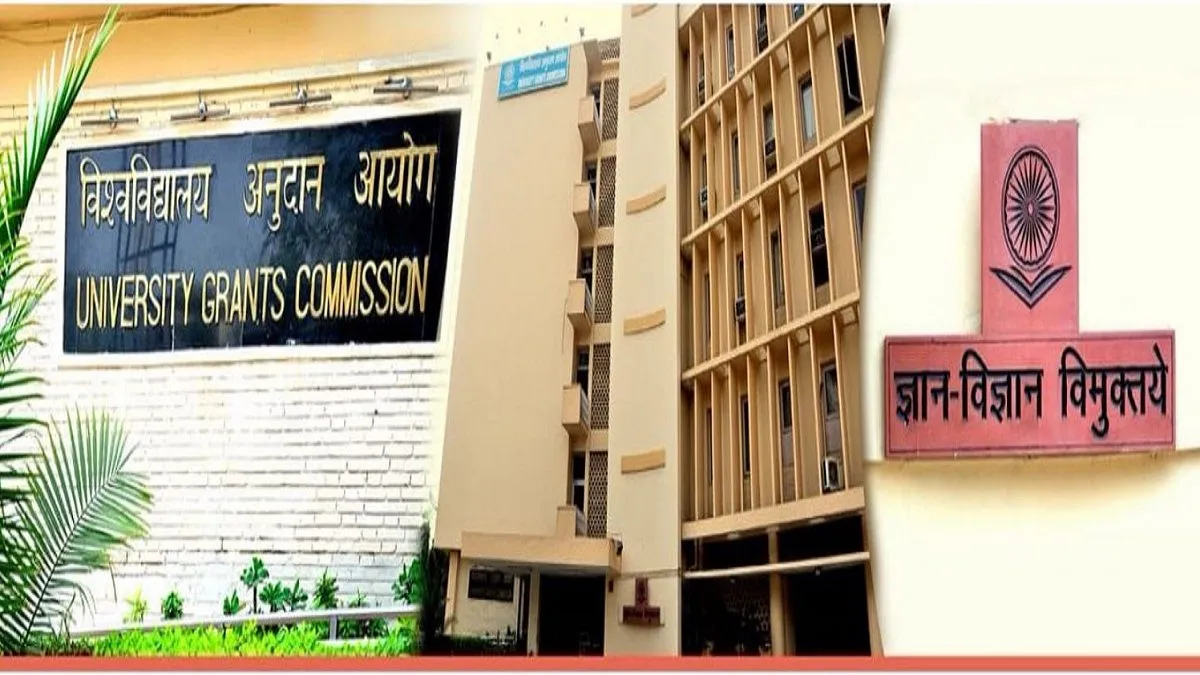
The University Grants Commission (UGC) on Tuesday released a draft Learning Outcomes-based Curriculum Framework (LOCF) for nine undergraduate subjects, drawing a plethora of reactions from several stakeholders.
The inclusion of Vinayak Damodar Savarkar’s The Indian War of Independence in the draft curriculum has sparked a massive row. Critics have said inclusion of Savarkar tantamounts to distorting historical narratives.
The UGC says the new LOCF aims to move beyond rote learning, focusing instead on practical and outcome-based education. The proposed framework includes fieldwork, lab work, and interactive assignments designed to build critical thinking, analytical skills and problem-solving abilities. It also seeks to connect students with real-life challenges.
However, it is the integration of traditional Indian knowledge that has sparked the most debate.
Subject-wise inclusions
In Chemistry, the syllabus opens with a Saraswati Vandana and includes modules on Ayurveda, Siddha and homeopathy. Students will explore traditional Indian medicines, including the use of milk, water and honey in treatment, along with local beverages.
Mathematics introduces ancient timekeeping methods (Kala Ganana), Sutra-based arithmetic and geometry, astronomical concepts from texts like the Surya Siddhanta and Aryabhatiyam, and Hindu cosmological cycles. The curriculum highlights the contributions of Aryabhata, Ramanujan and Kaprekar.
Commerce features Kautilya’s Arthashastra, the concept of Ram Rajya linked to corporate social responsibility (CSR), leadership teachings from the Bhagavad Gita and modules on Bharat Bodh, Viksit Bharat and other Indian knowledge traditions.
Anthropology includes the works of ancient medical scholars Charaka and Sushruta.
Savarkar mentioned in History curriculum
The most contentious proposal appears in History, where Savarkar’s The Indian War of Independence is listed as recommended reading for modules on India’s freedom struggle. This inclusion has ignited widespread criticism, with detractors warning that it risks distorting historical narratives.
The UGC maintains that the LOCF is still in the draft stage and open to feedback.
