
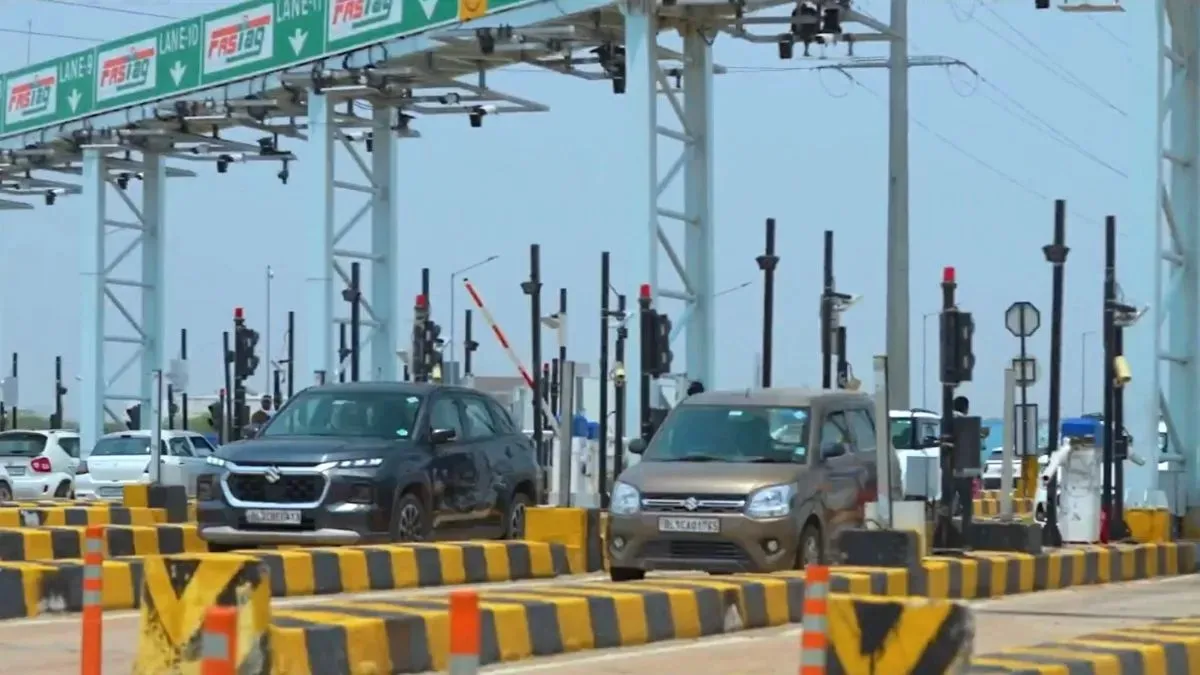
Delhi's Mundka Bakkarwala Toll Plaza on Urban Extension Road II has begun operating as a fully barrier-free tolling point, marking the country's second multi-lane free-flow system. Union Minister Nitin Gadkari launched the facility on Monday and said that once this model is adopted nationwide, commuters will enjoy uninterrupted highway travel while the government saves up to Rs 6,000 crore every year on fee plaza management.
While inaugurating the new system, Gadkari noted that the introduction of FASTag earlier pushed annual toll revenue from around Rs 40,000 crore to nearly Rs 55,000 crore. With the rollout of MLFF, he said operating costs will drop significantly. He added that the new technology will reduce expenses from the earlier 15 per cent to about 10 per cent, translating into an annual saving of Rs 5,500 crore to Rs 6,000 crore.
AI cameras enable high-speed passage
At the new plazas equipped with barrier-free tolling, vehicles can drive through without halting. AI-powered cameras can read vehicle details even when cars pass at speeds up to 100 km per hour. "Waiting time is zero at such plazas. AI has been used for number plate recognition. You can pass an MLFF barrier-less tolling system at a speed of 80 to 100 km/h," Gadkari said. Officials estimate that this technology will help save fuel worth Rs 285 crore and prevent almost 81,000 tonnes of carbon emissions in the coming years.
How the toll will be processed
Toll payments will continue to be deducted through FASTag. The National Highways Authority of India will receive the user fee directly from partner banks. If a motorist with low balance or an inactive FASTag crosses the MLFF lane, an e-notice will be issued on the registered mobile number. Commuters will get 72 hours to clear the dues through online modes such as UPI before further action is taken.
Nationwide expansion planned by 2026
After Choryasi in Gujarat and Mundka Bakkarwala in Delhi, NHAI is preparing to activate MLFF systems at 17 more toll plazas across nine states by September 2026. These include Gujarat, Delhi, Haryana, Rajasthan, Tamil Nadu, Karnataka, Maharashtra and Assam. The authority is also advancing the tender process for over 108 plazas under the second phase, which is expected to be completed by March 2027.
Focus on road safety alongside new tech
The upgraded system uses Automatic Number Plate Recognition and FASTag integration to improve traffic flow and enhance the driving experience. Gadkari urged motorists to follow safety rules, wear seat belts and avoid using mobile phones on highways. He noted that the new MLFF cameras can detect such violations even at night and report them to authorities for issuance of challans.
ALSO READ: No more barriers at toll plazas, electronic toll system to enhance user experience: Details here
