
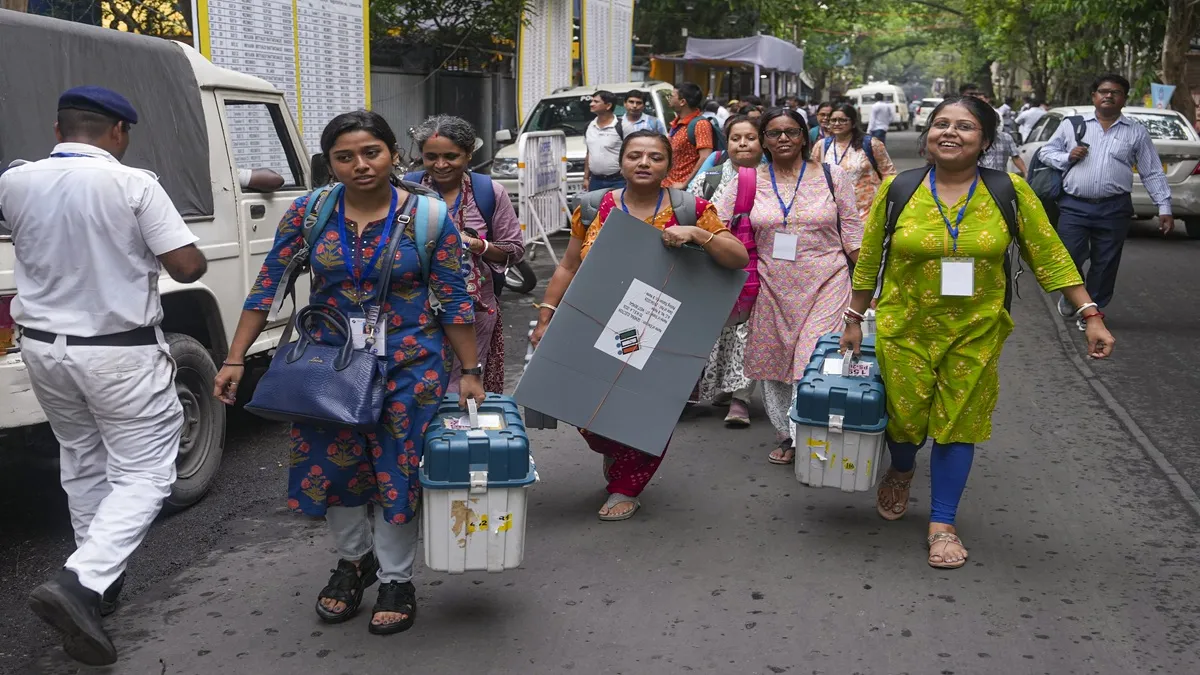
The second phase of the West Bengal Assembly Election will witness polling on 142 seats on Wednesday, with the Election Commission of India enforcing an unprecedented security plan. More than 3.5 lakh personnel from CRPF, SSB, RPF, ITBP and CISF have been stationed across seven districts. In Kolkata alone, around 35,000 security personnel have been deployed, while 2,550 companies of central forces are guarding the state. Along with this, 142 general observers and 95 police observers have been appointed to monitor polling.
NIA deployed for the first time in an election
For the first time, the National Investigation Agency (NIA) has been roped into election duties. Monitoring is being carried out from a central control room in Kolkata, divided into seven clusters, each handled by a nodal officer. As per officials, CCTV surveillance has been activated around every polling station, with real-time footage reaching the control room. CAPF control rooms are connected with poll officials at the state and district levels. Over 6,000 quick response teams are on the ground and armoured vehicles are patrolling sensitive regions.
Voter roll deletions spark tension in this phase
The Election Commission has launched a dedicated helpline for reporting violations. While 152 seats voted on April 23 in phase one, all eyes are now on the second phase where 3,21,73,837 voters will participate. This phase has seen major political tension due to the large-scale deletion of voter names from rolls. North 24 Parganas recorded 12.5 lakh deletions, South 24 Parganas around 11 lakh, Howrah 6 lakh, Hooghly 4.5 lakh and Nadia nearly 4.85 lakh. Around 25 seats may see their results shaped significantly by these missing names.
Bhabanipur seat draws national spotlight
The Bhabanipur constituency in Kolkata remains the centre of national attention, where Chief Minister and TMC chief Mamata Banerjee faces BJP heavyweight Suvendu Adhikari. Nearly 51,000 names, about 25 per cent of the voter list, have reportedly been removed. The TMC has termed it a conspiracy, while the BJP has dismissed the allegation. Bhabanipur is often called "Mini India" due to its diverse population. Mamata Banerjee won here by 58,000 votes in the last bypoll, but her margin fell to just 8,000 in the 2024 Lok Sabha polls, making this contest extremely competitive.
Tense atmosphere in South 24 Parganas
Among the seven districts, North and South 24 Parganas are the most influential, accounting for 64 of the 294 seats. In the previous elections, TMC swept 58 of these seats. Key areas include Barrackpore, Barasat and Bongaon in the north and Diamond Harbour and Alipur in the south. South 24 Parganas has nearly 35 per cent Muslim population and is witnessing a highly charged campaign environment. Most seats in this phase are expected to see direct contests between the TMC and BJP.
BJP boosts campaign outreach this time
Nadia is another crucial district, where the BJP had won 9 out of 17 seats last time. Votes of the Matua and Namasudra communities will play a decisive role. Issues like NRC and CAA are central to the political narrative. Prime Minister Narendra Modi has promised citizenship rights for refugees, while the TMC continues to oppose NRC. In 2019, the TMC won 123 of these 142 seats, while the BJP secured 18. This time, the BJP has intensified its campaign with rallies by Prime Minister Narendra Modi, Union Home Minister Amit Shah and Uttar Pradesh Chief Minister Yogi Adityanath.
Key role of Hindu and women voters
Political analysts believe that even a slight shift among Hindu and women voters may influence outcomes on 73 of the 142 seats. Urban concerns such as employment, healthcare and education also remain important. With heightened security and political tension, the nation would be closely watching Wednesday's voting, as the results could shape the future political direction of West Bengal.
