
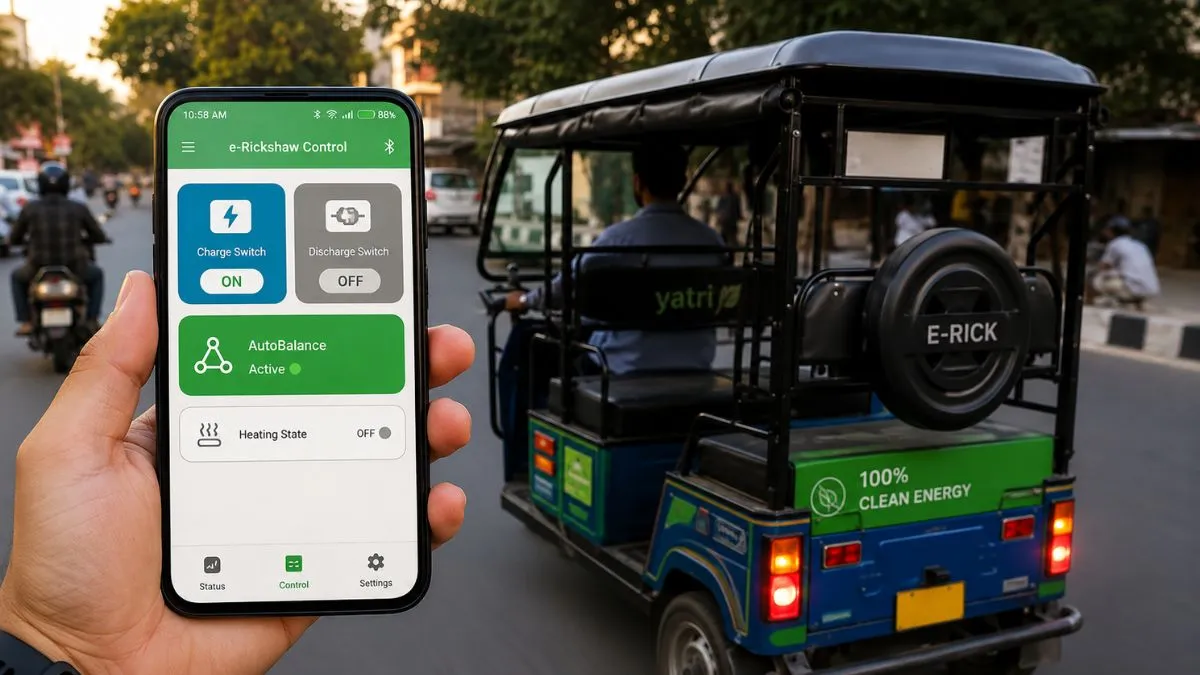
Videos claiming that a Chinese app called BAT-BMS can remotely switch e-rickshaws on and off have been doing the rounds on X, and understandably, they have caught people's attention. The idea that a vehicle could be controlled through something as simple as Bluetooth has left many users uneasy, with questions quickly piling up about how real these claims actually are.
As the clips spread, the conversation shifted from curiosity to concern. Some users began pointing out the potential risks, especially if such technology were to be misused. There were worries about drivers losing control of their vehicles, along with broader fears about road safety. However, a closer look by The Lallantop suggests the situation is not quite as straightforward as it appears online.
What is BAT-BMS?
The viral posts describe BAT-BMS as a Chinese application that can supposedly switch e-rickshaws on and off using Bluetooth.
A few users went a step further, claiming that the app can connect directly to an e-rickshaw's battery and cut off its power supply altogether.
These claims spread quickly, tapping into wider anxieties around how secure electric vehicles really are.
Fact-check explains how the app works
According to The Lallantop, the viral narrative leaves out some important details.
The report clarifies that BAT-BMS cannot simply connect to any e-rickshaw and shut it down via Bluetooth alone. To establish a connection, the app requires a unique ID linked to a specific battery.
In other words, without access to that battery-specific identification, the app cannot randomly connect to or control nearby vehicles.
The app operates through the Battery Management System, or BMS, which is essentially the control centre of a battery pack.
This system is responsible for monitoring and regulating key functions such as voltage, current and temperature, ensuring the battery operates safely and efficiently.
Social media users raise safety concerns
Even with this clarification, the videos have continued to spark debate.
Many users have urged caution, pointing out that tools capable of interacting with battery systems could still be misused if they fall into the wrong hands. There is also concern about the potential impact on e-rickshaw drivers, whose livelihoods depend on these vehicles.
Others highlighted the obvious safety angle, noting that any interference with a moving vehicle could be dangerous. The broader takeaway from the discussion is clear: while the technology may not work exactly as claimed, it still raises valid questions about responsible use and safeguards.
ALSO READ: 'Mai school student nahi hu': Gen Z employee's blunt reply to boss over sick leave goes viral
