
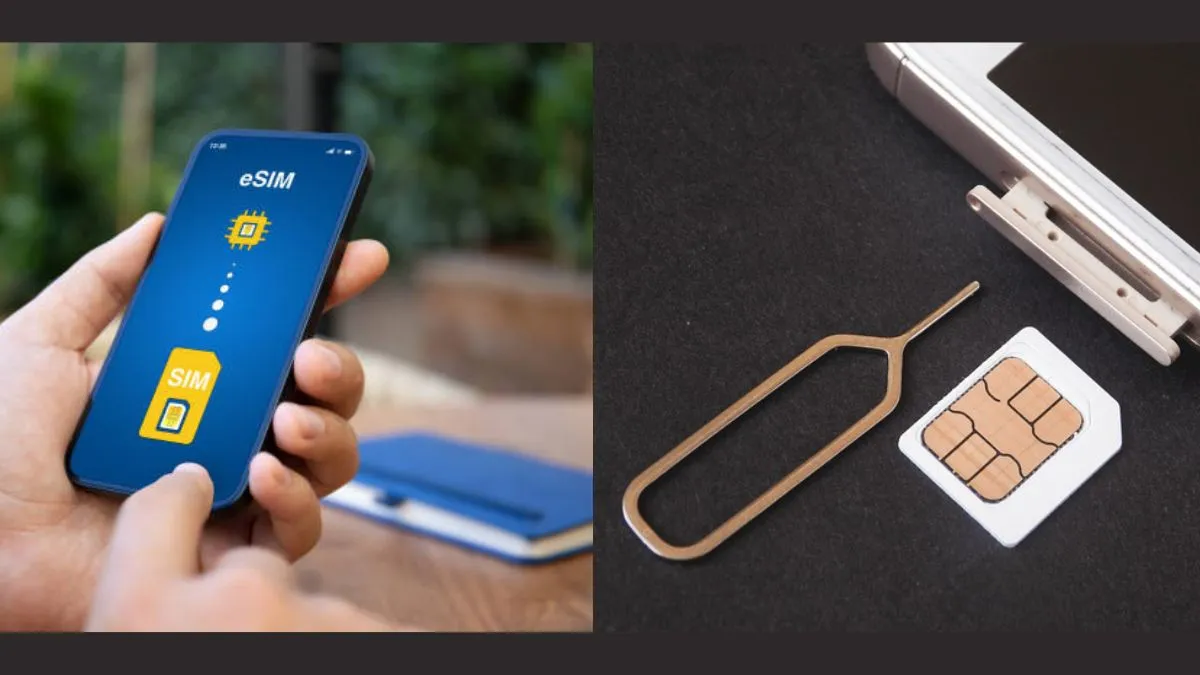
eSIM is a modern version of the traditional SIM card that comes built into a smartphone. Unlike a physical SIM, users do not need to insert or remove the card. Instead, your mobile operator can activate it digitally. For Indian users, eSIM is already being supported by major telecom companies like Jio, Airtel, and Vi on selected devices. But largely, many smartphone users are still wondering what this technology is, and does it fits the Indian market, as per the requirements?
Let us understand how eSIM works, its benefits, and how it is different from the regular SIM card.
What is a normal SIM card?
- A SIM (which stands for ‘Subscriber Identity Module’) is a small plastic card with a chip that you insert into your handset.
- It stores information like your phone number, network and contacts.
- In India, we commonly use nano-SIMs these days, which are the smallest form of SIM cards.
What is an eSIM?
- An eSIM (Embedded Subscriber Identity Module) is a digital version of a SIM card that is built directly into your device’s hardware.
- Instead of inserting a physical card, the user’s mobile operator will activate the SIM remotely through a QR code or settings option.
- Many premium smartphones like iPhones, Google Pixel and some Samsung Galaxy models already support eSIM in India.
Key differences between eSIM and a Normal SIM
- Physical vs Digital: A Normal SIM is a removable card, while an eSIM is built-in and cannot be removed.
- Switching Networks: With eSIM, you can change your mobile operator by scanning a QR code, while a normal SIM requires a physical swap.
- Dual SIM Usage: eSIM allows you to use both a physical SIM and a digital SIM at the same time, giving you two numbers in one phone.
- Security: eSIM is safer as it cannot be physically lost or stolen, unlike a normal SIM.
- Space Saving: eSIMs free up space inside the phone, allowing brands to make slimmer devices or add bigger batteries.
Benefits of eSIM in India
- Easy switching between operators like Jio, Airtel, and Vi without visiting a store.
- No risk of SIM card damage or misplacement.
- Helpful for frequent travellers, as you can activate an international plan instantly without buying a new SIM.
- Supports dual-SIM functionality for both work and personal numbers.
Drawbacks of eSIM in India
- Limited device support: Not all smartphones in India support eSIM. Mostly premium models like iPhones, Google Pixel, and some Samsung Galaxy phones have this feature. Budget and mid-range phones rarely come with eSIM support.
- Complicated activation process: Unlike a physical SIM, which you can just insert and start using, eSIM activation requires scanning a QR code and following multiple steps. If something goes wrong, you may need to contact customer care.
- Not easy to switch between phones: With a physical SIM, you can simply remove the card and put it in another phone. But with eSIM, you have to deactivate it from the old device and set it up again on the new one, which can be time-consuming.
- Dependence on operator support: Only Jio, Airtel, and Vi currently provide eSIM services in India. Smaller operators and regional networks don’t support it yet, limiting your options.
- Issues during repairs or phone loss: If your phone gets damaged or lost, you cannot just remove the eSIM like a physical SIM. You’ll need to request a new activation from your operator, which can take extra time.
If your phone supports eSIM, it’s worth trying for convenience and modern features.
