
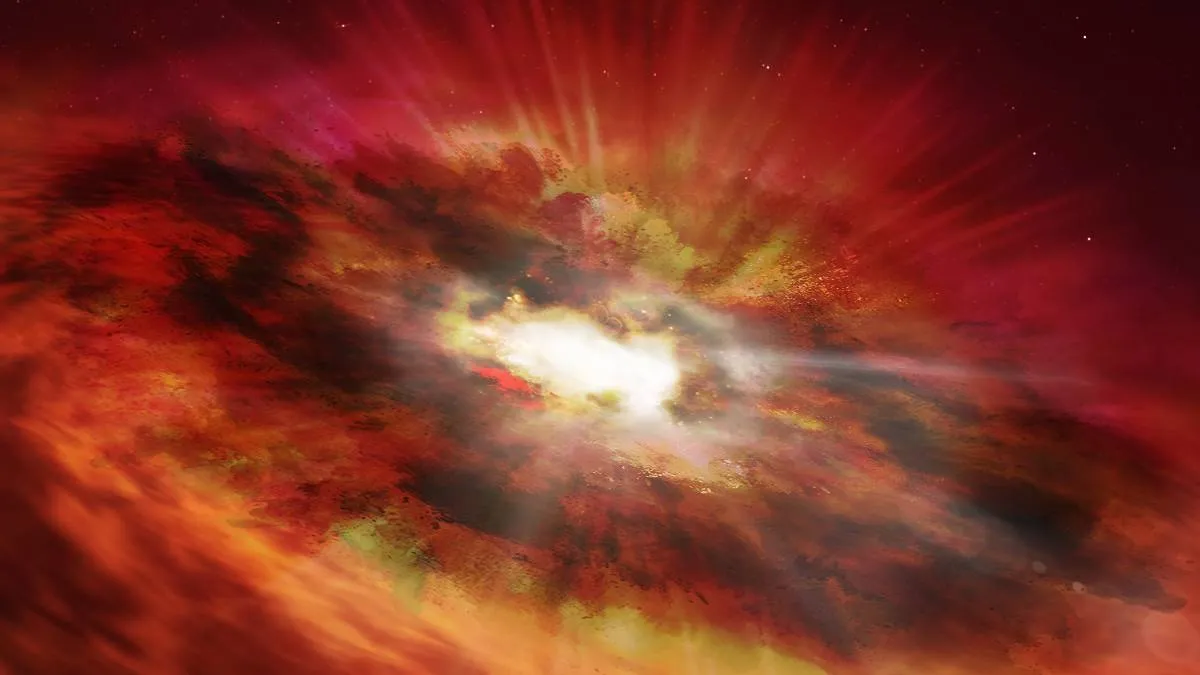
A major study by astronomers from the Indian Institute of Astrophysics (IIA) has provided strong evidence for a long-held idea: the powerful forces surrounding supermassive black holes can actually hinder the formation of new stars in their galaxies. The IIA, which is part of the Indian government's Department of Science and Technology and located in Bengaluru, has roots that go back to an observatory set up in Madras in 1786.
Scale and method of the study
The study’s success was attributed to recent advancements in observational astronomy, according to Prof C S Stalin, a faculty member at IIA and co-author of the research.
"Because of advancements in instrumentation, such as integral field spectroscopy, we are able to probe regions on very small scales that were not possible a few years ago," Prof Stalin told PTI. This ability to resolve complex connections between Active Galactic Nuclei (AGN)—the energetic centers powered by supermassive black holes—and their host galaxies was key.
Payel Nandi, a Ph.D. student at IIA and the lead author of the study, noted that the research is truly unique due to its scale and depth. Unlike previous works that focused on individual galaxies or small samples, this team studied 538 AGN.
"We carried out a systematic comparison of optical and radio properties, which led us to uncover trends linking black hole activity, gas outflows and star formation suppression," Nandi explained to PTI.
Key Findings: Black hole regulation
The researchers combined optical data from the Sloan Digital Sky Survey (SDSS) with radio data from the Very Large Array (VLA), both located in the United States.
Through nearly four months of intense data analysis and cross-matching, the team proved that the intense radiation and high-speed relativistic jets emitted by black holes work together. This energy can eject gas from the galactic centers, effectively shutting down star formation in those regions and thereby regulating the overall growth of the galaxy.
The role of radiation and outflows
A central takeaway from the study is that radiation from black holes is the primary driver of energetic gas outflows.
Prof Stalin provided quantitative evidence: these outflows—high-speed streams of gas pushed out from galactic centers—are more than twice as likely in galaxies detected in radio wavelengths (56 percent) compared to those without radio emission (25 percent).
Implications for galaxy evolution
Recent research published in The Astrophysical Journal sheds light on a big question in astronomy: why do some galaxies stop making new stars while others keep doing so? The lead researcher, Nandi, pointed out that to really understand how galaxies change and grow over time, astronomers need to study data from various types of light, such as what we can see with our eyes, as well as radio waves and other forms. This approach helps them piece together the puzzle of galaxy development.
She explained, "This method helps us understand not just the light we see, but also the hidden forces and energy processes that influence how galaxies are born, grow, and eventually fade away." Nandi believes that this kind of understanding is essential for enhancing our theories and computer models about the evolution of galaxies.
Prof Stalin stated that the study "has put in place a key piece of the puzzle" that will help astronomers eventually understand the full picture of galaxy evolution. Nandi echoed this, calling the comprehensive, data-driven work a "strong foundation for future explorations of how black holes shape the cosmic landscape”.
ALSO READ: Dinosaurs were thriving in North America before asteroid strike, say scientists
