
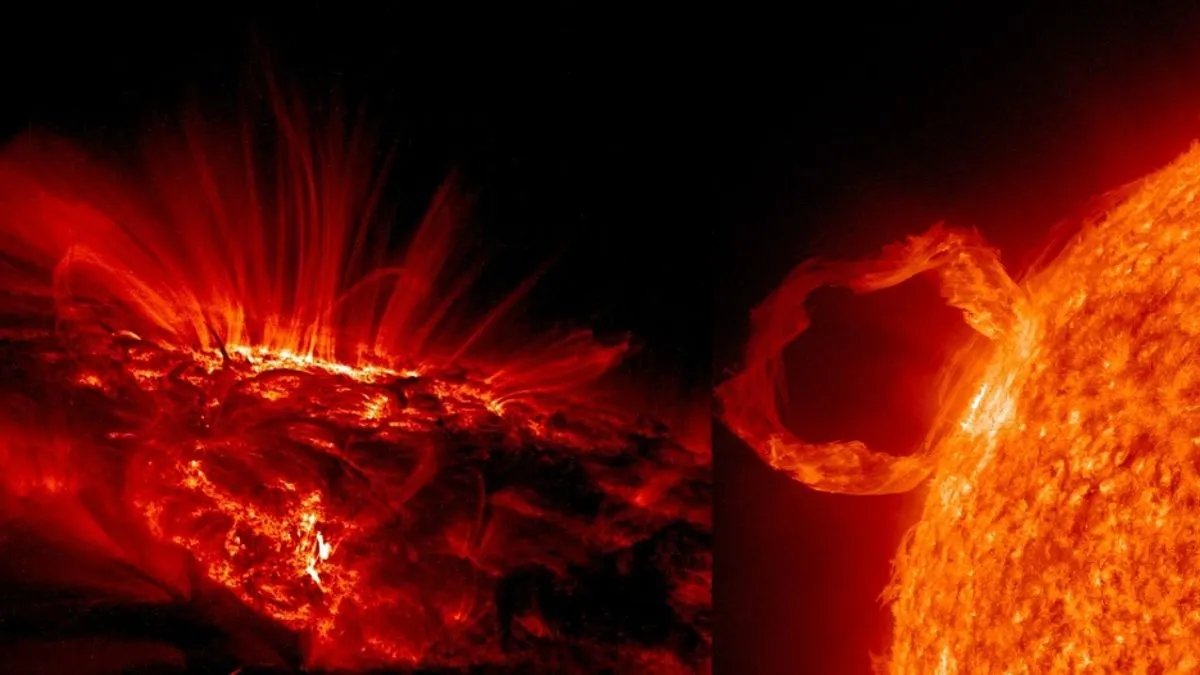
The sun unleashed its most powerful solar flare of the year on November 11 (2025), which was an X5.1-class eruption from the hyperactive sunspot AR4274. As per the report from Space.com, this flare was not only intense but also rich in high-speed protons—charged particles that can reach particularly deeply into Earth's atmosphere.
This influx of energetic particles caused a very rare event called a GLE, where radiation levels intensify at altitudes that should be protected from space weather. Radiation levels were recorded to increase almost 10 times above the normal background at about 40,000 feet, marking the most intense atmospheric spike in almost two decades.
Impact on flights and safety
Although the spike was brief, experts say that it approached the lower threshold of official aviation safety limits. Airline passengers were not in imminent danger, but such events point to the vulnerability of high-altitude aviation.
Scientists warn that a flare even slightly more powerful might cause temporary problems to aircraft systems, including:
- Disruption in onboard electronics
- Interference with high-frequency radio communications
- Navigation accuracy issues for polar-route flights
Fortunately, the November 11 flare remained below hazardous levels. With the Sun moving into its peak solar cycle phase, however, researchers expect more events like this in the months to come.
What exactly are solar flares?
Solar flares are the sudden release of intense radiation that results from changes within magnetic fields around sunspots. It is due to a swift realignment of magnetic energy, which produces a massive explosion, which is equivalent to billions of nuclear bombs detonating at a single moment, but from a massive distance.
Flares are categorised by power:
- C-class for small, mild flare
- M-class for moderate flare
- X-class for very strong and most disruptive flares
X-class flares are capable of sending a wave of X-rays, electromagnetic pulses, and high-speed protons toward Earth in just minutes.

As per the current scenario, the particles will actually reach the ground, as they are greatly accelerating exposure to radiation in high-altitude regions.
What happens next?
With the solar maximum approaching, scientists are expecting more intense flares, which could affect:
- Satellites
- GPS systems
- Power grids
- Radio communications
The event on November 11 underscores that space weather is not simply a scientific curiosity, and it could affect aviation, technology and everyday Earthly life.