
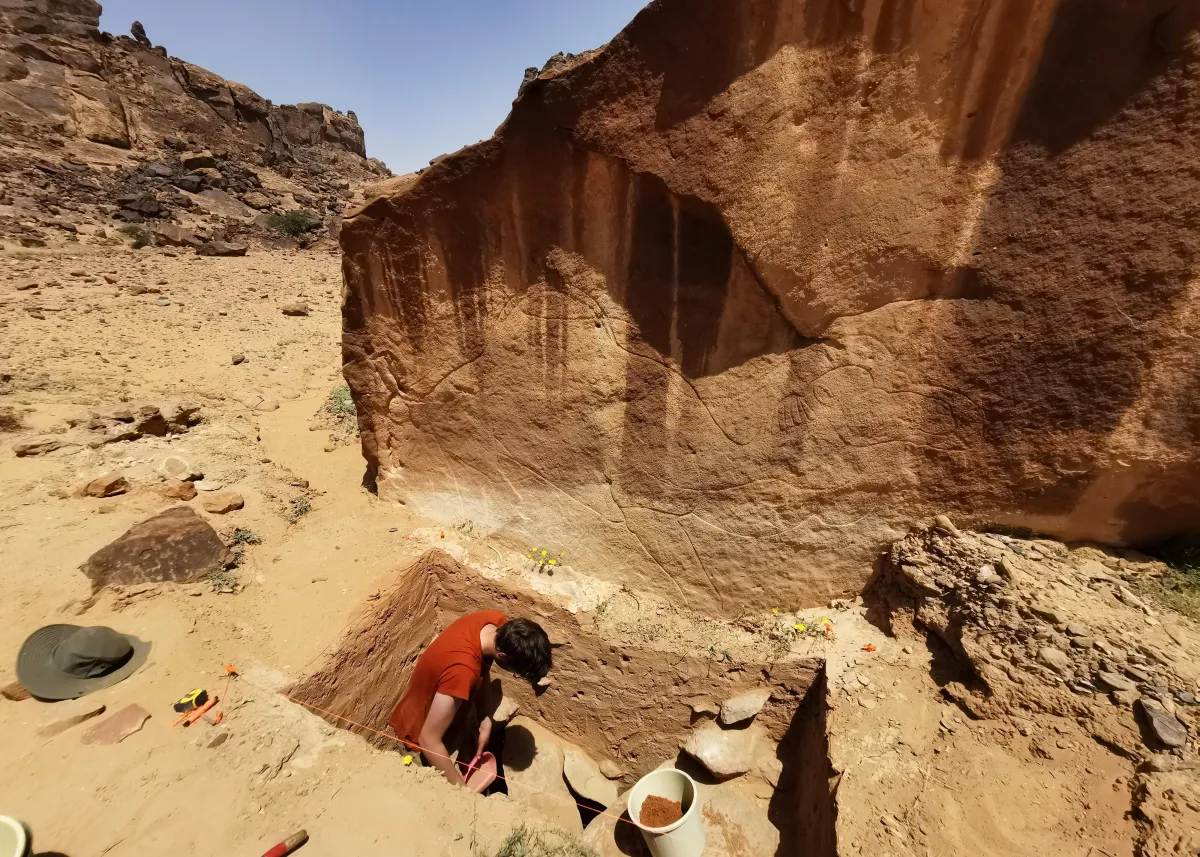
Researchers have discovered life-size rock carvings of camels, gazelles, and other animals in the Saudi Arabian desert. Dating back approximately 12,000 years, many of these carvings stand over six feet tall. Scientists determined they were created using a wedge-shaped rock to etch sharp, detailed lines.
Several carvings were etched on narrow ledges, meaning the artists couldn't even step back to survey the final product while they were working. "To engrave that much detail with just a rock takes real skill," said Maria Guagnin, an archaeologist with the Max Planck Institute of Geoanthropology in Germany who was involved in the discovery.
New timeline for human habitation

The animal carvings and the engraving tools found at the site suggest that people were living in the area about 2,000 years earlier than previously thought. It remains unclear how these communities survived in such arid conditions—whether they relied on shallow lakes that pooled seasonally or drank water that accumulated in deep crevices.
Guagnin noted that people have been creating rock art in Saudi Arabia for thousands of years. However, dating older engravings can be tricky since they rarely feature writing and often lack remnants like charcoal, which can be sent to a lab for analysis. Michael Harrower, a Johns Hopkins University archaeologist not involved in the research, commented, "We know relatively little about art in the Middle East during this very ancient period of the human past".
In this latest discovery, scientists found a rock pick buried directly beneath the carvings, allowing them to accurately date the tool and, by extension, the art it was used to create. Their findings were published Tuesday in the journal Nature Communications.
A Community's deep knowledge
Prior to this finding, scientists were unsure if people lived in the desert during this dry period, assuming water was too scarce. They believed people migrated to the area later, when the landscape was marked by greener pastures and lakes.
One of the carvings depicts an auroch, an ancestor of wild cattle that did not inhabit the desert and is now extinct. This led Guagnin to wonder if the artists had encountered the animals by traveling elsewhere during the dry season. She concluded that the carvers "must have been fully established communities that knew the landscape really well".
ALSO READ: Oregon scientists create 'fertilisable' eggs from skin cells to help people conceive