
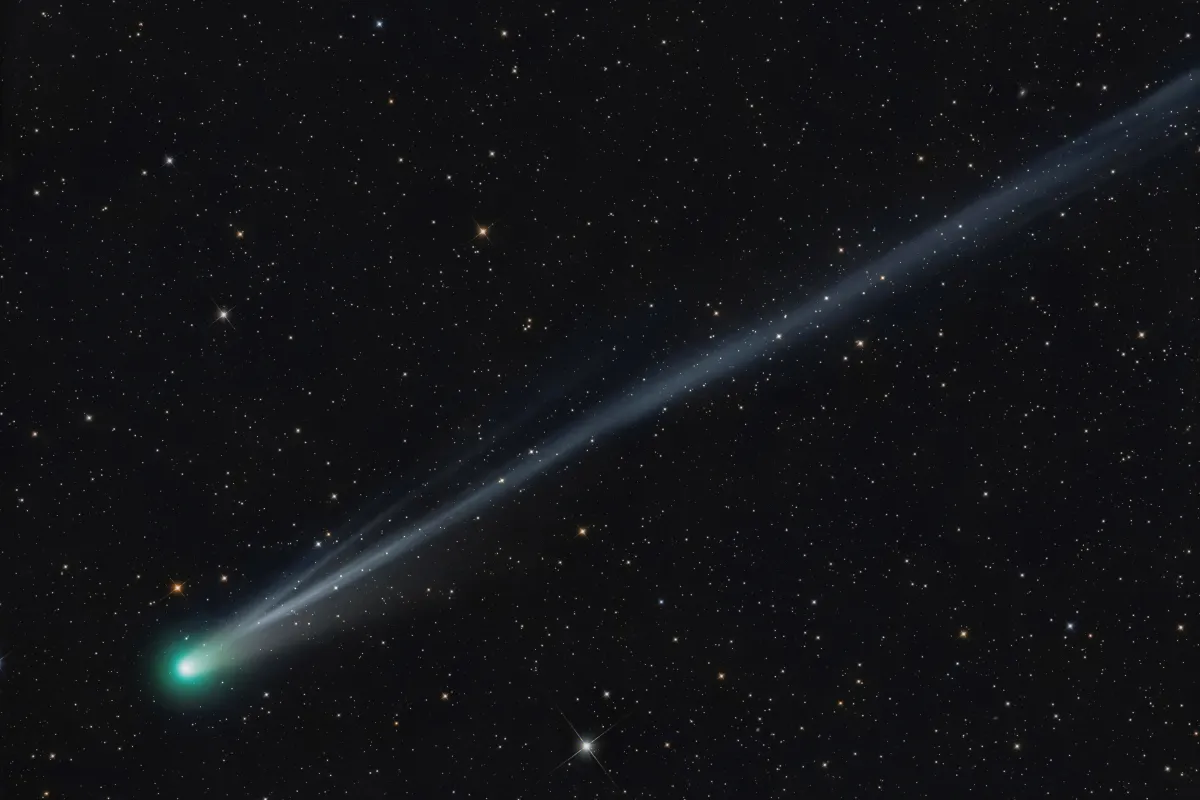
Two rare comets are illuminating skies around the world, including India, this week. The comets C/2025 R2 (SWAN) and C/2025 A6 (Lemmon) are currently visible through binoculars from dark-sky locations. They will remain visible throughout this week. Both comets had their closest flyby of Earth recently: SWAN was closest to Earth on Monday, and Lemmon was closest to Earth on Tuesday.
Rare phenomenon
This is a rare phenomenon, as it is uncommon for two large comets to appear in the sky at the same time. While SWAN is not expected to return to our solar system for the next 20,000 years, Lemmon will next be visible in the year 3175.
Lemmon is the brighter of the two comets and has a visibility of magnitude 4.5 as per SpaceWeather.com, which technically puts it in the visible range. Some estimates suggest that it may brighten further; however, there is uncertainty on this.
How to catch Lemmon and SWAN comets
While many reports suggest that the comet is visible via binoculars, there are some who say that the comet is also visible via long-exposure camera shots. Skygazers can get a glimpse of these comets this week an hour after sunset, around 7 PM.
Lemmon appears in the northwest horizon in the Boötes constellation, close to the 'handle' of the Big Dipper (Saptarishi). It sets around 7:45 PM. SWAN is currently a little higher up in the sky, just above the teapot-shaped Sagittarius constellation in the southern horizon.
Discovered in 2025
These comets were discovered in 2025 and come from the outer regions of the solar system. Comet Lemmon was discovered on Jan 3, 2025, as part of the Mount Lemmon Survey that uses a 60-inch telescope at Mt Lemmon, Arizona, US. SWAN too is a newly discovered comet, first spotted by Ukrainian amateur astronomer Vladimir Bezugly as late as Sept 10.
The last such comet that was visible via binoculars was C/2023 A3 (Tsuchinshan), which appeared in October 2024. The last comet that was widely visible to the naked eye was C/2020 F3 (NEOWISE), which appeared in mid-2020.
