
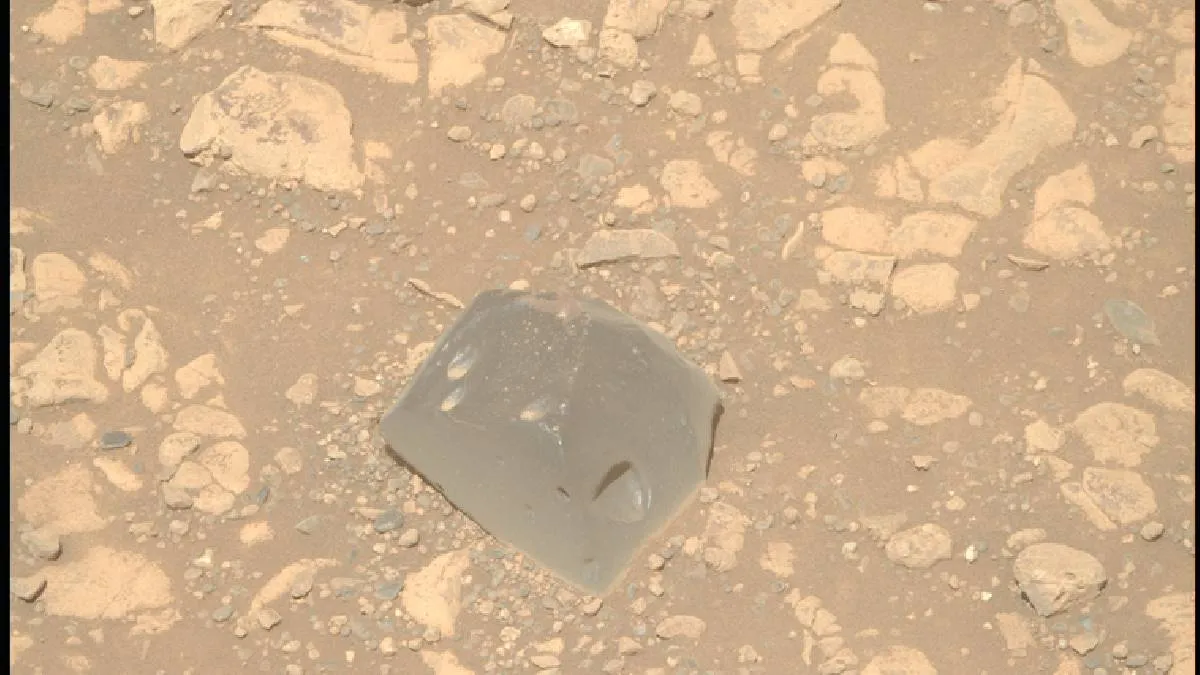
NASA reported that its Perseverance rover had captured images of a mysterious, skull-shaped rock on the Red Planet, the origin of which remains uncertain. The rock, referred to as "Skull Hill," was discovered on April 11 by the Perseverance rover on the rim of Jezero Crater, utilising the Mastcam-Z instrument. According to NASA, the region surrounding Skull Hill is predominantly light-colored and dusty, while the rock itself stands out with its dark, angular appearance and features tiny pits on its surface. The agency noted that this contrast makes Skull Hill particularly striking compared to the surrounding light-toned outcrop.
Though the origins of the rock are still unclear, NASA suggested that the pits might have formed due to erosion or could have resulted from the rock being deposited by an impact. It was mentioned that the pits might be the result of clast erosion or wind scouring. Alternatively, NASA speculated that "Skull Hill" could be an igneous rock, potentially eroded from a nearby outcrop or ejected from an impact event.
Interestingly, the team observed that the color of Skull Hill reminded them of meteorites previously discovered in Gale Crater by the Curiosity rover. They emphasised that they are working to gather more information regarding the origins and transportation of these intriguing rocks.
Previous findings on Mars
In January, NASA's Mars Reconnaissance Orbiter captured images of frozen sand dunes in the planet's northern hemisphere. Unlike Earth’s shifting dunes, the kidney-shaped formations on Mars appeared oddly still.
In October of the previous year, scientists proposed that microbes could persist beneath Mars' icy surface. Their study indicated that sunlight might penetrate shallow pools beneath frozen layers, potentially enabling photosynthesis—a fundamental requirement for life—to occur.
Recent data suggests that this field may have endured until 3.9 billion years ago, which is more recent than previously believed, thereby enhancing the notion that life-sustaining conditions may have existed for a longer period than assumed.
ALSO READ: ISRO’s Spadex satellites complete second successful docking, more tests underway: Union Minister
