
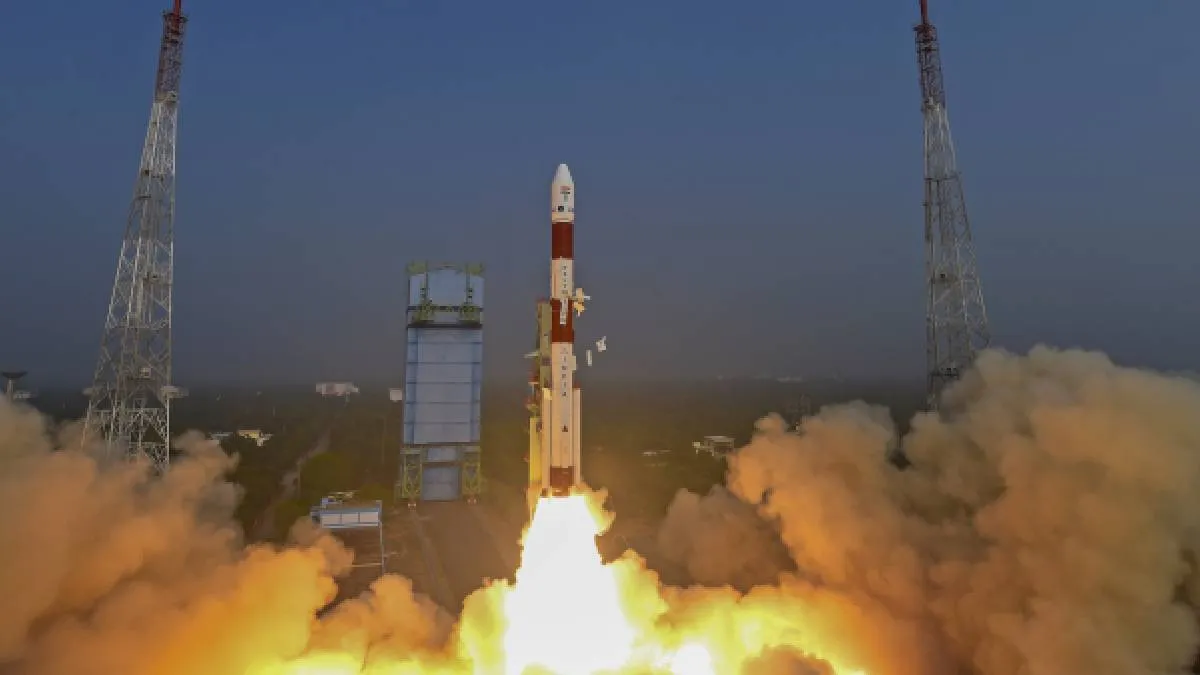
The PSLV-C62 / EOS-N1 Mission marks the 9th dedicated commercial venture undertaken by NewSpace India Limited (NSIL). This mission involves the construction and launch of the EOS-N1 Earth observation satellite for a specific user, alongside providing launch services for 15 co-passenger satellites from both domestic and international customers.
The PSLV-C62 mission is scheduled for lift-off on January 12 at 10:18 AM from the First Launch Pad at the Satish Dhawan Space Centre, Sriharikota. Utilising the PSLV-DL variant, equipped with two solid strap-on motors, this flight will be the 64th mission for the PSLV program.

Workhorse of ISRO
The Polar Satellite Launch Vehicle (PSLV) is known as the "Workhorse of ISRO" due to its exceptional reliability and versatility, which has been instrumental in India's rise as a prominent space power. The rocket's journey is a story of resilience, record-breaking feats, and strategic innovation.
History of the PSLV Program
ISRO initiated the PSLV program in the 1980s with the primary goal of launching indigenous Indian Remote Sensing (IRS) satellites into Sun-synchronous polar orbits, thereby eliminating India’s reliance on foreign launch services.
- First Flight (1993): The maiden developmental flight (PSLV-D1) on September 20, 1993, was unsuccessful due to a software error and an issue regarding second and third-stage separation.
- The Comeback (1994): ISRO quickly recovered from this setback. The subsequent launch in October 1994 was a successful "textbook launch," signaling the start of the rocket's celebrated career.
Following that initial failure, the PSLV has maintained a stellar success rate of over 95 per cent, leading many scientists to affectionately refer to it as the "Perfect Satellite Launch Vehicle".
Iconic missions of the PSLV
The PSLV has been the vehicle of choice for India's most ambitious interplanetary and scientific missions:
- Chandrayaan-1 (2008): India's first lunar probe was launched using the PSLV-XL variant; this mission famously confirmed the presence of water on the Moon.
- Mars Orbiter Mission (Mangalyaan) (2013): The PSLV successfully launched India's first mission to Mars, making ISRO the fourth space agency to reach the Red Planet and the first to do so on its maiden attempt.
- Aditya-L1 (2023): India's first solar observatory was precisely injected into its intended orbit by the PSLV.
- World Record (2017): On February 15, 2017, the PSLV-C37 mission launched 104 satellites in a single flight. This was a world record at the time, demonstrating incredible efficiency and cost-effectiveness to the global community.
Global commercial success
The PSLV is a preferred choice for international clients due to its ability to place satellites into precise orbits, including Sun-synchronous, Low Earth, and Geosynchronous Transfer Orbits. As of June 2022, it has launched 345 foreign satellites from 36 countries, generating significant revenue and cementing India's status in the commercial launch market.
Currently, ISRO is transitioning the production and operation of the PSLV to private Indian industry consortiums, such as the HAL-L&T joint venture. This strategic move allows the space agency to focus on advanced research and heavier-lift vehicles like the LVM3.
ALSO READ: ISRO's Aditya-L1 finds how solar storm impact on Earth’s magnetic field