
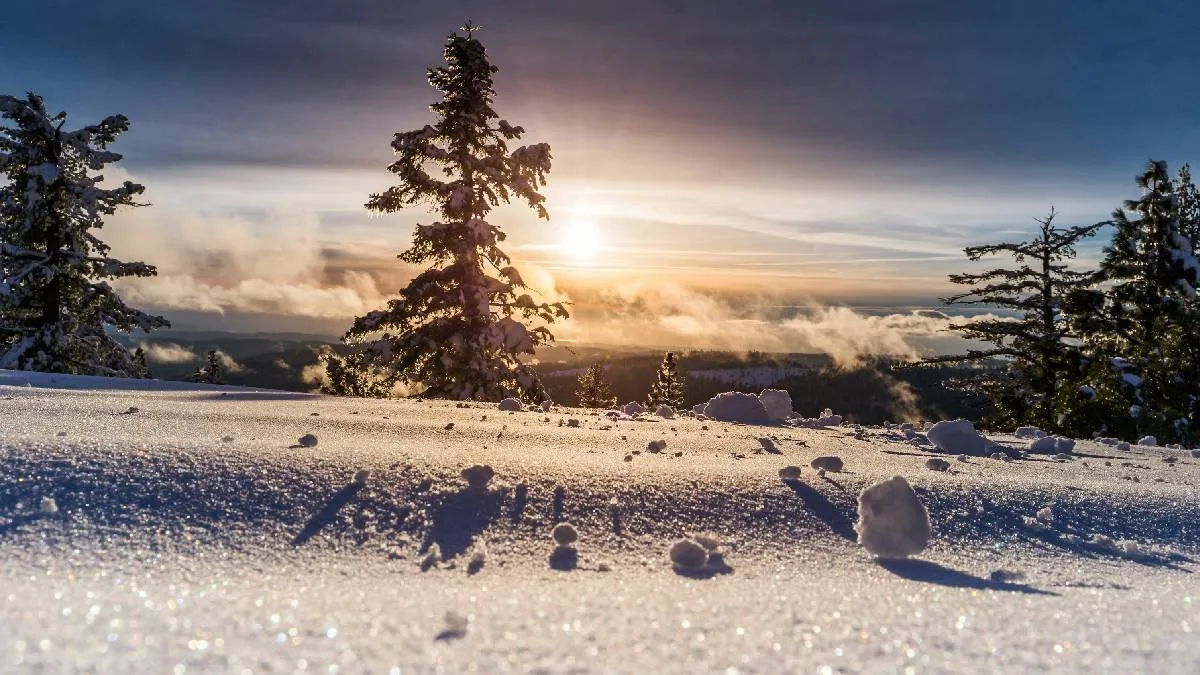
Sunday marks the shortest day of the year for those north of the equator, where the winter solstice signals the start of astronomical winter. Conversely, the Southern Hemisphere will experience its longest day of the year, ushering in the start of summer.
The word “solstice” is derived from the Latin words sol (sun) and stitium (to stop or stay). This is because the solstice represents the end of the sun's annual journey of climbing higher or sinking lower in the sky.
During the winter solstice, the sun traces its shortest, lowest arc across the horizon.The good news for sun lovers? From this point forward, the sun begins its ascent once more, and the days will gradually lengthen until late June.
For a very long time, people have celebrated the solstices, which are the longest and shortest days of the year. They built monuments to mark these special times. One famous example is Stonehenge, which was created to line up with the sun's position during these events. But what exactly is happening in the heavens? Here is everything you need to know about Earth’s orbit.
What is the solstice?
As the Earth orbits the sun, it does so at a tilt. This axial tilt causes the sun’s light and warmth to fall unequally on the Northern and Southern Hemispheres for most of the year.
The solstices happen when the Earth is tilted at its furthest angle either toward or away from the sun. This tilt causes the two halves of the Earth to get very different amounts of sunlight. As a result, we experience the longest and shortest days and nights during these times.
Winter Solstice (Northern Hemisphere): The top half of the Earth is tilted at its furthest point away from the sun, resulting in the shortest day and longest night of the year. While it can fall between December 20 and 23, this year it occurs on the 21 at 3:03 pm UTC (20:33 IST).
Summer Solstice (Northern Hemisphere): The Earth leans toward the sun, creating the longest day and shortest night of the year. This typically falls between June 20 and 22.
What is the equinox?
During an equinox, the Earth’s axis and its orbit align such that both hemispheres receive an equal amount of sunlight.
The word "equinox" stems from two Latin words meaning "equal" and "night." On these days, day and night are nearly identical in length—though you might get a few extra minutes of light depending on your specific latitude.
- Autumnal (Fall) Equinox: In the Northern Hemisphere, this occurs between September 21 and 24.
- Vernal (Spring) Equinox: This takes place between March 19 and 21.
Meteorological vs Astronomical Seasons
These terms represent two different ways of measuring the calendar year:
- Astronomical Seasons: These are defined by the Earth's physical position relative to the sun (solstices and equinoxes).
- Meteorological Seasons: These are defined by the annual temperature cycle and the calendar. To keep statistics simple, meteorologists break the year into four three-month periods. By this system, spring begins March 1, summer June 1, fall September 1, and winter December 1.
ALSO READ: NASA loses contact with veteran Maven spacecraft orbiting Mars for past decade
