
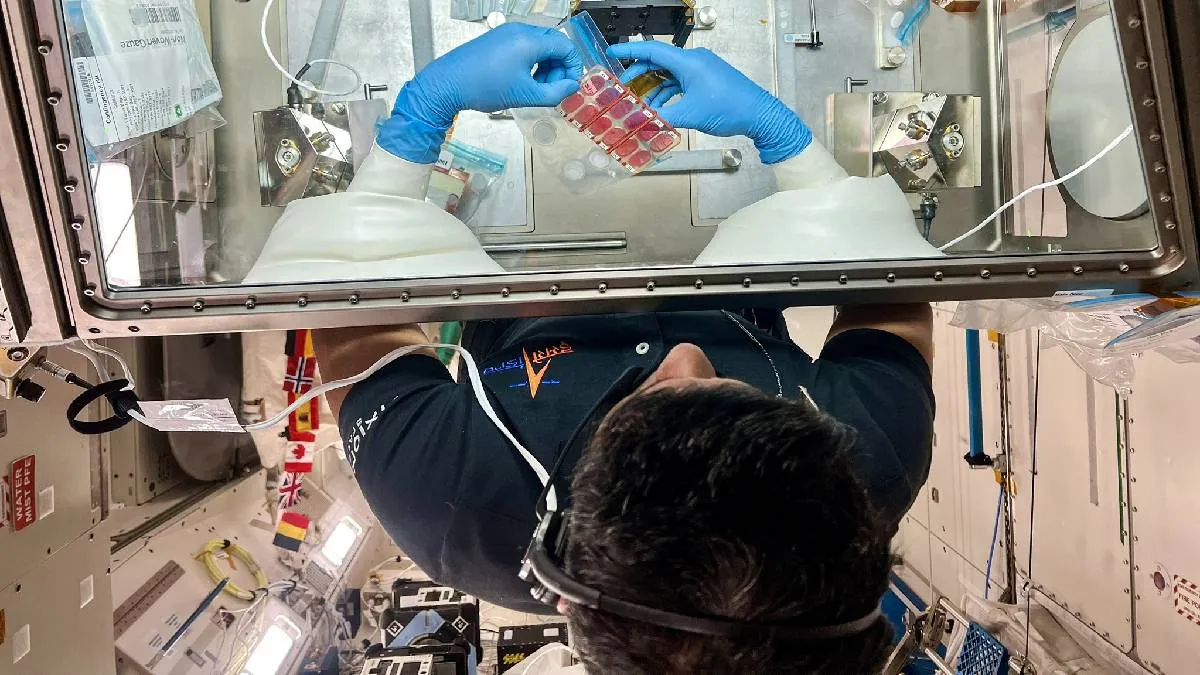
Astronaut Shubhanshu Shukla, a member of the recent Axiom-4 space mission, announced on Thursday that his flight has effectively opened the doors for microgravity research in India. Speaking at the India Today Conclave, Shukla detailed his 18-day stay in space, during which he conducted several experiments. These experiments were specifically designed to support India’s future space ambitions, including the planned manned Gaganyaan mission, the establishment of an Indian space station, and a manned mission to the Moon.
Researchers in India, who previously lacked access to microgravity platforms, are now evaluating the outcomes of the experiments conducted during Axiom-4. The successful mission completed work on several key areas, including:
- The Indian strain of Tardigrades (water bears)
- Myogenesis (muscle tissue formation)
- Sprouting of methi (fenugreek) and moong seeds
- Studies on cyanobacteria, microalgae, crop seeds, and the Voyager Display
A stepping stone to Gaganyaan
Shukla, a Group Captain in the Indian Air Force who became the second Indian to travel to space after Rakesh Sharma's 1984 flight, called the Axiom-4 flight a crucial stepping stone to the Gaganyaan mission, which is officially scheduled for 2027.
"We have already established a process where all the information is going back into the system," he said. "We have already started refining everything that we were doing. Human space missions are very complex, and it changes the scale and magnitude of work that is involved".
Understanding microgravity and future plans
On the future Indian space station, Shukla confirmed that work has already begun, conceptually defining it as similar to orbiting laboratories.
"The accomplishment is we have opened doors for microgravity research for our country through this mission. This will now continue to happen," Shukla stated. He added that the mission was critical for Indian researchers to understand the challenge of replicating ground experiments in the extremely complex microgravity environment.
Shukla emphasised the unique potential of this research: "The unique part of conducting research in microgravity is... you are trying to create life in an environment where it should not exist. When you try to do that, you come up with solutions which solve the problems on Earth which you didn't even think of".
Finally, Shukla shared a philosophy for innovation, advising that people should not fear failure. "We should start celebrating defeats rather than success, so that we can encourage our children that failure is part of the process. That is what we need to inculcate".
ALSO READ: YouTube introduces new AI feature to boost child safety and restrict adult content
