
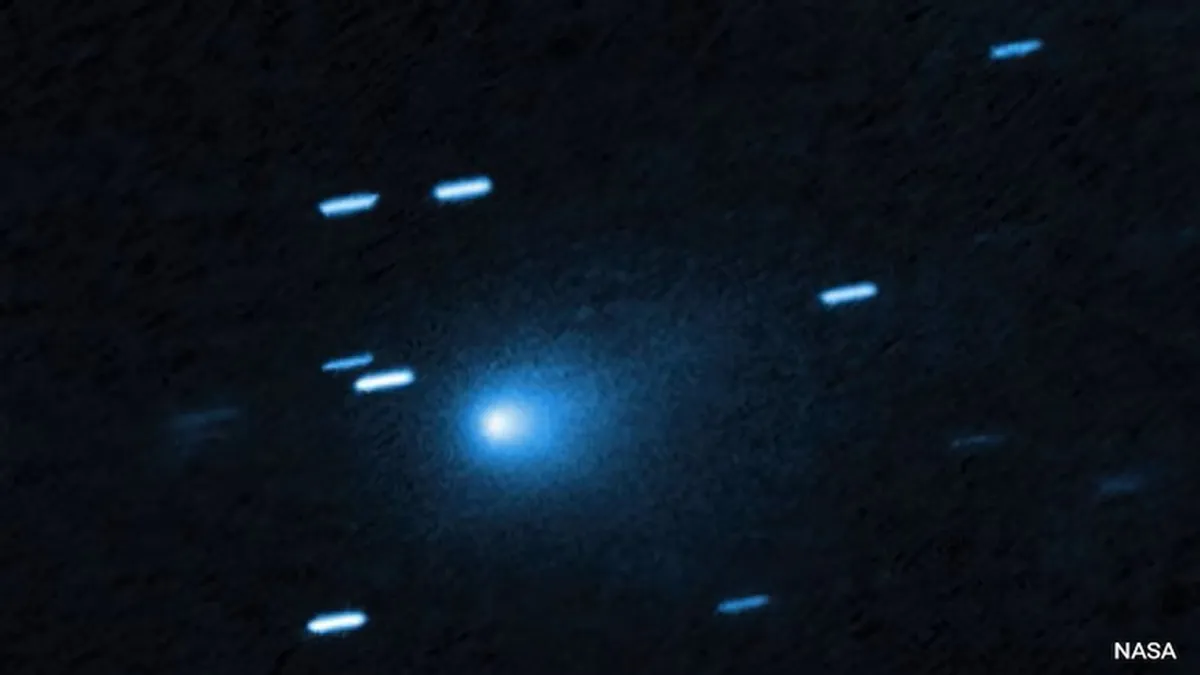
Astronomers around the world are observing 3I/ATLAS, a rare interstellar object that has suddenly sped up and changed colour as it travels through the solar system. Discovered in July 2025 by a telescope in Chile, it is only the third object from beyond our solar system ever detected. While NASA says it poses no threat to Earth, scientists are puzzled by its unexpected movements and bright blue hue.
A new visitor from beyond the solar system
3I/ATLAS was first spotted on July 1, 2025, by the ATLAS survey team in Rio Hurtado, Chile. It follows ‘Oumuamua (2017) and Comet Borisov (2019) as the third known interstellar visitor. NASA confirmed that it will make its closest approach to Earth in December, passing at a safe distance of 269 million kilometres.
In late October, astronomers noticed that 3I/ATLAS had begun moving faster, reaching speeds of about 244,600 km per hour. According to NASA’s Jet Propulsion Laboratory (JPL) engineer Davide Farnocchia, the object is experiencing “non-gravitational acceleration”, meaning something other than the Sun’s gravity is pushing it forward.
Harvard astrophysicist Avi Loeb suggested that the acceleration could be caused by the comet losing mass, as gases and dust are expelled into space.“As it expels this material at a greater rate, it’s being kicked in the opposite direction,” Loeb wrote in a blog post, estimating that 3I/ATLAS could lose up to one-tenth of its mass in a month.
Observations show deviation
Using the Atacama Large Millimeter/submillimeter Array (ALMA) in Chile, researchers detected a deviation of four arcseconds from the expected path. Loeb described this as “statistically significant”, possibly linked to the evaporation of a large part of the comet’s mass. He predicted that in November and December, a large gas plume should become visible as the comet continues to lose material.
On October 29, 3I/ATLAS appeared to turn bluer as it neared the Sun. Some reports claimed multiple colour changes, but Qicheng Zhang of the Lowell Observatory clarified that the change happened only once when the comet’s gas coma first became visible. “As far as we know, the comet just changed colour once when its gas coma became bright,” Zhang told Space.com.
He added that amateur astronomers had already seen its blue-green glow as early as September.
Could it be artificial?
Avi Loeb, who has previously suggested that some interstellar objects could be artificial in origin, said a technological explanation cannot be ruled out.“The non-gravitational acceleration might be the technological signature of an internal engine,” he said.
He noted that comets usually appear redder, not bluer, and speculated that a hot engine or artificial light source could explain the unusual colour. However, he added that a natural cause such as ionised carbon monoxide remains the most likely explanation.
No tail after solar encounter
Surprisingly, new images show that 3I/ATLAS does not have a visible tail, even after passing close to the Sun. Normally, comets produce bright tails of gas and dust when heated, but in this case, none appeared. Loeb estimated that about 13% of the comet’s mass should have formed a tail, calling its absence “unusual and puzzling.”
NASA and the European Space Agency (ESA) will continue to track 3I/ATLAS as it moves toward Jupiter by March 2026. Scientists hope that upcoming observations will help determine whether its strange behaviour is natural or something more mysterious.
What’s with the name?
The name 3I/ATLAS combines:
3- marking it as the third interstellar object discovered,
I- for interstellar, and
ATLAS- after the Asteroid Terrestrial-impact Last Alert System in Chile, which detected it.
