
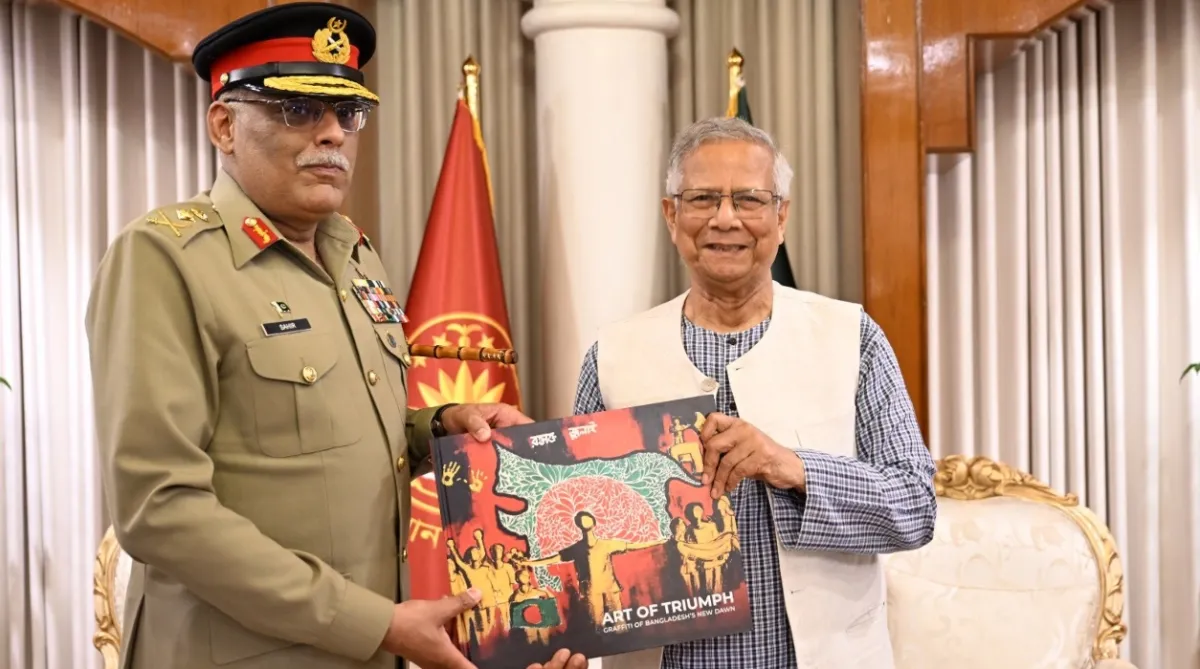
Bangladesh’s interim Prime Minister Muhammad Yunus has found himself at the centre of a major diplomatic controversy after presenting a book featuring a disputed map to Pakistan's Joint Chiefs of Staff Committee chairperson, General Sahir Shamshad Mirza, during his visit to Dhaka over the weekend.
The book, titled "Art of Triumph," depicts India's northeastern states — including Assam and Arunachal Pradesh — as part of Bangladesh. This move has triggered outrage across social media and drawn criticism from political observers in both India and Bangladesh.
The incident has sparked a diplomatic flashpoint between the two South Asian neighbours, with many accusing Yunus of promoting anti-India propaganda and endorsing the extremist "Greater Bangladesh" narrative.
'Greater Bangladesh' map fuels regional tensions
The controversial map on the book’s cover reportedly mirrors those circulated by Islamic extremist groups advocating for the creation of a "Greater Bangladesh" — a concept that envisions Bangladesh expanding into India's northeast.
Analysts note that Yunus’s actions appear to symbolically support these irredentist ambitions, raising alarm in diplomatic and security circles. The Ministry of External Affairs (MEA) in New Delhi has yet to issue an official statement but is said to be closely monitoring the situation.
Growing Dhaka-Islamabad alignment
The episode has also revived scrutiny over the increasingly close ties between Bangladesh and Pakistan under Yunus’s interim government. Relations between the two countries had remained frosty since the 1971 Liberation War, but Yunus’s recent outreach to Islamabad — including this symbolic gesture — signals a potential foreign policy shift away from India.
Observers believe Yunus's moves could be part of a broader Pakistan-China strategic alignment, aimed at challenging India’s regional influence.
History of provocative remarks against India
This is not the first time Yunus has drawn India's ire. During a state visit to China in April 2025, he described Bangladesh as the "maritime gateway" for India's northeast, suggesting the region could serve as an extension of China's economy.
New Delhi viewed those comments as a direct challenge to its sovereignty, and in response, suspended a transit agreement that allowed Bangladeshi goods to pass through India to Nepal, Bhutan, and Myanmar.
Adding to the tension, Yunus's aide, Nahidul Islam had previously shared a "Greater Bangladesh" map on social media in 2024, depicting parts of West Bengal, Tripura, and Assam as Bangladeshi territory — an act that further strained bilateral relations.
A deliberate provocation?
Yunus's latest act of gifting a book featuring an altered map to a top Pakistani military official is being seen by analysts as a deliberate provocation and a symbolic affront to India’s territorial integrity.
Diplomatic experts warn that the incident could further destabilise India-Bangladesh relations, already under pressure since Yunus assumed office.
As one senior Indian diplomat put it, "This is not just a diplomatic misstep — it’s a statement. And it’s one that New Delhi cannot ignore."
