
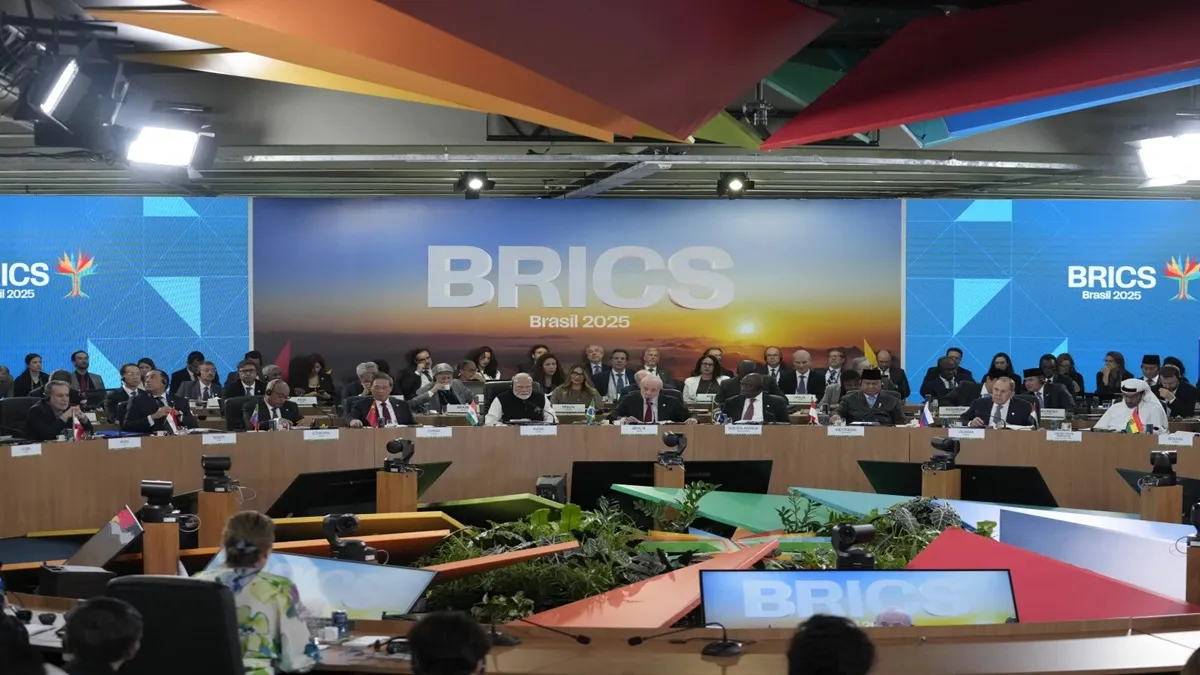
The BRICS bloc of major developing economies has come out strongly against the European Union’s carbon border tax, warning that it threatens to derail fair climate action and global trade equity. In a joint statement released during their summit in Rio de Janeiro this week, the nine-nation bloc including India, China, Brazil and South Africa called the EU’s Carbon Border Adjustment Mechanism (CBAM) a “unilateral, punitive and discriminatory” measure cloaked in climate concerns. The declaration marks the clearest and most unified stance yet by BRICS on CBAM, a policy tool that is set to take full effect in 2026 and will impact carbon-intensive exports from developing countries.
What is CBAM and how it works
Introduced by the EU in 2023, the Carbon Border Adjustment Mechanism imposes a tariff on certain imported goods like steel, cement, aluminium, fertilisers and electricity based on the emissions generated during their production. The idea is to align the carbon cost of foreign imports with what European producers pay under the EU’s internal carbon market.
During the current transitional phase (2023-25) only emissions reporting is required. But from January 1, 2026, EU importers will need to buy carbon certificates if the embedded emissions of imported goods exceed EU standards. If exporters can prove they’ve already paid for emissions in their own countries that cost can be deducted. Brussels argues that CBAM is necessary to prevent “carbon leakage” - a situation where companies shift production to countries with weaker climate policies. But critics say it’s a thinly veiled trade barrier.
Why developing nations are upset
India, China and other developing countries have consistently opposed CBAM warning that it undermines the principle of equity embedded in the global climate regime. They argue that it unfairly penalises exporters from countries still reliant on fossil fuels even as they attempt a difficult and costly energy transition.
India for instance has raised the issue at multiple platforms including bilateral talks with the EU and at climate summits. The Indian government flagged CBAM during the India-EU free trade negotiations this year, warning that it would burden sectors like steel and aluminium which account for significant exports to Europe.
“The CBAM is discriminatory in nature and distorts global markets,” said the BRICS declaration, adding that it would “undermine the ability of developing countries to invest in just energy transitions and meet their development priorities”.
The declaration also pointed to CBAM’s incompatibility with international law, a view shared by many trade experts. Although the European Commission claims CBAM is compliant with World Trade Organization (WTO) rules, developing countries argue that its unilateral nature breaches the multilateral trading system.
Conflict with global climate agreements
The EU’s policy also appears to go against the spirit of the Paris Agreement and subsequent declarations at COP28 in Dubai where countries agreed that climate response measures should not result in “arbitrary or unjustifiable discrimination or disguised restrictions on international trade”.
The BRICS bloc has reminded developed nations of their historic responsibility in causing climate change and the commitments made to support the Global South. The 2015 Paris Agreement explicitly acknowledges the principle of “common but differentiated responsibilities”, giving developing countries more flexibility in their climate efforts. By ignoring this differentiation, CBAM effectively imposes uniform carbon costs on unequal economies.
Delay tactics and climate diplomacy
This is not the first time developing countries have resisted the CBAM. At the COP29 preparatory talks in Baku last year, a formal demand by China and India to discuss trade-related climate measures including CBAM delayed the plenary session by several hours. The EU and several developed nations opposed its inclusion on the agenda.
Earlier at COP27 in Egypt, the BASIC group (Brazil, South Africa, India and China) had cautioned that carbon border taxes could distort markets and deepen mistrust. They urged a “united response by developing countries” against what they called “unfair shifting of responsibilities”.
Climate finance
The CBAM debate comes amid growing frustration over broken promises on climate finance. In Rio, BRICS leaders expressed serious concern over the failure of developed nations to meet their USD 100 billion per year pledge for climate action in developing countries, a commitment made in 2009 and reaffirmed in the Paris Agreement.
The group called for new finance targets: at least USD 300 billion annually by 2035 and a doubling of adaptation finance from 2019 levels by 2025. The declarations reflect long standing demands for more predictable, adequate and accessible climate finance, especially for adaptation.
India has repeatedly said that without significant financial support and technology transfer, developing countries cannot meet climate targets or transition fairly to clean energy.
