
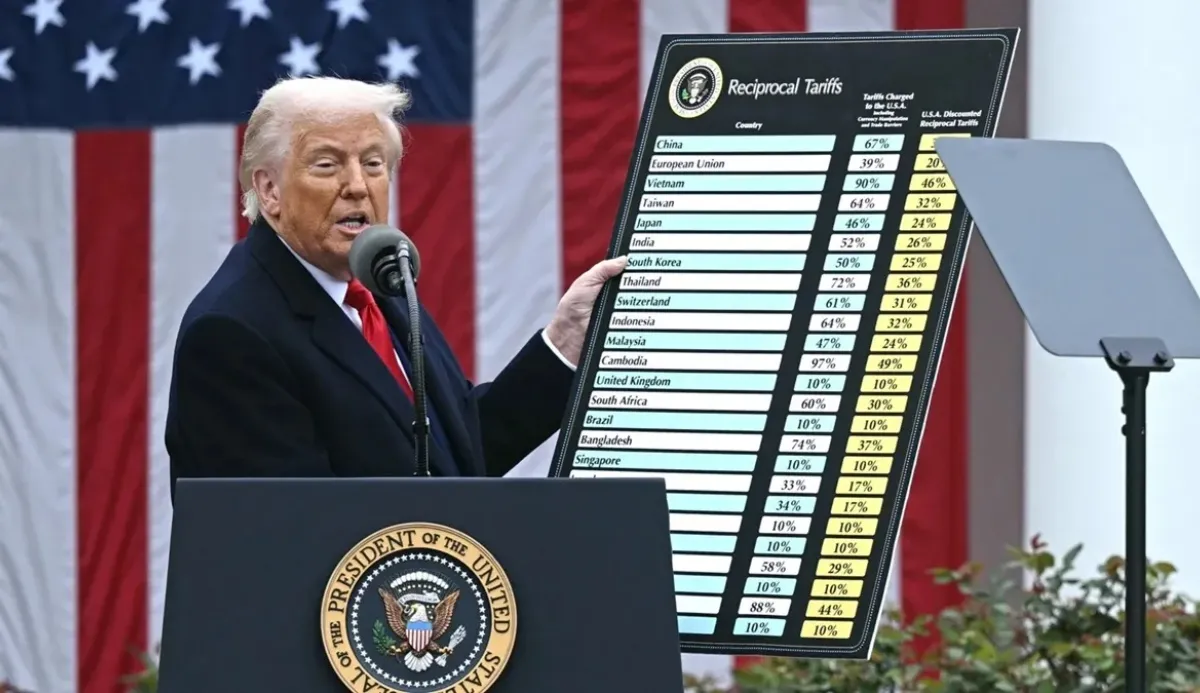
US President Donald Trump has announced that India and the US agreed to a trade deal under which Washington will bring down the reciprocal tariff on Indian goods to 18 per cent from current 25 per cent. Trump imposed 50 per cent tariffs on Indian goods, including the 25 per cent punitive tariffs for India's procurement of Russian crude oil. India now has a clear advantage over competing export economies in the region, with lower tariff rates compared to competing export economies. Let's look at the current tariffs imposed on various other countries.
Full list of Trump tariffs on countries
| Country | Tariff (%) |
| India | 43 (after cut since February 2) |
| China | 37 |
| Pakistan | 19 |
| European Union | 15 |
| Switzerland | 15 |
| Vietnam | 20 |
| Brazil | 50 |
| Bangladesh | 20 |
| Afghanistan | 15 |
| Indonesia | 19 |
| Malaysia | 19 |
| Cambodia | 19 |
| Thailand | 19 |
| United Kingdom | 10 |
| South Africa | 30 |
| South Korea | 15 |
| Japan | 15 |
| Myanmar | 40 |
| Laos | 40 |
| Syria | 40 |
| Canada | 25 |
| Mexico | 25 |
What does imposing tariffs mean?
Imposing higher tariffs on a country means that goods imported from that country are subject to higher duties. This directly impacts product prices, international trade, and bilateral relations between the two countries. When the US or any other country imposes a high tariff on a particular country, products from that country become more expensive. This increases costs for importing companies, a burden often passed on to consumers.
Tariff increases are typically implemented to exert trade pressure, protect domestic industries, or for strategic reasons. Sometimes, the goal is to force another country to change its trade policies. While higher tariffs may provide short-term relief to domestic industries, in the long run, they can lead to more expensive trade, inflation, and increased global tensions.
Also Read: 'PM Modi and I are two people that get things done,' says Trump | 5 quotes on India-US trade deal
Also Read: PM Modi thanks Trump for reducing tariffs to 18%: 'His leadership vital for global peace, stability'
