
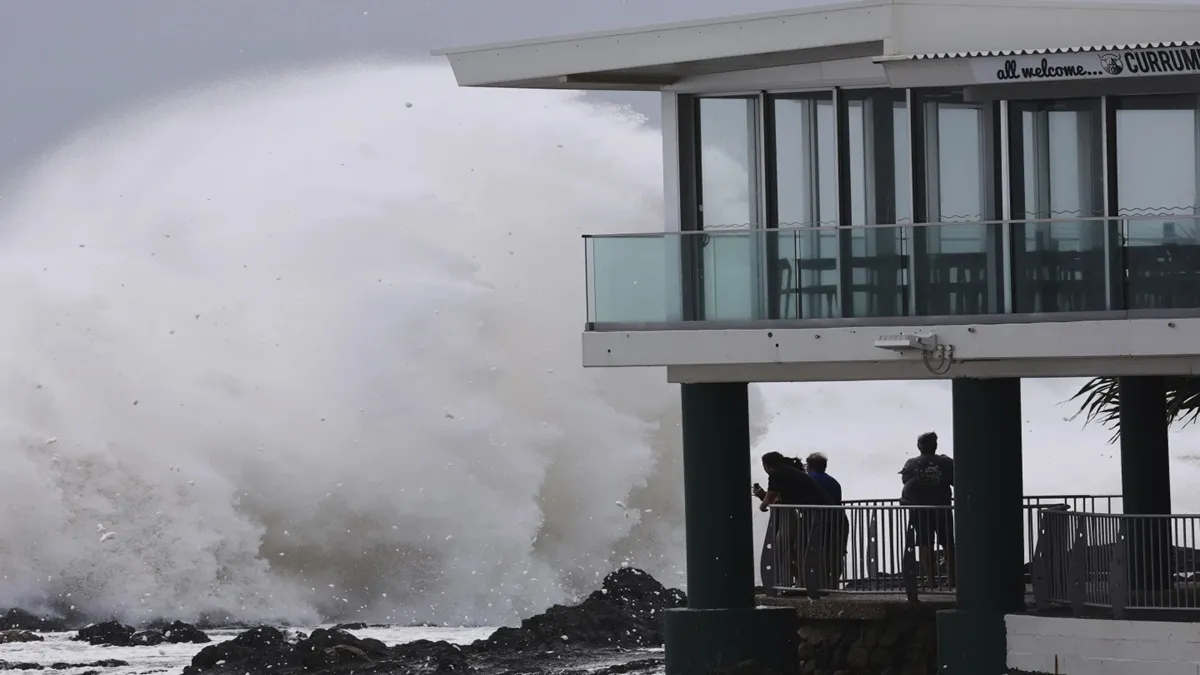
Cyclone Alfred: Early wind and rain from the rare tropical 'Cyclone Alfred' began lashing parts of eastern Australia on Thursday, which led to school closures, suspension of public transport, and frantic preparations by residents bracing for impact. As sandbag shortages hit affected areas, desperate locals resorted to buying potting mix to protect their homes from potential flooding.
According to Matt Collopy, manager at the Bureau of Meteorology, Cyclone Alfred is expected to make landfall on Queensland’s coast between the Sunshine Coast region and Gold Coast city early Saturday (local time). Between the two tourist strips is the state capital Brisbane, Australia's third-most populous city which will host the 2032 Olympic Games.
“The wind impacts, we're already seeing those start to develop on the exposed locations along our coast with gusts reaching 80-to-90 kph (50-to-56 mph). We are expecting those to continue to develop,” Collopy told reporters in Brisbane. 'Alfred' is expected to become the first cyclone to cross the coast near Brisbane since Cyclone Zoe hit Gold Coast in 1974 and brought widespread flooding. Notably, Cyclones are common in Queensland's tropical north but are rare in the state's temperate and densely populated southeast corner that borders New South Wales state. More than 4 million people lie in the cyclone's path.
Winds and flooding forecast
Alfred was 280 kilometers (170 miles) east of Brisbane and moving west Thursday with sustained winds near the center of 95 kph (59 mph) and gusting to 130 kph (81 mph), Collopy said. The storm is expected to maintain its wind strength before hitting land. But the greatest fears are for the expected flooding over a wide area. Modeling shows that up to 20,000 homes in Brisbane, a city largely built on a river floodplain, could experience some level of flooding.
Prime Minister Anthony Albanese said 660 schools in southern Queensland and 280 schools in northern New South Wales were closed Thursday as weather conditions worsened. The federal government had delivered 310,000 sandbags to Brisbane and more were on the way, Albanese said. “My message to people, whether they be in southeast Queensland or northern New South Wales, is we are there to support you. We have your back," the Prime Minister added.
Power outages and rising rivers
Strong winds had cut power to 4,500 homes and businesses in northern New South Wales on Thursday, officials said. Rivers were rising across the region due to rain and emergency teams expected to soon start evacuating residents from low-lying areas on the New South Wales side of the border. The coast near the border has been battered for days by abnormally high tides and seas. A 12.3-meter (40-foot) high wave recorded off a popular Gold Coast beach on Wednesday night was a record for the area, officials said.
(With AP inputs)
