
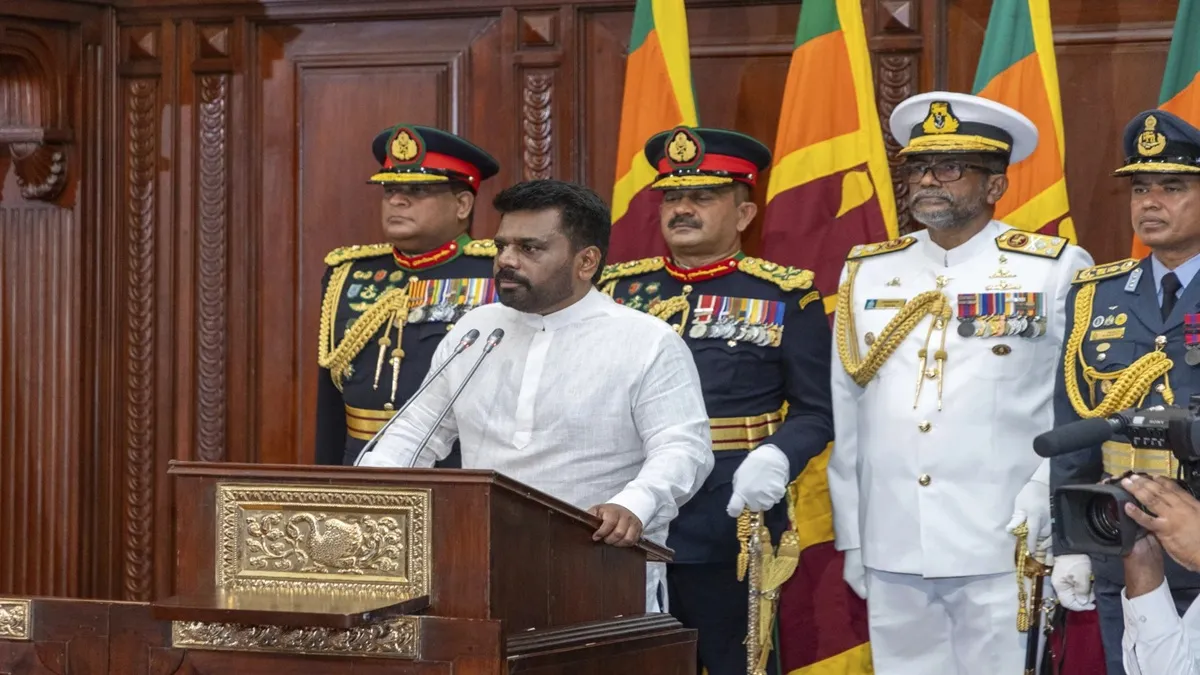
Sri Lankan President Anura Kumara Dissanayake told Parliament on Friday that the government refused permission for two United States warplanes to land at the Mattala International Airport earlier this month. According to him, aircraft stationed in Djibouti requested clearance to land on March 4 and March, but both appeals were turned down.
The President said that Colombo is committed to maintaining a balanced foreign policy despite intense geopolitical pressure. "We want to maintain our neutrality despite many pressures. We won't give in. The Middle East war poses challenges but we will do everything possible to remain neutral," he added as per The Associated Press (AP). He further stated that the US aircraft sought to bring in two warplanes carrying eight anti-ship missiles each, a request Sri Lanka "said no" to.
High-level talks with US envoy
The announcement followed Dissanayake's meeting with US Special Envoy for South and Central Asia Sergio Gor. Discussions centred on safeguarding key maritime routes, strengthening port security, enhancing trade cooperation and advancing an open Indo-Pacific.
Strikes and naval movements
Sri Lanka's decision comes as tensions rise in the region. On March 4, the US torpedoed the Iranian frigate Iris Dena off the Galle coast, killing 84 sailors and rescuing 32 others. The frigate had just departed Visakhapatnam after a naval fleet review. Two days later, another Iranian vessel, Iris Bushehr, sought entry into Colombo Port with 219 sailors aboard. Authorities instructed the ship to divert to Trincomalee, where 204 sailors are currently being housed at a naval facility near the capital.
Sri Lanka announces 4-day working week
Earlier this week, Sri Lanka announced a four-day working week with every Wednesday a public holiday as a contingency measure for possible fuel shortages in view of the war in West Asia. Currently, the island nation follows a five-day work week. "It was decided to declare every Wednesday a public holiday with effect from March 18," Commissioner General of Essential Services Prabath Chandrakeerthi said. Clarifying that this would not apply to health, ports, water supplies and customs, he said, "It would be applicable to schools, universities and the judiciary. The government expects the private sector to apply the same measure, the commissioner said.
