
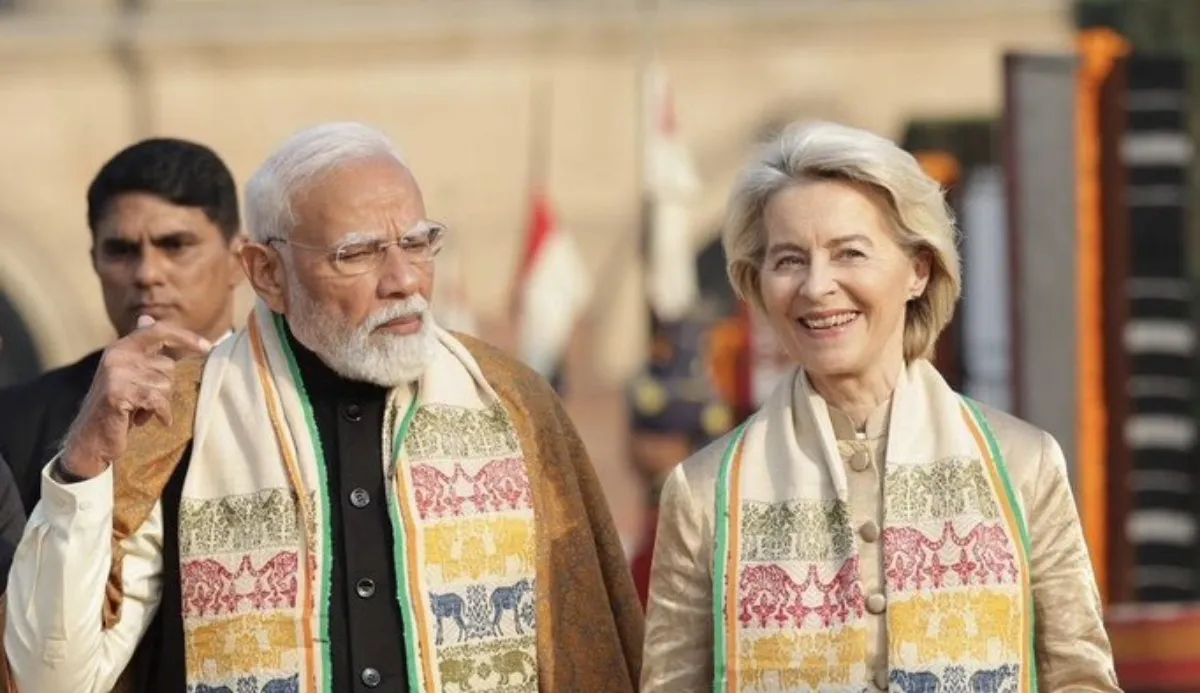
Prime Minister Narendra Modi on Tuesday announced that India and the European Union have successfully concluded a landmark Free Trade Agreement (FTA), describing it as the "mother of all deals" that will significantly reshape global trade, manufacturing, and supply chains.
What is the European Union?
The European Union (EU) is a political and economic union of European countries formed to promote peace, stability, economic cooperation, and shared prosperity among its members. It allows free movement of goods, services, capital, and people across member states and works together on trade, climate policy, digital rules, agriculture, competition, and foreign affairs.
The EU evolved from post–World War II efforts to prevent conflict in Europe and formally came into existence with the Maastricht Treaty in 1993.
How many countries are in the European Union in 2026?
As of 2026, the European Union has 27 member countries.
- Austria
- Belgium
- Bulgaria
- Croatia
- Cyprus
- Czechia
- Denmark
- Estonia
- Finland
- France
- Germany
- Greece
- Hungary
- Ireland
- Italy
- Latvia
- Lithuania
- Luxembourg
- Malta
- Netherlands
- Poland
- Portugal
- Romania
- Slovakia
- Slovenia
- Spain
- Sweden
India-EU FTA represents 25% of global GDP: PM Modi
Addressing the Indian Energy Week virtually, the Prime Minister said the India-EU FTA represents 25 per cent of global GDP and nearly one-third of global trade, underlining its scale and strategic importance. "Kal hi Bharat aur European Union ke beech ek bahut bada agreement hua hai. This is an excellent example of coordination between two major economies of the world," Modi said.
Calling the agreement a major opportunity for 140 crore Indians and crores of Europeans, PM Modi said the deal would open new doors for Indian businesses, youth, and investors, while strengthening global supply chains amid geopolitical uncertainty.
The Prime Minister noted that the agreement would complement India’s existing trade pacts with the UK and the European Free Trade Association (EFTA), further reinforcing India’s role as a trusted global economic partner.
He highlighted sectors such as textiles, gems and jewellery, leather, footwear, manufacturing, and services as major beneficiaries, stating that the FTA would not only boost domestic manufacturing but also expand India’s fast-growing services sector. "This free trade agreement will strengthen confidence in India for every business and every investor in the world. India is working extensively on global partnerships in all sectors," he said.
Bilateral trade already forms the backbone of India-EU ties. Total trade crossed USD 190 billion in 2024-25, with India exporting USD 75.9 billion in goods and USD 30 billion in services to the EU, while EU exports to India stood at USD 60.7 billion in goods and USD 23 billion in services.
With negotiations first launched in 2007 and revived in 2022, the conclusion of the FTA marks a decisive moment in India-EU relations—one that could redefine economic engagement between India and the 27-nation European bloc for decades to come.
Also Read: India-EU FTA Deal 2026 LIVE: PM Modi's show of strength with Ursula, Costa at Hyderabad House
Also Read: India-EU FTA compliments trade deal, will boost manufacturing sector: PM Modi at Energy Week
