
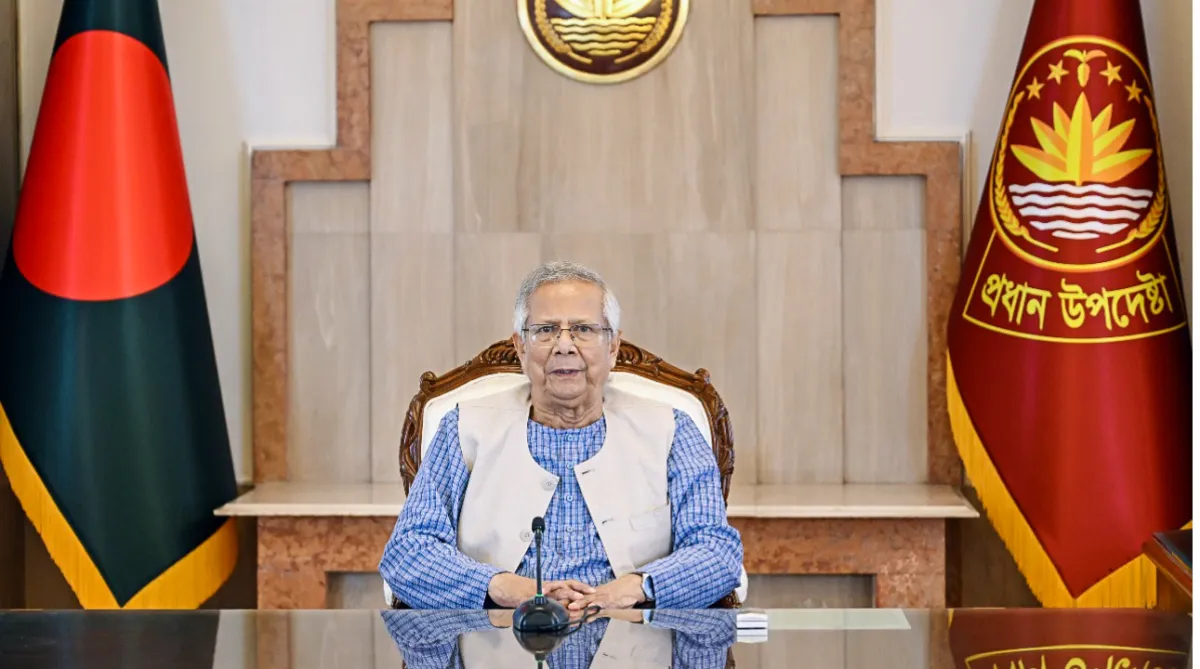
Facing sustained criticism in Bangladesh over failure to fully restore democratic normalcy and ensure protection of vulnerable minorities, outgoing interim adviser Muhammad Yunus once again invoked the rhetoric of the "Seven Sisters" in his departing address to the nation, pointedly omitting any direct reference to India.
The remarks came ahead of the formation of a new government in Bangladesh, set to be headed by Tarique Rahman of the Bangladesh Nationalist Party.
Yunus mentions India's Northeast
In his final address before handing over power, Yunus referred to India’s northeastern states, popularly known as the “Seven Sisters”, alongside Nepal and Bhutan as part of a broader regional economic space combined with Bangladesh.
He proposed a sub regional economic framework linking Bangladesh’s maritime access with Nepal, Bhutan and the "Seven Sisters".
"Our open sea is not only a geographical boundary, it is an open door to engage with the world economy for Bangladesh. This region along with Nepal, Bhutan and Seven Sisters has great economic potential," Yunus said.
His deliberate choice to describe the Indian states as the “Seven Sisters” while excluding a direct mention of India has been viewed in strategic circles as calculated messaging aimed at redefining the political and economic identity of the region.
What rhetoric is Yunus signalling
The deliberate omission amounted to deliberate strategic signalling intended to reshape global perception of India’s northeast. Yunus’s remarks suggested a regional economic framework centred on Bangladesh’s ports and maritime access, implicitly positioning Dhaka as a gateway not only for neighbouring countries but also for India’s landlocked northeastern region.
Such framing is likely to draw attention in New Delhi. Over the years, India has invested heavily in connectivity and infrastructure projects through Bangladesh to integrate its northeast more closely with the rest of the country. Yunus’s speech appeared to invert that narrative, implying that access and economic opportunity for the region could increasingly depend on Bangladesh’s strategic choices rather than Indian planning alone.
Silence on domestic criticism
Equally notable was what Yunus did not address. He presented his 18-month tenure as a period of reform and recovery, but made no reference to criticism over the interim government’s handling of communal tensions or concerns regarding the protection of minorities.
There was no acknowledgement of anxieties among Hindu citizens who had sought reassurance from the state during a period of political uncertainty. Instead, the address appeared to shift focus outward, emphasising regional economic visions and foreign policy positioning rather than confronting domestic shortcomings.
Also read: Tarique Rahman sends big message ahead of oath-taking ceremony today
