
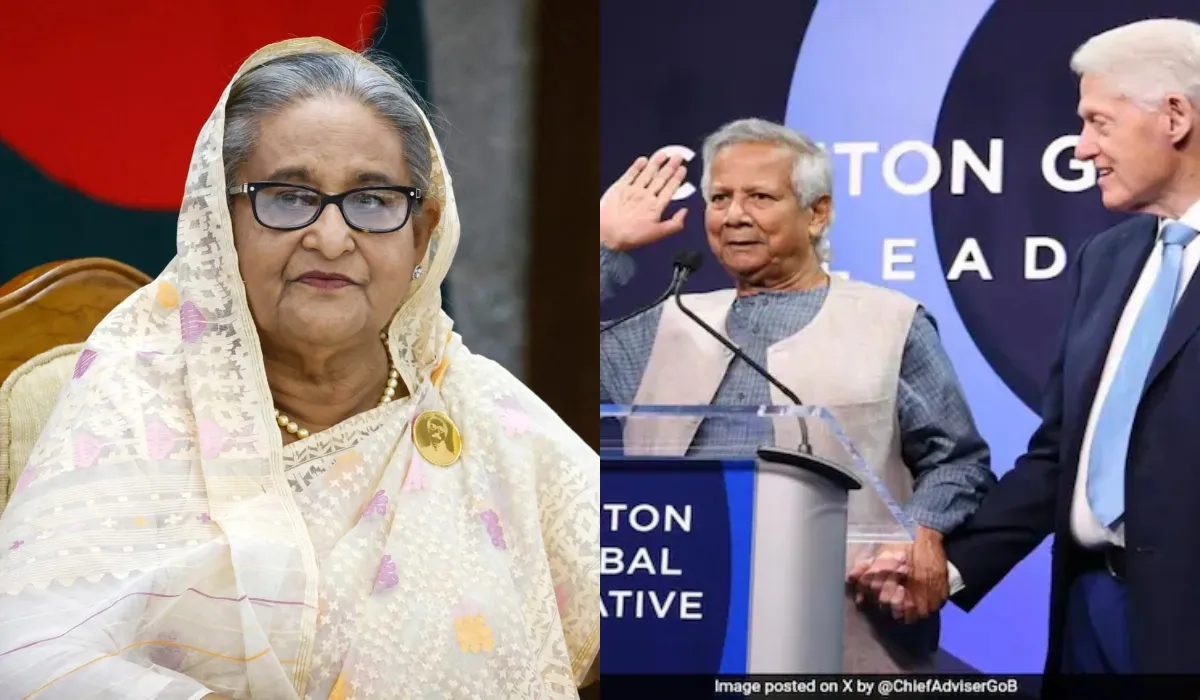
A former senior Bangladeshi minister has alleged that the 2024 uprising that toppled Prime Minister Sheikh Hasina was orchestrated with funding and support from US-linked groups and political families, including the Clintons. In an interview with Russia Today (RT), Mohibul Hasan Chowdhury, a key aide to Hasina and former education minister, claimed that the United States Agency for International Development (USAID) and Nobel laureate Muhammad Yunus’s interim government were part of a “Western-sponsored nexus” aimed at regime change in Dhaka.
'USAID and NGOs funded regime change activities
Chowdhury alleged that the unrest which forced Hasina’s exit was “carefully planned” and funded through clandestine channels. He directly accused USAID—the U.S. government’s humanitarian arm—and the International Republican Institute (IRI) of channelling funds to groups opposed to Hasina’s administration since 2018.
"Certain NGOs, especially from the U.S.—USAID and IRI to name a few—were running campaigns against our government for years," Chowdhury told RT.
He claimed that millions of dollars in aid money had "vanished" and were instead used to finance anti-government movements. "The chaos was carefully planned with this money, and it turned into a big riot," he said.
Clinton family and Yunus nexus alleged
The former minister also accused the Clinton family of maintaining a long-standing alliance with Muhammad Yunus, who became the head of the interim government after Hasina fled.
"There is a nexus between the Clinton family and the Yunus regime from a very long past," Chowdhury said, alleging that "funding of clandestine NGOs was going on" for years to destabilise Bangladesh.
Chowdhury linked the 2024 unrest to a broader Western effort to reshape Bangladesh’s leadership, implicating US political figures, philanthropist George Soros, and sections of the Biden administration.
Student protests and Hasina's fall
The crisis began as student-led protests over government job quotas in July 2024 but quickly escalated into violent clashes that left at least 700 people dead. Islamist groups allegedly infiltrated the movement, leading to mob attacks and the storming of Hasina’s official residence.
Hasina fled the country on August 5, 2024, and has since been living in New Delhi. The U.S. denied any role in the turmoil, calling the claims "laughable."
Yunus government's policy shift
After Yunus took charge, Bangladesh’s foreign and domestic policies shifted sharply. His administration has strengthened ties with Pakistan, softened its stance on the 1971 genocide, and faced criticism for turning a blind eye to rising attacks on Hindu minorities.
Chowdhury warned that Bangladesh’s sovereignty was at stake, describing the change in leadership as a "Western-engineered operation" to install a more compliant regime. “They were hell-bent on changing the government in Bangladesh,” he said.
While the US and its allies have rejected the allegations, Chowdhury’s statements have reignited debate over foreign interference in Bangladesh’s 2024 regime change and the growing influence of Western-backed NGOs in South Asian politics.
