
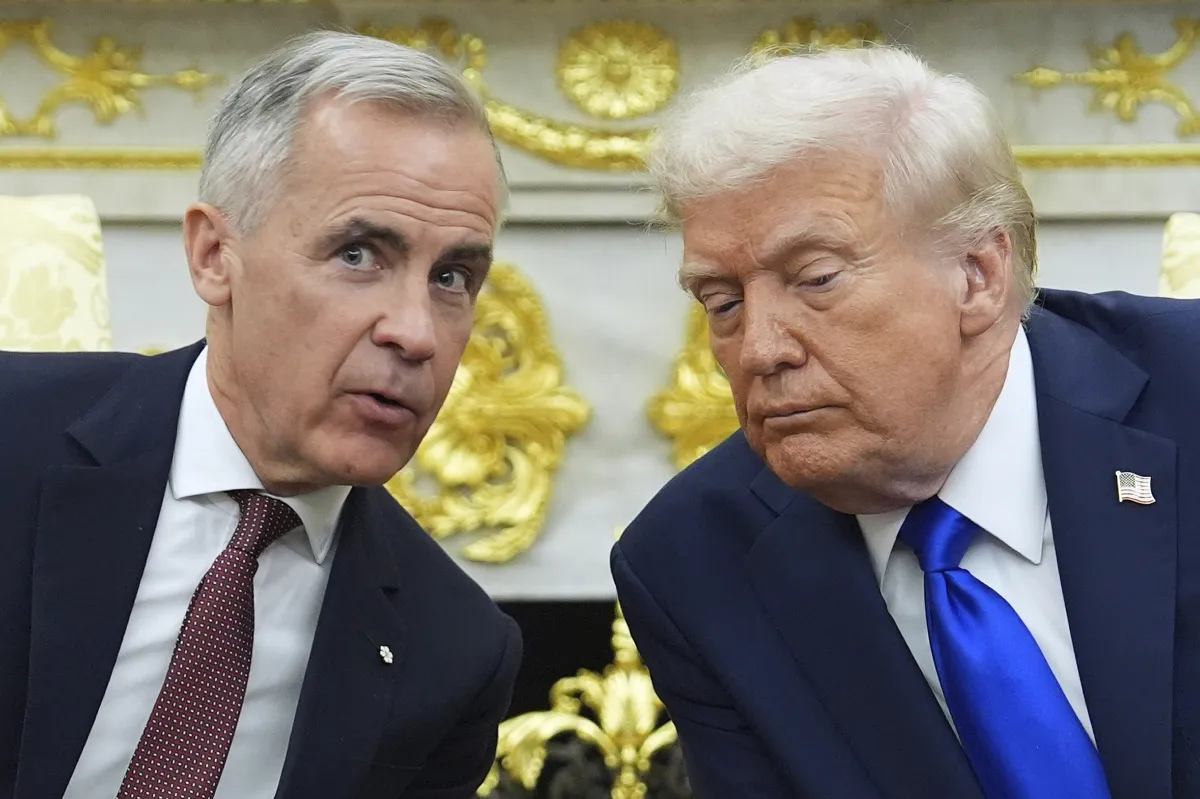
Even though India consistently rejects any assertion of third-party involvement in India-Pakistan ceasefire, Canadian Prime Minister Mark Carney backed US President Donald Trump's ceasefire claim, calling him 'transformative.' In the Oval Office, Carney spoke on Trump’s impact on global stability, economic growth, and defense commitments.
"You are a transformative president the transformation in the economy, unprecedented commitments of Nato partners to defence spending, peace from India, Pakistan through to Azerbaijan, Armenia, disabling Iran as the force of terror," he said, with Trump nodding in agreement. Carney, who assumed office in March, had previously met Trump in May during an earlier Washington visit. His comments mark a significant shift in Canada’s diplomatic tone after months of strained relations due to Trump’s tariff threats and earlier controversial statements suggesting Canada should be “annexed” by the US.
During their Oval Office conversation, Carney acknowledged Trump’s broad influence in global affairs, specifically citing the “peace from India, Pakistan” as part of the president’s transformative achievements.
Trump's repeated claims of mediation between India-Pakistan
President Trump reiterated his belief that US-imposed tariffs played a critical role in averting multiple global conflicts, including a potential war between India and Pakistan. He asserted that America’s trade leverage had positioned the country as a key “peacekeeping” force. "If I didn’t have the power of tariffs, you would have at least four of the seven wars raging," Trump said. "If you look at India and Pakistan, they were ready to go at it. Seven planes were shot down... I don’t want to say exactly what I said, but what I said was very effective."
Since May 10, Trump has frequently claimed—nearly 50 times—that his diplomatic intervention helped secure a "full and immediate" ceasefire between India and Pakistan after a tense "long night" of talks mediated by Washington.
India denies any US mediation
India has consistently rejected any assertion of third-party involvement in the ceasefire, with the Ministry of External Affairs stating that the agreement was reached directly between the Directors General of Military Operations (DGMOs) of both countries through established communication channels.
Operation Sindoor
The ceasefire followed Operation Sindoor, launched by India on May 7 to target terror infrastructure in Pakistan and Pakistan-occupied Kashmir. This operation was a retaliation for the April 22 Pahalgam terror attack that killed 26 civilians. The ensuing four days saw intense drone and missile exchanges before both sides agreed to halt hostilities on May 10.
