
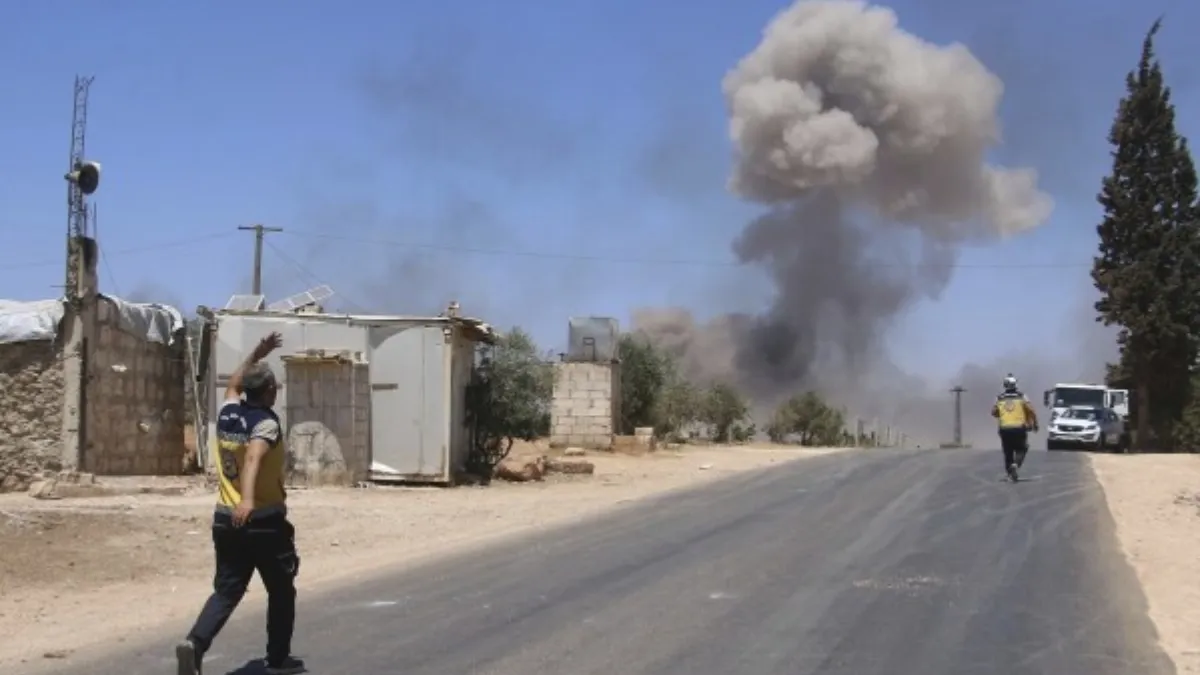
A bomb exploded Thursday on a Syrian Defense Ministry bus in eastern Syria, killing four soldiers and injuring others, according to Syrian officials.
Oil Minister Mohammed al-Bashir announced on social media platform X that the soldiers were traveling to their posts as guards at an oil facility when the explosion occurred. State-run Al-Ikhbariah TV reported that the blast took place on the road connecting Deir el-Zour and Mayadeen, two cities in Syria’s oil-rich eastern region near the Iraqi border.
Casualty reports vary
While the Syrian Observatory for Human Rights, a UK-based monitoring group, reported three soldiers killed and nine wounded, Syrian officials confirmed four deaths. No group has yet claimed responsibility for the attack.
IS sleeper cells remain a threat
The region is known to harbour sleeper cells of the Islamic State (IS), which was defeated in Syria in 2019. Despite its territorial losses, IS continues to oppose the Damascus government led by interim President Ahmad al-Sharaa, who was formerly the head of al-Qaida’s branch in Syria. IS has carried out attacks against government forces during Syria’s civil war, often targeting buses transporting military personnel.
Recent IS-linked violence
This attack follows a series of recent violent incidents attributed to IS. In May, a blast targeted a police station in al-Mayadin, killing at least three people. In June, a deadly suicide bombing at a Damascus church killed 25, though IS did not claim responsibility. The latest attack happened near areas controlled by the Kurdish-led Syrian Democratic Forces (SDF), where tensions with government forces have escalated recently.
Geopolitical and security challenges
The area lies along the Euphrates River, dividing government-controlled zones from SDF-held oil fields. In August, Syria accused the SDF of a rocket attack that injured military personnel and civilians. Meanwhile, ongoing Israeli incursions in southern Syria add another layer of complexity, with recent raids reported in the Quneitra countryside.
Leadership amidst conflict
Interim President Ahmad al-Sharaa has sought to unify Syria, improving international relations and attracting economic investment despite internal sectarian clashes and external military threats. However, security challenges, including IS sleeper cells and foreign interventions, continue to threaten stability in the war-torn nation.
