
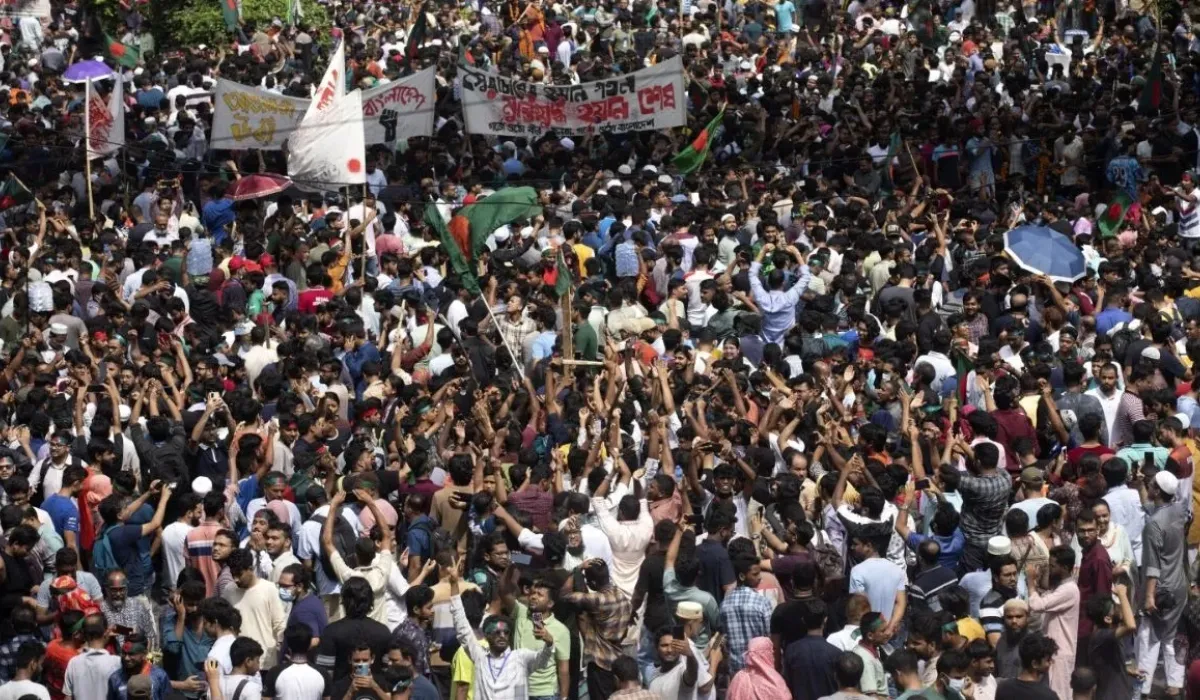
The streets of Dhaka, Bangladesh’s capital, were once again filled with protesters on Saturday, with demonstrations spreading to several other cities. Thousands of people took to the streets demanding that former Prime Minister Sheikh Hasina be brought to the country and executed following a court ruling. On November 17, Hasina was sentenced to death by the International Crimes Tribunal (ICT) for alleged killings during the 2024 student protests. Former Home Minister Asaduzzaman Khan Kamal also received a similar sentence for crimes against humanity. Hasina was not present in court when the verdict was announced.
BNP and Jamaat-e-Islami rally demands execution
Following the court’s ruling, tensions escalated sharply in Bangladesh. On Sunday, a joint rally was held by the main opposition Bangladesh Nationalist Party (BNP) and the Islamic organisation Jamaat-e-Islami. Protesters marched from the Dhaka University campus to Shahbagh Chowrangi, raising slogans such as “Give Hasina the death penalty,” “Extradite from India,” and “Ensure justice.” Student organisations, families of victims, and political activists participated. Dhaka University student R. Rafi stated, “Hasina ordered the killing of our brothers and sisters. Death is the only justice.”
Calls for Hasina's extradition
During the rally, BNP General Secretary Mirza Fakhrul Islam Alamgir described the verdict as “the end of dictatorship” and urged India to hand over the “fugitive.” Jamaat-e-Islami General Secretary Mia Golam Parwar called it the “aspiration of 18 million people” and stressed the need for a fair process compared to previous trials. The 2024 student movement in July-August had protested against the reinstatement of a 30% quota in government jobs, during which Hasina’s government was accused of using excessive force. According to UN reports, over 1,400 people were killed and 14,000 were injured.
Elections and rising political tensions
Interim government head Muhammad Yunus has promised elections in February 2026, but tensions have risen due to the ban on the Awami League. Hasina’s supporters called for a “lockdown” between November 13 and 17, disrupting traffic in Dhaka and leading to buses being set on fire. During Sunday’s rally, Jamaat and seven other parties also demanded election reforms while controversially labelling the Ahmadiyya community as “kafir.” Police resorted to baton charges and tear gas, leaving dozens injured. The “Moulik Bangla” group staged a symbolic hanging of Hasina in Shahbagh. Former IGP Chowdhury Abdullah Al-Mamun testified against Hasina but received a light sentence.
Hasina calls verdict political
Amnesty International criticised the trial as “unfair,” while the United Nations called for justice but opposed the death penalty. Sheikh Hasina described the sentence as “political revenge.” Experts warn that the ruling could increase instability ahead of elections, especially amid the Awami League boycott. Families of victims argued that “justice remains incomplete without the death penalty.” While BNP and Jamaat displayed unity in the protests, concerns over Islamic extremism have added further complexity.
Rising challenges for Hindu minority
Meanwhile, the Hindu minority in Bangladesh continues to face escalating challenges, with the Dhaka-based HRCBM (Human Rights Congress for Bangladeshi Minorities) reporting over 2,200 cases between January and December 2024, including attacks on Hindus, temple vandalism, blasphemy allegations, abduction of 94 girls (half of whom remain missing), 50 cases of forced religious conversions, and 1,190 instances of rape or harassment; most cases were registered as FIRs but saw little action, prompting the NGO to file court cases to pressurise authorities, while its General Secretary Rudra highlighted the worsening conditions and urgent need for protection for the Hindu community.
