
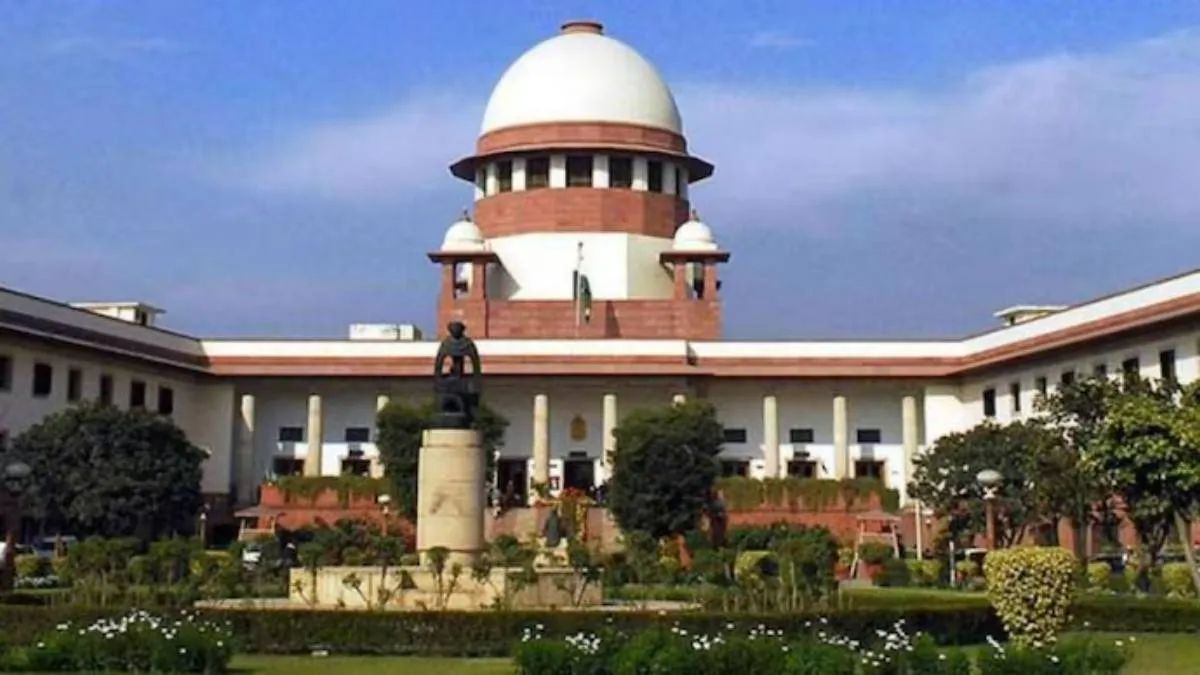
The Supreme Court on Monday extended the February 14 deadline for the verification of documents and publication of the final electoral roll in West Bengal by one week to February 21. The apex court issued a notice to the DGP of West Bengal during the hearing on the Special Investigation Report (SIR). The Supreme Court also directed the West Bengal DGP to file a personal affidavit. The Supreme Court issued a show-cause notice to the West Bengal DGP, seeking a response to complaints of intimidation and violence against officials engaged in SIR duties on behalf of the Election Commission.
During the hearing on the West Bengal Special Investigation Report (SIR), the Chief Justice of India (CJI) Surya Kant made it clear that the Supreme Court would not permit any obstruction in the SIR process. He stated that orders would be issued wherever improvements were required, but emphasized that no hurdles would be allowed.
“All states should understand this,” the CJI remarked.
The CJI also observed that had the list of officers been submitted by February 5, the Election Commission of India (ECI) would have already taken a decision.
Dispute over submission of officers’ names
Senior advocate Abhishek Manu Singhvi submitted that the Election Commission had never requested the state to provide names of officers. In response, senior advocate Shyam Diwan stated that a list of 8,500 officers had now been submitted and urged the court to accept it.
The CJI immediately questioned whether the list included the officers’ names, designations, and places of posting. He also asked how the officers would be contacted and whether they could report to the concerned Electoral Registration Officers (EROs) by the next day. Diwan replied in the affirmative.
However, senior advocate D S Naidu, appearing for the Election Commission, countered that the Commission had not been given the names. He said the documents received on Saturday at 12:30 PM did not contain such details.
Diwan claimed that district-wise information had been provided, but Naidu denied receiving any such list. The CJI cautioned that the court did not want factual disputes and warned that continued discrepancies could lead to the Chief Secretary being summoned for an explanation.
Concerns over delays and officer deployment
Diwan informed the court that the officers’ names were ready and that all of them were Group B officers. The CJI observed that the names could have been submitted on February 4 or 5. Diwan responded that the state had taken some time.
The CJI noted that even now the complete list was unavailable and that officers would have to report to the District Election Officer (DEO). Singhvi argued that an impression was being created that the state was unwilling to cooperate, whereas micro-observers belonged to a different category. He explained that many were from public sector undertakings (PSUs) and had no direct connection with West Bengal.
When questioned by the CJI about this, Singhvi stated that these individuals were clerks or customer assistants, while the state had suggested officers of a different category.
Voter mapping and logical discrepancies
The CJI raised questions regarding mapped and unmapped voters and sought clarification on the court’s earlier order concerning the mapping process. Diwan referred to the instructions issued to the ECI and stated that over 50 percent of the discrepancies in the Logical Discrepancy (LD) category were due to minor spelling errors.
The CJI asked whether approximately 70 lakh voters had fallen into this category merely due to spelling mistakes.
It was recalled that in the previous hearing, the Election Commission had stated that micro-observers were required due to a staff shortage. Diwan reiterated that 8,500 officers had now been arranged, prompting the CJI to ask the Commission whether it had received the list.
Courtroom discipline and procedural concerns
Senior advocate Menaka Guruswamy questioned why an organisation managing temples had filed a petition in the matter and what its connection to the issue was. The Chief Justice expressed displeasure over multiple parties speaking simultaneously.
“This is Court Number 1, not a marketplace,” the CJI said sternly, emphasising the need for discipline.
Timeline and electoral roll data
Referring to his written submissions, Diwan informed the court that the entire process was scheduled to conclude by February 14, underscoring the urgency of the matter. He also cited the court’s observations made on February 4.
According to Diwan, the draft electoral roll contains approximately 7.08 crore voters. Of these, about 6.75 crore voters have already been identified or linked to existing records, while around 32 lakh voters are yet to be identified. Additionally, approximately 1.36 crore voters were identified through the logical discrepancy process.
Background of the hearing
At the outset of the hearing, CJI Surya Kant stated that the court would first examine whether its previous order had been complied with. Diwan informed the court that the order, along with a notice, had been issued on February 4 and included certain observations.
The Supreme Court was hearing petitions filed by the West Bengal State Election Commission (SIR) and Chief Minister Mamata Banerjee.
ALSO READ: Lok Sabha descends into chaos over allowing Rahul Gandhi to speak; House adjourned till Tuesday
