
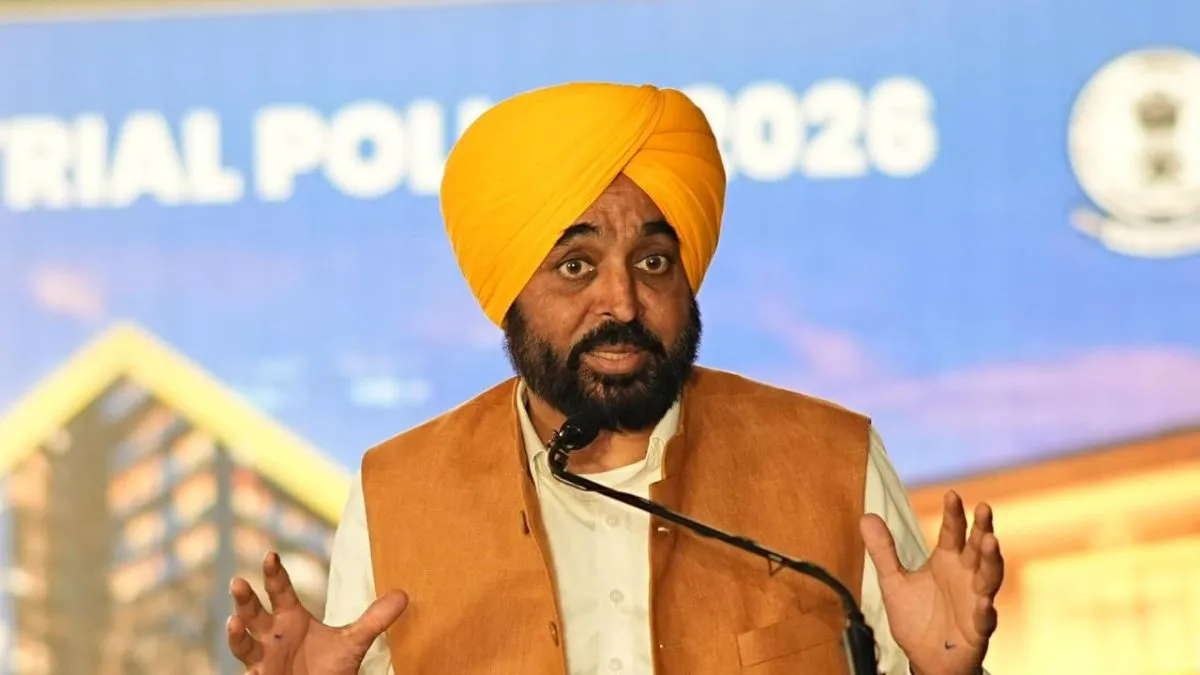
Chief Minister Bhagwant Mann unveiled the state's Industrial and Business Development Policy 2026 in Ludhiana on Saturday, with a focus on making Punjab the number one investment destination in India. Mann said his government is focused on accelerating industrial growth in Punjab and attracting large-scale investment, which would further help generate employment across the state.
He said the new policy will allow investors to choose up to 20 incentives and design customised packages suited to their business models, introducing capital subsidy for the first time in Punjab and offering incentives of up to 100 per cent of Fixed Capital Investment.
Under the new policy, Employment Generation Subsidy eligibility has also been reduced to Rs 25 crore investment, which would open industrial incentives to a much wider base of businesses and strengthen Punjab's position as a leading destination for manufacturing, services and emerging technology sectors.
"Every other state in India hands investors a fixed menu and says take it or leave it, but Punjab has changed that. Now an investor can pick up to 20 incentives and build a package around their own business model," the Punjab chief minister said, adding that the policy represents a major shift in the way industrial incentives are structured in the state.
"Pharmaceutical companies need different support than an EV manufacturer; a data centre has different costs than a textile plant. The new policy acknowledges that and builds around it," he said, adding that different industries have different operational realities and cost structures.
During the event, Mann said the framework allows investors to optimise incentives according to their sector, cost structure and scale of operations. “The incentive package can be optimised for their specific cost structure, their specific sector and their specific scale. That is money on the table that wasn’t there before,” he said.
Highlighting another major feature of the policy, the Chief Minister stated that for the first time in Punjab’s history, the government has introduced a capital subsidy. “If someone is planning a Rs 100 crore plant, without a capital subsidy Rs 100 crore is their risk. With capital subsidy, the government co-invests a portion upfront and their capital at risk drops,” he said.
He added that this significantly improves investment economics. He also observed that most industrial policies in other states are largely designed to attract new investors while existing businesses often receive little attention. He said the new policy corrects this imbalance by extending incentives to modernisation and expansion projects as well.
“Most industrial policies in other states are drafted for outsiders with new investors, greenfield projects and companies being wooed from other states. Businesses already operating, already paying taxes and already employing people are usually an afterthought,” he said.
“Punjab’s new policy changes that as modernisation and expansion projects are now eligible for incentives. A Ludhiana manufacturer who wants to upgrade machinery, add a production line or expand capacity now gets policy support alongside new investors,” he added.
What are the key features of the policy?
- Investor-designed incentive packages: For the first time, investors will be able to select up to 20 incentives and create customised incentive packages suited to their own business models. This flexible framework recognises that industries such as pharmaceuticals, electric vehicles, data centres and textiles operate with very different cost structures, allowing incentives to be optimised according to sector, scale and operational requirements.
- Capital subsidy introduced for the first time in Punjab: The Punjab Government has introduced capital subsidy for the first time in the state’s history. This effectively allows the government to share part of the upfront investment burden, reducing capital risk for investors and improving the Internal Rate of Return of projects even before production begins.
- Existing industries now eligible for incentives: The policy recognises the contribution of industries already operating in Punjab. Modernisation, machinery upgrades, capacity expansion and new production lines undertaken by existing manufacturers will now qualify for incentives, placing them on equal footing with new investors.
- Incentive support extended up to 15 years: Incentive support under the policy can extend up to fifteen years, significantly longer than the typical five to ten year support period offered by many other states. This makes Punjab particularly attractive for capital-intensive sectors such as semiconductors, pharmaceuticals and data centres that require long gestation periods before generating returns.
- Expanded definition of Fixed Capital Investment: The policy expands the definition of Fixed Capital Investment, which forms the basis for calculating incentives. Investments in land, labour housing, research and development facilities, effluent treatment plants, sewage treatment plants and zero liquid discharge systems will now be included, ensuring that investments in sustainable and compliant infrastructure contribute to the incentive base.
- Greater support for small and medium enterprises: Eligibility for Employment Generation Subsidy has been reduced to ₹25 crore investment and 50 workers. This change brings thousands of small and medium manufacturing units into the incentive framework, particularly in industrial clusters such as Ludhiana, Jalandhar, Batala and Gobindgarh where many businesses operate with workforces of 30 to 50 employees.
- Inclusion linked to financial incentives: Higher Employment Generation Subsidy will be available for companies employing women, Scheduled Castes, Scheduled Tribes, persons with disabilities and workers in IT, ITeS and Global Capability Centres. By linking incentives to workforce diversity, the policy integrates inclusion into the financial architecture of industrial development.
- 25% additional incentives for thrust sectors and priority regions: Nine thrust sectors, as well as border and Kandi regions, will receive an additional 25 per cent incentive support. Border districts such as Pathankot, Gurdaspur, Amritsar, Ferozepur and Fazilka will benefit from these enhanced incentives aimed at encouraging industrial activity in historically underinvested regions.
- Flexible incentive period based on project timelines: Investors will have the option to extend their incentive support period up to fifteen years and can decide when their incentive window begins, depending on the gestation period of their project. This allows incentives to align with the actual lifecycle of investments rather than fixed policy timelines.
- Dedicated sectoral policies introduced: Separate policy frameworks have been launched for major sectors, including IT and ITeS, Global Capability Centres, electric vehicles, electronics system design and manufacturing, semiconductors, filmmaking and tourism. Each sector now has a dedicated policy developed through consultation with industry experts and sector committees to ensure incentives align with sector-specific needs.
