
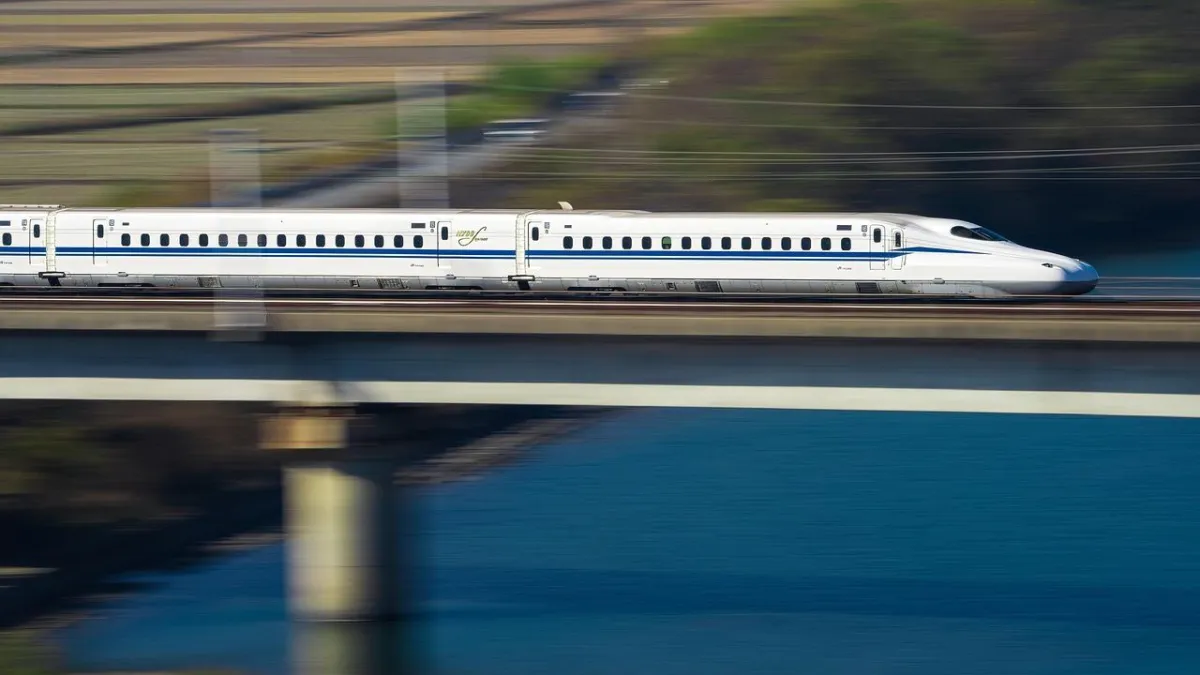
Union Railway Minister Ashwini Vaishnaw on Wednesday said the entire Mumbai-Ahmedabad bullet train corridor, from Maharashtra to Sabarmati in Gujarat, is expected to be completed by December 2029, while the Gujarat stretch between Vapi and Sabarmati is likely to be ready by December 2027.
The minister was responding to questions in the Lok Sabha on the progress of the country’s first high-speed rail project. He said the Mumbai-Ahmedabad High Speed Rail (MAHSR) corridor, covering 508 km, is being developed with financial and technical assistance from Japan.
Twelve stations planned, all civil contracts awarded
The high-speed rail line will pass through Gujarat, Maharashtra, and Dadra & Nagar Haveli, with 12 stations proposed at Mumbai, Thane, Virar, Boisar, Vapi, Billimora, Surat, Bharuch, Vadodara, Anand, Ahmedabad, and Sabarmati.
Vaishnaw informed the House that all civil contracts have been awarded, and 24 out of 28 tender packages finalised. As of now, 392 km of piers have been constructed, 329 km of girders cast, and 308 km launched. Construction has also begun on the under-sea tunnel section, which is around 21 km long.
Rs 78,839 crore spent so far, delay due to land acquisition in Maharashtra
The total estimated cost of the MAHSR project is around Rs 1.08 lakh crore. Of this, the Japan International Cooperation Agency (JICA) is funding 81% (approximately Rs 88,000 crore), while the remaining Rs 20,000 crore is being shared between the Ministry of Railways and the state governments of Maharashtra and Gujarat.
Vaishnaw noted that land acquisition delays in Maharashtra affected the project timeline until 2021. However, all required land—totaling 1,389.5 hectares—has now been acquired.
Surveys, clearances done; focus on expanding HSR network
The final location survey and geotechnical investigations have been completed, and all key environmental clearances, including for wildlife, CRZ, and forests, have been obtained. The minister said detailed project reports (DPRs) for expanding high-speed rail networks to other parts of India are currently being prepared. “HSR projects are capital-intensive, and any new corridor will depend on technical feasibility, economic viability, traffic projections, and financing options,” he said.
He also said fare structures would be designed to ensure affordability while ensuring optimal patronage of the high-speed rail network.
(With inputs from PTI)
