
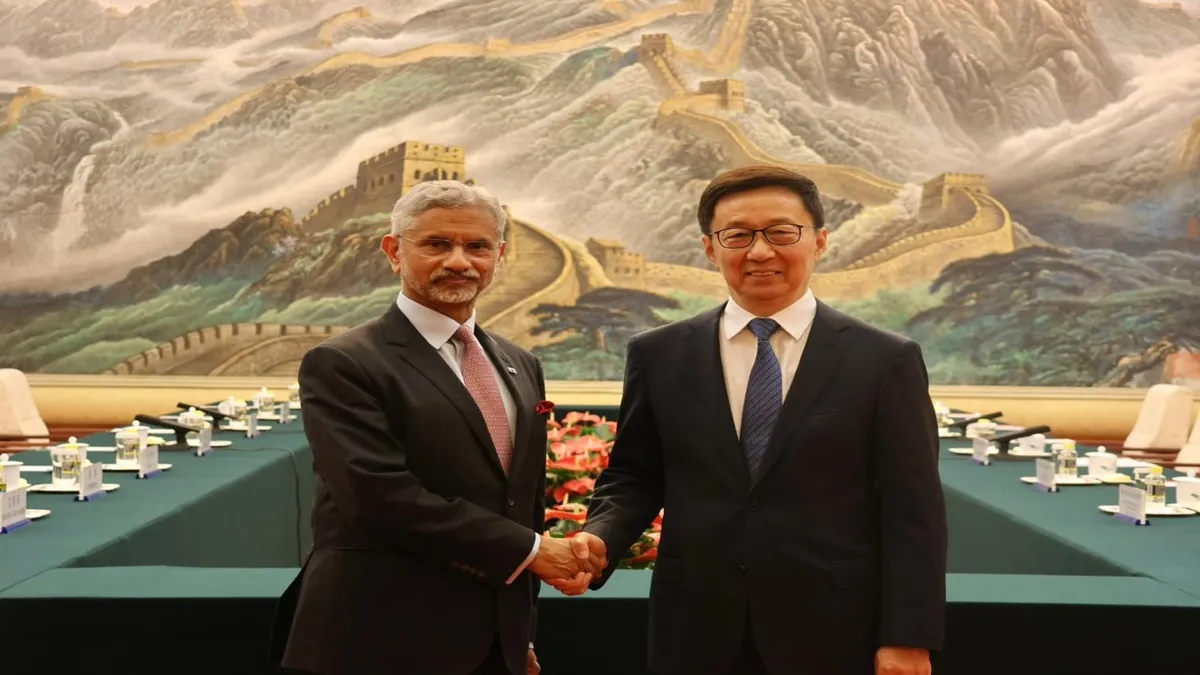
External Affairs Minister S Jaishankar’s visit to China this week, his first since the deadly Galwan Valley clashes in June 2020 marks a significant diplomatic moment as India and China attempt to manage a relationship battered by military standoffs, deep distrust and geopolitical rivalry. In Beijing on Monday, Jaishankar met Chinese Vice President Han Zheng and stressed that the “continued normalisation” of relations between Asia’s two largest nations could deliver “mutually beneficial outcomes.” He underlined India’s support for China’s presidency of the Shanghai Cooperation Organisation (SCO) and highlighted the recent resumption of the Kailash Mansarovar Yatra as a symbolic step towards stability. This visit which also includes his participation in the SCO Foreign Ministers’ meeting in Tianjin is taking place amid a fragile thaw in ties with lingering concerns over the unresolved border dispute, Tibet and China’s growing military partnership with Pakistan.
First visit since Galwan
Jaishankar’s visit comes after a five-year freeze in bilateral visits at the foreign minister level, the longest such gap in decades. The deadly Galwan Valley clash in June 2020 which left 20 Indian soldiers dead had plunged relations to their lowest point since 1962. China admitted four casualties on its side, a figure widely seen as understated.
Since then, while there has been partial disengagement at some friction points along the Line of Actual Control (LAC), including Pangong Tso and Gogra-Hot Springs, no breakthrough has been achieved on other sensitive areas like Depsang and Demchok. Both nations have kept large numbers of troops deployed along the frontier for more than four years now.
It was only after a brief exchange between Prime Minister Narendra Modi and President Xi Jinping in Kazan in October 2024 that both sides agreed to revive dormant dialogue mechanisms, including the Special Representatives (SR) talks on the boundary question.
What is on the table during Jaishankar’s visit?
Jaishankar’s meeting with Han Zheng focused on sustaining the modest momentum generated since the Kazan summit. In his remarks, Jaishankar pointed to the 75th anniversary of India-China diplomatic ties and expressed confidence that bilateral exchanges could help prevent ties from sliding further.
“The resumption of the Kailash Mansarovar Yatra is widely appreciated in India. Continued normalisation of our ties can produce mutually beneficial outcomes,” he said, referring to the reopening of the pilgrimage route after a five-year pause caused by the pandemic and border tensions.
Jaishankar also acknowledged the “very complex” global environment, stressing that India and China as neighbours and major economies must maintain open communication channels.
His visit comes ahead of a likely visit by Chinese Foreign Minister Wang Yi to India next month, where he is expected to meet National Security Adviser Ajit Doval under the revived Special Representatives mechanism. Talks between Wang and Jaishankar in Beijing are expected to focus on this process, though any tangible breakthrough on the boundary question remains distant.

Tibet issue and Beijing’s warning to India
Despite efforts to stabilise relations, longstanding flashpoints remain. Days before Jaishankar’s arrival, the Chinese embassy in New Delhi issued a sharp statement on Tibet warning India against what it called “playing the Tibet card.” It asserted that the Dalai Lama’s succession is an internal matter for China and accused some in India’s strategic community of making “improper remarks.”
The remarks came ahead of the Dalai Lama’s 90th birthday celebrations this month. India, for its part reiterated that it does not interfere in matters of religious belief. Union Minister Kiren Rijiju, who attended the Dalai Lama’s birthday event said: “The Dalai Lama alone decides on his reincarnation. No one else has the right.”
Tibet has long been a sensitive issue in India-China relations and Beijing’s renewed warnings show the limits of how far this fragile thaw can go.
China’s support to Pakistan adds another layer of tension
Beyond the boundary dispute and Tibet, India remains deeply wary of China’s growing military cooperation with Pakistan. This concern intensified after the Pahalgam terror attack on April 22, which killed 26 civilians in Jammu and Kashmir.
In the wake of Operation Sindoor, India’s cross-border strikes targeting terror infrastructure in Pakistan-occupied Kashmir, China openly reiterated its support for
Pakistan’s sovereignty and territorial integrity. While Beijing condemned terrorism in principle, it has continued to strengthen military ties with Islamabad.
India’s Deputy Chief of Army Staff, Lt Gen R S Singh recently stated that 81 per cent of Pakistan’s military hardware used during the recent conflict was of Chinese origin underlining the depth of the strategic nexus between the two.
China’s Foreign Minister Wang Yi also reaffirmed ties with Pakistan calling it an “ironclad friend” and vowing deeper cooperation remarks that sit uneasily with India’s ongoing attempts to stabilise ties with Beijing. The boundary issue is far from resolution with no clarity on when disengagement in Depsang and Demchok will be achieved. China’s continued support to Pakistan, tensions over Tibet, and wider strategic competition in Asia suggest that the relationship remains fragile.