
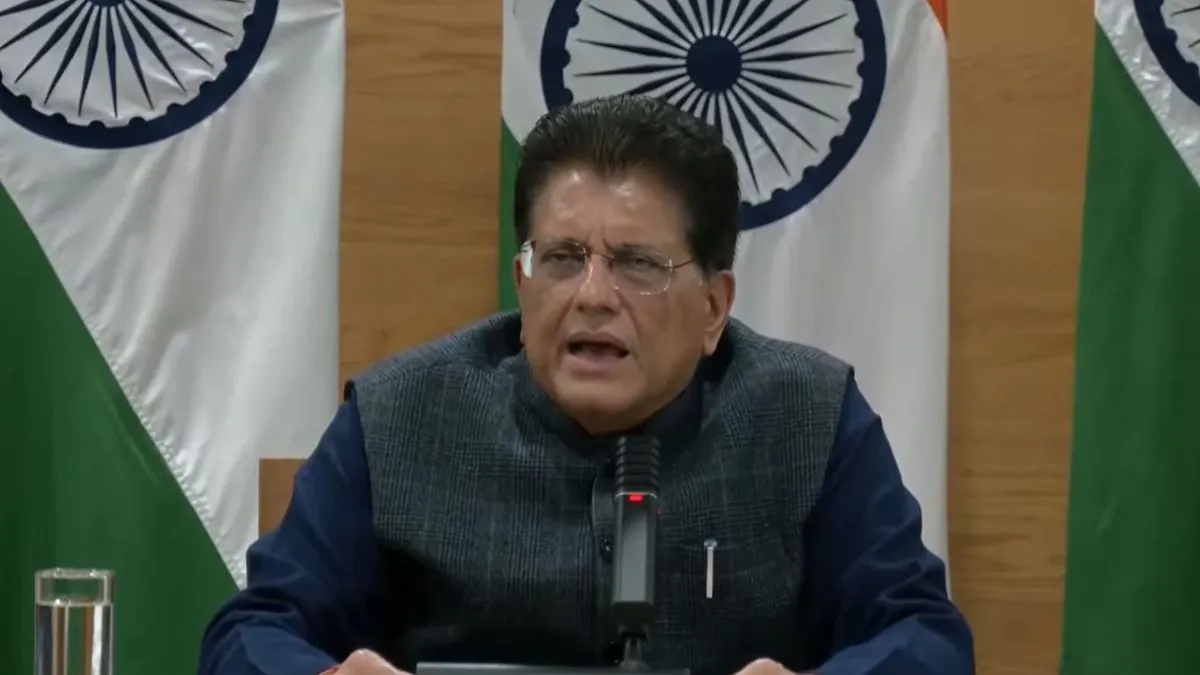
Commerce and Industry Minister Piyush Goyal on Saturday hailed the trade deal between India and the United States. Divulging the details of the agreement, Goyal said the US will now be the most preferred destination for export and the Indian traders will get excess to world's biggest market to sell their products.
He said the main aim of both the nations under this agreement is to achieve annual bilateral trade of $500 billion. He said every sector was happy with the deal and the government was getting positive responses from everywhere.
"Today is a very important day in India's journey towards a developed India by 2047...With the future in mind, and considering the two countries' relations, diplomatic ties, and the friendship between their leaders, discussions on a bilateral trade agreement began in February 2025. The objective was to achieve bilateral trade of $500 billion between India and the United States annually. Today will be written in golden letters for achieving that goal. There is a wave of happiness throughout the country. There is great enthusiasm in every sector of the country regarding the future. It seems that in the coming days, new opportunities will open up, and the United States of America, the world's largest economy, an economy of approximately thirty trillion dollars, will now open up to our exporters with most-favoured-nation status," he said.
US tariffs reduced to 18 per cent
The Union Minister said the US tariffs on India have been reduced to 18 per cent from 50 per cent, which is lowest among all the neighboring countries. Addressing concerns of the agrarian and dairy sector, Piyush Goyal said the interests of farmers have been fully protected under the trade deal.
"Considering how the interests of our farmers have been protected, the interests of farmers and the dairy sector have been protected. I believe that the joint statement between the United States and India, which was finalised late last night and presented to the world, has been welcomed in every corner of the country. Under this agreement, the reciprocal tariff of fifty percent that was levied on Indian exports to the US will now be reduced from fifty percent to just eighteen percent. Eighteen percent is lower than the tariffs imposed by all our neighboring countries and other countries with whom we compete, and this will greatly benefit us and our exporters in the coming days," he said
Several Indian products attracting zero tariffs
Goyal said several Indian products will now attract zero tariffs in America. These products include gems, diamonds, pharmaceutical products among others. He said several agricultural products, including spices, tea, coffee will also have zero tariffs.
"There are several items on which zero duty will now be levied when our exporters send goods to the United States of America. For example, zero duty will be applied to gems and diamonds. Pharmaceutical products, which are exported from India in large quantities, will also be subject to zero duty. Smartphones, which are exported from India to the US in large numbers, will continue to have zero duty. In this way, there are numerous such items on which zero duty will be levied in the future. In the agricultural sector as well, there are many items that will be exported from India to the US on which a zero reciprocal tariff will be applied, meaning the additional duty will be zero. For example, spices, tea, coffee and products made from them, coconut and coconut oil, vegetable wax, areca nut, Brazil nut, cashew nut, and chestnut. Many fruits and vegetables are also included," he said.
The Commerce Minister said the products in which India is self reliant have been kept completely out of the deal. These include meat, dairy products, maize, rice, wheat, sugar, cereals, millets, oil seeds and soybean.
India, US finalise trade deal framework
Notably, India and the United States have finalised a framework for trade deal and a joint statement has been released by the two nations.
Both countries said the interim deal reflects a shared commitment to fair and balanced trade, improved market access and more resilient supply chains.
ALSO READ: India-US trade deal: Key takeaways from interim agreement | Full statement
ALSO READ: ASEAN Connect: How PM Modi's Malaysia visit reinforces India's Act East Policy
