
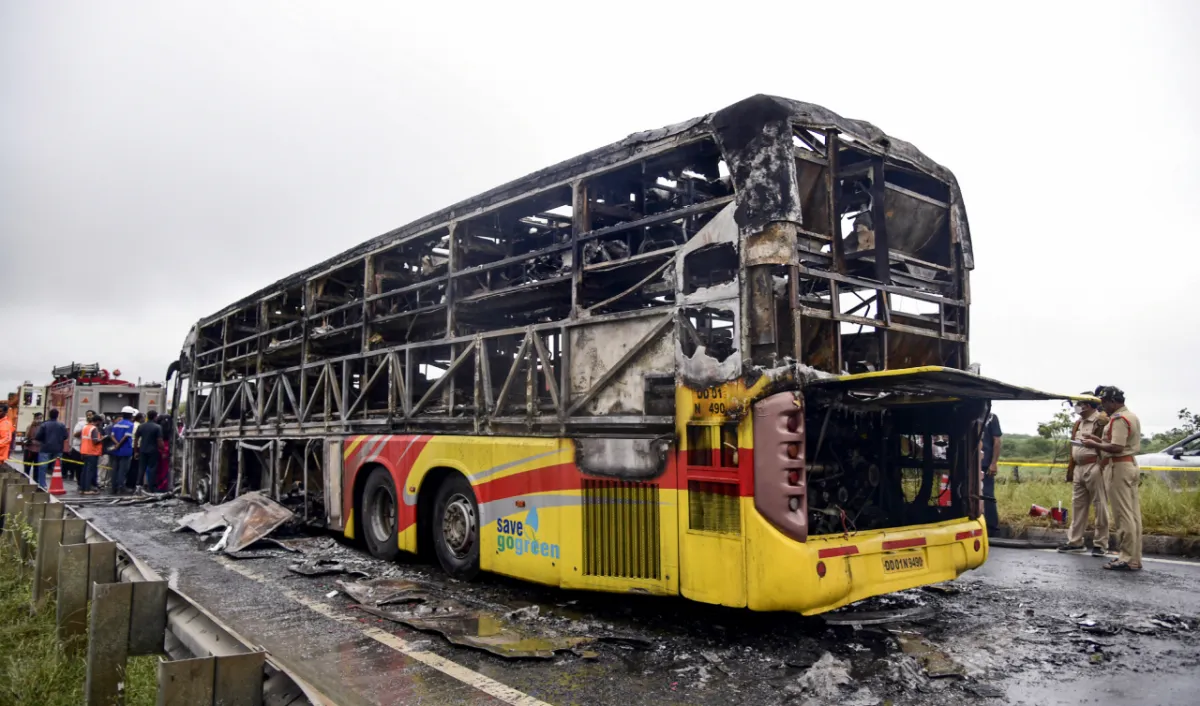
A private sleeper bus travelling from Jaisalmer to Jodhpur catches fire shortly after starting its journey. 26 people were killed, and many others suffered injuries. About a week later, on October 24, 20 were killed in a fiery crash involving a bike and a sleeper bus in Andhra Pradesh's Kurnool on the Bengaluru-Hyderabad Highway. 20 people were killed in the tragedy.
Most recently, on Tuesday, November 11, at least 29 people had a narrow escape when the private sleeper bus they were travelling in caught fire near a village in Nalgonda district on National Highway 65 in Telangana.
These repeated incidents have again raised the question about road safety in India and why these long-route sleeper buses become a death trap for passengers on roads.
Sleeper buses: Travelling means or a life hazard?
India TV spoke to Piyush Tewari, a road safety expert and the CEO of SaveLife Foundation, to know what goes on behind the scenes to bring such tragic incidents on roads.
According to him, a larger nexus between transport authorities and bus parts manufacturers is at play, risking the lives of people.
"So this is entirely due to a nexus between bus owners, bus body builders and Road Transport Offices (RTOs). What's fundamentally happening is bus owners are purchasing chassis from Original Equipment Manufacturers (OEM), and then they send that chassis to a bus bodybuilder who then builds the body parts over it," he said.
Tewari elaborated that bus body builders are required to follow Automotive Industry Standards, or AIS 052 and 119 – the two regulations that determine the features, including safety features, in these buses.
Poor compliance on the ground
"But the compliance at the ground level is very weak. The RTOs are required to verify and ensure that these vehicles are compliant with the law don't do a good job. As a result, many of these buses end up adding more seats than what is approved, Tewari added.
This, he explains, leads to blocking the emergency exits.
"Then they don't always carry fire extinguishers. So a lot of the challenge exists because these buses are built informally by bus body builders; they are not built by the larger automobile companies that follow the rules," he added.
Problem with bus body parts
Instead of using reinforced steel, which is used in making cars. Many of them use aluminium wood composite material, which is extremely flammable, he said.
"Inside the bus, they build cages that trap people, because they are not collapsable compartments. The curtains in the compartments are also not made of flame-retardant material," Tewari elaborates.
Due to such circumstances, he claims, recent reports showed that the fire engulfed the whole bus within 4-5 minutes.
In some cases, he claims, bus bodybuilders, while being in a nexus with the RTOs, also add a fuel tank so the buses can undertake longer journeys, which creates a problem because it does not meet the safety norms of the vehicle as per the OEMs.
Safety standards of electric buses
However, the scenario is quite different when it comes to electric buses because they are completely made by the OEMs, and there are no bus bodybuilders involved, in that EV buses meet the compliance standards.
About SaveLife Organisation
As a scientific organisation, SaveLife Foundation has been conducting forensic investigations of road crashes to uncover the underlying causes behind them.
Based on the data recorded, they are in a collaboration with the Centre and nine state governments to have identified 100 highways and 100 districts which are the deadliest in the country.
The list is likely to be released by the government in January 2026, Tewari said.
