
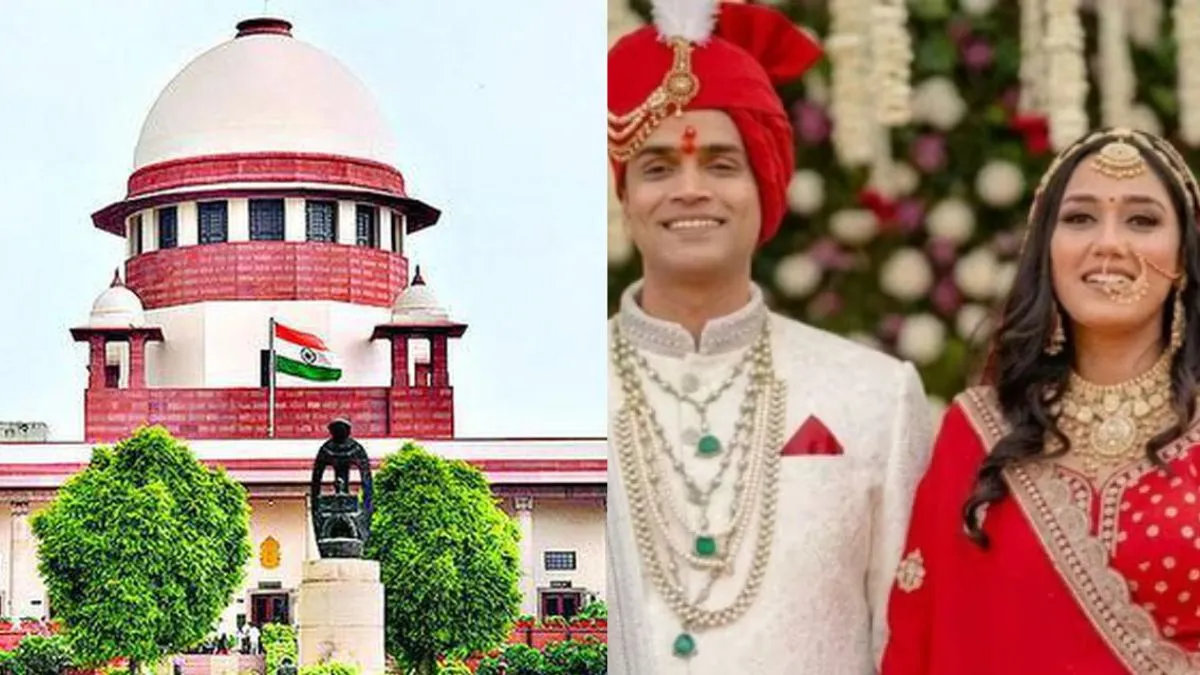
The Supreme Court on Monday heard the high-profile Twisha Sharma death case and stressed on the need for a fair, independent and impartial investigation, while also cautioning against media trials and public speculation in the matter. The hearing came after the apex court took suo motu cognisance of the case amid allegations of institutional bias, procedural lapses and irregularities in the probe into the 32-year-old actor-model’s death at her matrimonial home in Bhopal.
The matter, registered as “In Re: Alleged institutional bias and procedural discrepancies in the unnatural death of a young girl at her matrimonial home,” was heard by a bench led by Chief Justice of India Surya Kant along with Justices Joymalya Bagchi and Vipul M Pancholi.
What did the Supreme Court say in the Twisha Sharma Death case hearing?
At the beginning of the hearing, the CJI noted that one of the major concerns before the court, the second autopsy had already been addressed. “There were two or three aspects. One is with respect to the second autopsy, that is over,” the bench observed.
The court then voiced concern over the manner in which the case was being discussed publicly. “We are slightly at pain because of some of the actions,” the CJI said, requesting the media not to rely on statements from either the victim’s family or the accused side. “Let the things move as per law and procedure,” the bench added.
Referring to allegations that the accused mother-in-law’s position as a former district judge could influence the case, the CJI remarked that it was “unfortunate” that suggestions were being made that the judiciary was not permitting a fair investigation.
“We have no doubt that the victims and accused will cooperate with the investigation. We have no doubt on our state agencies also or on the CBI that whoever will investigate will definitely take the investigation to the logical conclusion and will find the truth,” the bench observed.
During the hearing, Senior Advocate Siddharth Dave, appearing for the accused, complained that statements recorded under Section 161 of the CrPC had appeared in newspapers the very next day. Solicitor General Tushar Mehta, appearing for the Madhya Pradesh government, countered by alleging that the former judge in the case had been “hopping from channel to channel almost maligning the deceased.” Mehta also informed the court that the matter had been recommended for transfer to the Central Bureau of Investigation.
The CJI reiterated that the court’s primary concern was to ensure a fair investigation. “Whatever the unfortunate incident has taken place, it must be fairly and independently and impartially investigated. There were doubts that both sides are also going to the media,” the bench said.
The court further appealed to both sides to avoid public commentary and instead place their versions before investigators. “It is our request that whatever statement you want to make please make it before the authority that is the investigating agency,” the CJI said, adding that the media should avoid “reducing their pain into sound bytes.”
At the same time, SG Mehta acknowledged that media attention had also played a role in bringing certain aspects of the case into the public domain. “Not be sensationalised but at the same time because of the media and intervention several things have come out,” he submitted.
The bench responded by clarifying that it was not against media reporting, but wanted restraint during the ongoing probe. “Our only concern is not to make statement. It came to our notice also only because of the media,” the CJI observed.
Senior Advocate Sidharth Luthra raised concerns over the investigation, alleging that there had been a three-day delay in registering the FIR and claiming there had been a failure to preserve evidence. He also alleged that the accused mother-in-law was herself producing call detail records.
The court once again urged all parties to avoid “premature statements” while the investigation was in progress.
‘Better to have a divorced daughter than a dead one’
During the hearing, SG Mehta made a strong remark that drew attention in the courtroom. “Without attributing motives to either side, the moral of the story is clear that it is better to have a divorced daughter than a dead one,” he said while addressing broader concerns linked to matrimonial disputes and alleged dowry harassment.
Case likely to be transferred to the CBI
In its order, the court recorded Mehta’s submission that the second post-mortem had already been conducted in Bhopal pursuant to directions issued by the Madhya Pradesh High Court. The bench said the main issue now before it was the recommendation made by the state government to transfer the investigation to the CBI.
The court further recorded SG Mehta’s assurance that he would speak to the concerned authorities to ensure that the CBI “immediately takes over the investigation.” The bench also issued a strong appeal to both the victim’s family and the accused family not to make statements in public or before media platforms. According to the order, their versions should instead be recorded before the investigating agency “so that no prejudice or adverse impact is had on the ongoing investigation.”
The Supreme Court additionally requested the media not to record statements from people who may become potential witnesses in the case, observing that such coverage could impact issues that are yet to be investigated. The bench also urged the public to avoid speculation and place faith in the investigating agency. “We are sure that in due course of time it will take the investigation to a conclusion,” the order stated.
Before concluding the hearing, the court clarified that none of its observations should be treated as comments on the merits of the allegations. “While making these observations it is clarified that we have not expressed any opinion on any of the allegations or otherwise and it is entirely on the investigating agency to look into the different aspects,” the bench said.
Also Read: Twisha Sharma's husband Samarth Singh, on the run for 10 days, arrested in Jabalpur
