
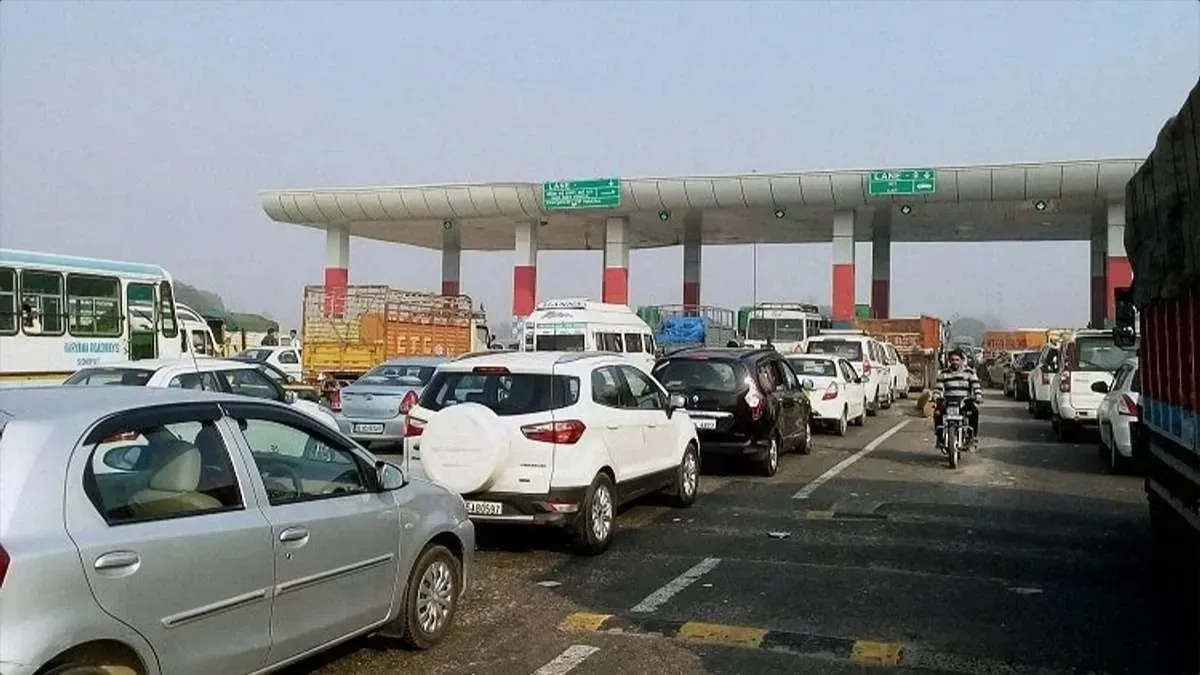
The Supreme Court on Wednesday made a strong observation during the hearing on air pollution in the Delhi-NCR region, suggesting that toll collection at Delhi's borders should be suspended to help curb vehicular pollution. Chief Justice of India (CJI) Surya Kant said revenue generation through tolls cannot take priority when pollution levels are alarmingly high. "We do not want income from tolls in such severe pollution," the CJI remarked.
The apex court expressed its intent to evolve a concrete plan to ensure that no toll plazas operate at Delhi's borders until January 31 next year. It further suggested that from the coming year onwards, toll collection should remain suspended annually between October 1 and January 31, the period when pollution peaks in the national capital. The CJI also directed that a notice be issued in the matter.
NHAI accepts notice
A senior advocate appearing for the National Highways Authority of India (NHAI) accepted the court notice. The bench also asked NHAI to consider relocating nine toll collection booths currently operated by the Municipal Corporation of Delhi to locations where NHAI personnel can be deployed. The court suggested that a portion of toll revenue collected by NHAI could be shared with the MCD to compensate for temporary losses arising from removal or shifting of toll booths.
The Chief Justice further observed that on national highways, toll plazas should be set up after 50 kilometres instead of the current distance of 5 to 10 kilometres. He noted that if toll plazas are placed further away, some traffic can be diverted, potentially reducing congestion and pollution near city limits.
Direction to consider temporary suspension of nine toll plazas
The top court directed authorities to examine the possibility of temporarily suspending operations at the nine toll plazas around Delhi. The court asked that a decision be taken within one week and placed on record. The bench also stressed that urgent administrative action is required to balance environmental concerns with infrastructure management.
Courts cannot decide on school closures: SC
The Supreme Court made another significant observation during the hearing, stating that decisions on opening or closing schools under the Graded Response Action Plan (GRAP) fall within the domain of policy and expert bodies, not the judiciary. The court was hearing challenges to the Delhi government's decision to shut schools due to severe air pollution when it underlined the limits of judicial intervention in such matters. Chief Justice of India Surya Kant remarked that the court cannot act as a "super specialist" while deciding sensitive issues such as school closures. He said whether schools should remain open or closed is a policy decision that must be left to experts who assess public health risks. "School attendance or non-attendance itself can become a problem. This decision must be left to specialists," the CJI observed.
Concern raised over impact on poor children
Senior advocate Menaka Guruswamy, appearing for one of the petitioners, argued that repeated school closures disproportionately harm children from economically weaker sections. She pointed out that poor students lose access to essential facilities such as mid-day meals whenever schools are shut. Responding to this, the Chief Justice noted that if a hybrid system is allowed, parents who are both working may still choose to send their children to school.
Conflicting demands before the court
The Supreme Court highlighted that it was faced with two completely opposing sets of petitions. On one hand, affluent sections were demanding complete closure of schools and suspension of outdoor activities. On the other, several parents and stakeholders were seeking reopening of schools. "This is entirely a matter of policy. Why should the court interfere?" the CJI questioned.
Hybrid model under GRAP vs Delhi govt circular
The amicus curiae informed the court that GRAP guidelines permit a hybrid mode of education, whereas the Delhi government's circular had ordered complete closure of schools up to Class 5. Additional Solicitor General Aishwarya Bhati, appearing for the Centre, told the court that the Delhi government had adopted a hybrid model. She added that the Centre could suggest extending the hybrid option to all classes, including nursery to Class 5.
The Supreme Court indicated that it would prioritise the assessment of administrative authorities and expert bodies on this sensitive issue. The bench reiterated that policy decisions related to public health and education during pollution emergencies should be guided by scientific evaluation rather than judicial directives.
SC tightens NCR vehicle curbs
The top court allowed the Delhi government to initiate action against owners using vehicles that do not meet the Bharat Stage IV emission norms in the National Capital Region. Modifying its August order, in which authorities were permitted to act only against vehicles below the Bharat Stage III emission standard, the top court expanded the scope of regulatory action to include older and more polluting vehicles below BS IV norms.
However, the court made it clear that no coercive action should be taken against vehicle owners whose vehicles comply with BS IV emission standards or are newer than the BS IV category. The court underlined that enforcement measures must remain focused on higher-emission vehicles while ensuring that compliant vehicle owners are not harassed.
