
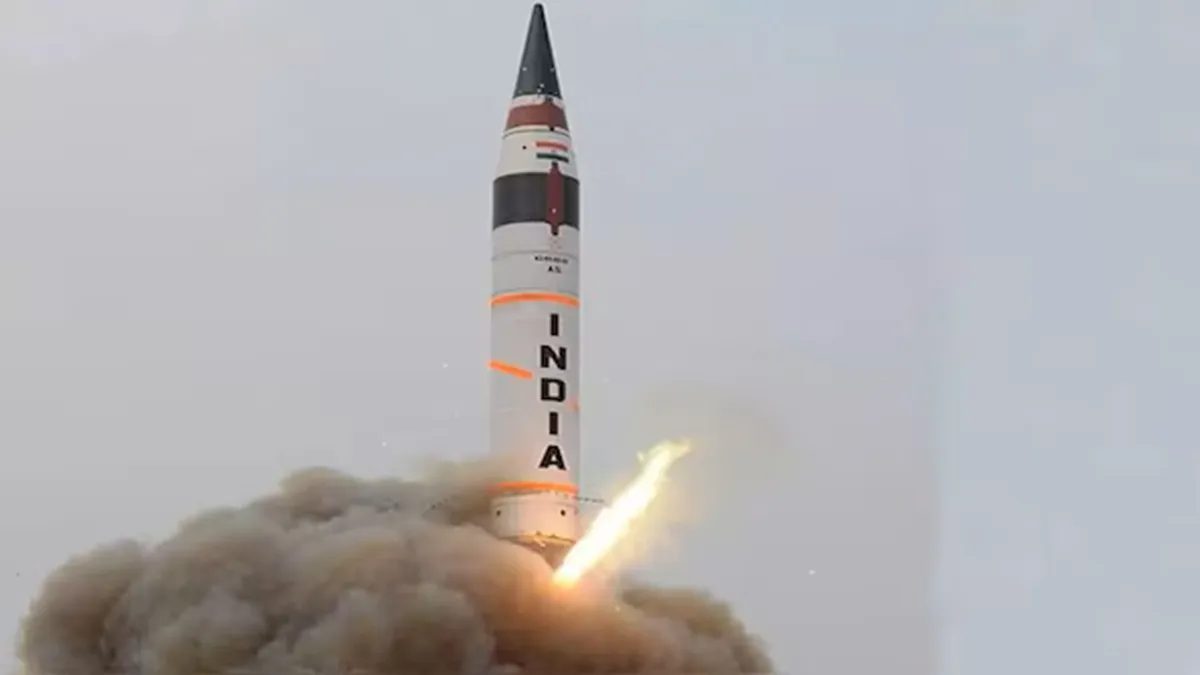
In order to strengthen the country's defence capabilities, India is all set to launch another missile a month after the success of Operation Sindoor as the country is getting ready to test the Extended Trajectory-Long Duration Hypersonic Cruise Missile (ET-LDHCM), its most sophisticated hypersonic missile. This missile, which was developed exclusively using domestic technology as part of DRDO's covert "Project Vishnu," is being hailed as a geopolitical game-changer that has the ability to alter the balance of power throughout Asia.
Once the ET-LDHCM is operational, India will be able to strike deep within enemy territory, whether it be China or Pakistan, in a matter of minutes and with devastating precision. The missile can travel three kilometers in a second at its maximum speed of Mach 8, which is about 11,000 km/h, or eight times the speed of sound. As per reports, it is almost impossible for current radar and air defence systems to intercept it at this speed.
Range, other details of the missile
Equipped with a range of about 1,500 kilometers, the ET-LDHCM can target and destroy enemy sites using conventional or nuclear warheads weighing 1,000–2,000 kg. It can sustain hypersonic speeds for prolonged periods of time thanks to its sophisticated propulsion system, the scramjet engine, which draws air from the atmosphere to burn fuel. It is hence deadly. An impressive 1,000-second ground test of the engine has already been completed successfully by the DRDO. It demonstrates how close India is to implementing this cutting-edge technology in practical settings.
Missile designed to work in most extreme conditions
The ET-LDHCM travels at low altitudes, can manoeuvre in mid-flight, and is made of heat-resistant materials that can sustain temperatures of up to 2,000 degrees Celsius, in contrast to ballistic missiles that follow predictable courses. Additionally, it has oxidation-resistant coatings that guarantee it will continue to work in the most extreme conditions, such as seawater and intense sunshine. What distinguishes the ET-LDHCM is its adaptability. With the ability to launch from land, the air, or the sea, India has never had more strategic options. The missile's accuracy, range, and evasion make it a nightmare for any adversary, whether it is aiming for strategic command centers, enemy radar installations, or naval destroyers.
India joins nations that have perfected hypersonic missile technology
India now has the ET-LDHCM, joining a select group of countries that have perfected hypersonic missile technology, which also includes the US, China, and Russia. The missile was designed and constructed at the Dr APJ Abdul Kalam Missile Complex in Hyderabad in collaboration with commercial Indian defence companies, making India's accomplishment all the more noteworthy. Deep within enemy territory, Indian soldiers can use it to carry out precision hypersonic strikes—possibly before the enemy even realises they have been hit.
Benefits of hypersonic technologies
Furthermore, beyond military applications, developing hypersonic technologies could strengthen India's capacities in disaster relief, aerospace development, and satellite launches—all vital areas for the country's development. Additionally, the program promises to give Indian MSMEs new chances in the defence ecosystem and generate thousands of employment. The ET-LDHCM is designed to deliver deadly blows with remarkable speed and little warning, whether it be a deep strategic assault on enemy infrastructure, a naval strike on aircraft carriers and destroyers, or a land-attack mission to destroy reinforced military bunkers.
ALSO READ: Exclusive: India developing variants of Rudram Missile, says DRDO chief | All you need to know
