
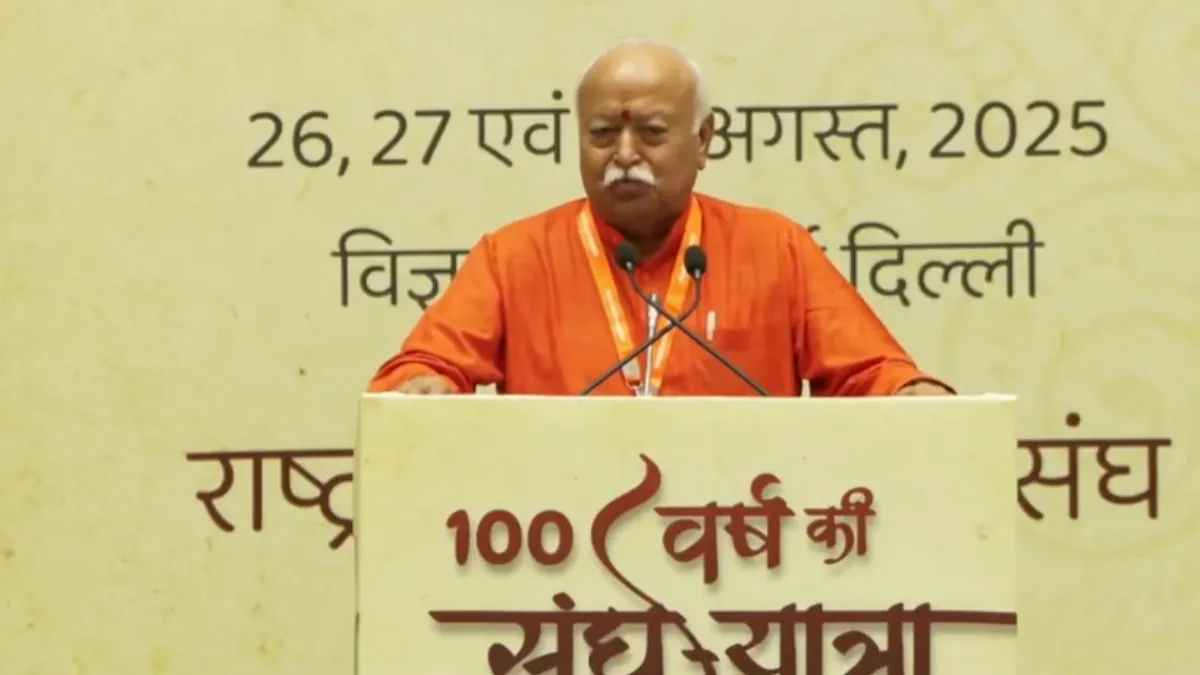
Marking 100 years of the Rashtriya Swayamsevak Sangh (RSS), Sarsanghchalak Mohan Bhagwat delivered a powerful address during a special lecture series in the capital, urging India to embrace its spiritual and cultural identity and take up its role as a global guide—or Vishwaguru—for the modern world.
India's time has come, says Bhagwat
Bhagwat opened his remarks by reflecting on the founding of the RSS in 1925 by Dr. Keshav Baliram Hedgewar, stating that the vision of such an organisation had germinated in his mind years earlier. “We are celebrating 100 years this year, but the idea took shape before 1925,” he noted. Bhagwat emphasized that the essence of the Sangh is rooted in selfless service to the nation and the Hindu community.
“Anyone who wants to be identified as a Hindu will have to be a responsible citizen of the country. This is a responsible community because we got this identity a long time ago,” he added.
India as Vishwaguru: Spiritual contribution over economic power
Highlighting India’s role on the global stage, Bhagwat stated, “India also has its contribution. If any country is to become a leader, it should not do so for its own sake, but rather its leadership should bring a necessary new momentum to the world order.”
He drew from the thoughts of Swami Vivekananda, who said every nation has a mission to fulfill. According to Bhagwat, India’s mission lies not in military or economic dominance, but in spiritual leadership. “The world values India for its adhyatma (spiritual wisdom) and dharma. That is our true strength,” he asserted.
Bhagwat calls for harmony and collective responsibility
Bhagwat reiterated that Hindu culture is about “coordination, not confrontation.” He described a Hindu as “one who follows their own path while respecting the beliefs of others.” He also referred to the cultural unity of India, saying, “The DNA of people living in India for the past 40,000 years is one; it is our culture to live together.”
From freedom struggle to national awakening
Paying tribute to India's revolutionary past, Bhagwat recalled leaders like Savarkar and movements that shaped the pre-independence era. “That wave no longer exists, and is no longer needed, but it was an inspiration to live and die for the country,” he said. He noted that while political movements helped achieve independence, a deeper national consciousness must now take root.
RSS's purpose: Service to Bharat
Reflecting on the founding principles of the Rashtriya Swayamsevak Sangh (RSS), Sarsanghchalak Mohan Bhagwat stated that the organisation was established for Bharat, works for Bharat, and its significance lies in India becoming a vishwaguru (world teacher). Emphasising the Sangh’s core spirit, he said it is encapsulated in the final line of its daily prayer: “Bharat Mata ki Jai.” Bhagwat further stressed that having different views is not a crime but a natural quality, adding that when diverse perspectives come together, they pave the way for consensus and collective progress.
Talk about RSS based on facts, not perceptions
Concluding his address, Bhagwat called for an informed discourse around the RSS. “Discussion on RSS should be based on facts and not on perception,” he said, urging people to explore the organisation’s century-long contributions rather than rely on hearsay.
The centenary lecture series marks a significant milestone for the RSS, which has grown from a small ideological movement into one of India’s most influential socio-cultural organisations.
