
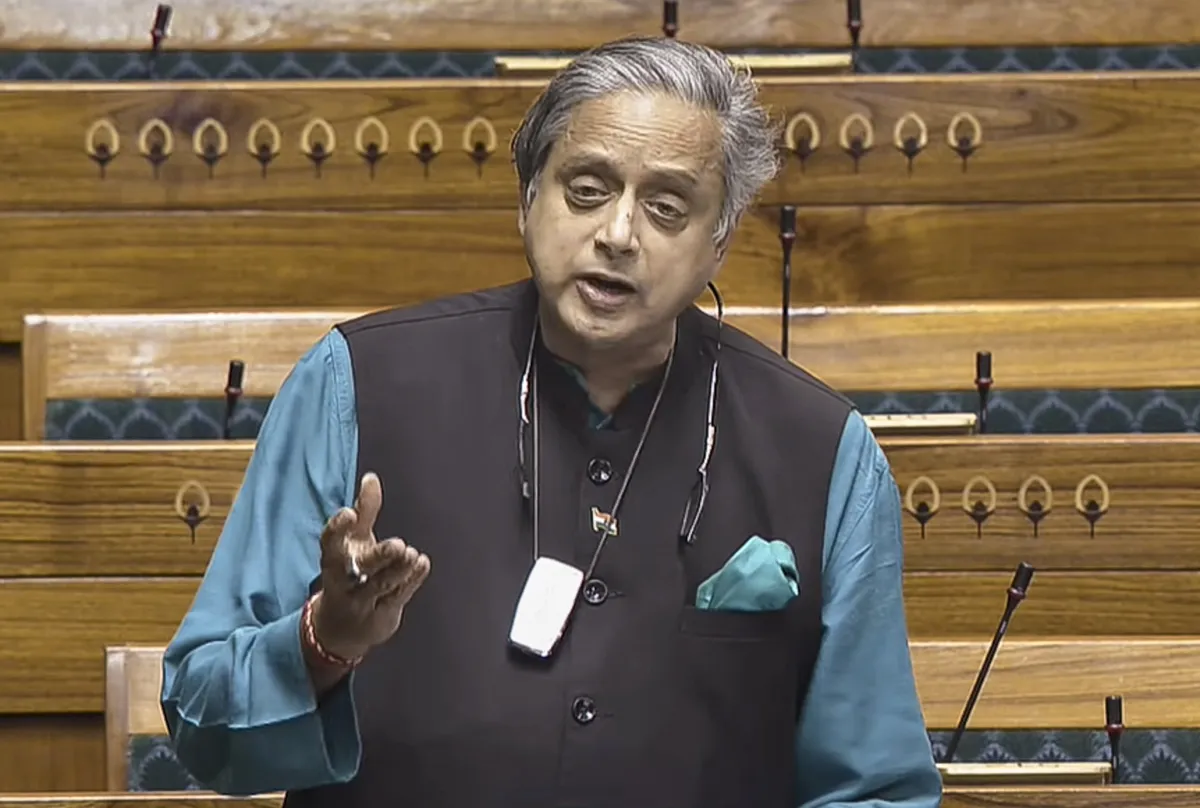
Senior Congress leader Shashi Tharoor, who has often differed with his party leadership but remains with the Congress, strongly criticised the Bharatiya Janata Party (BJP)-led government’s decision to rename the Mahatma Gandhi National Rural Employment Guarantee Act (MNREGA). Despite recent speculation about his political future and past disagreements with the Congress high command, Tharoor made it clear in Parliament that he stands firm against what he called an “unfortunate” decision by the Centre.
He opposed the move to replace MNREGA with a new scheme called the Viksit Bharat Guarantee for Rozgar and Ajeevika Mission, also referred to as G Ram G.
‘Wrong to remove Gandhi’s name’
Speaking in the Lok Sabha on Tuesday, the Thiruvananthapuram MP said it was immoral to remove Mahatma Gandhi’s name from a scheme meant to support rural workers.
Tharoor said Gandhi’s vision of self-reliant villages and social justice was deeply connected to the employment guarantee programme. He urged the government not to “sully Ram’s name” by linking it to a move that, he said, weakens the spirit of the scheme.
Tharoor also objected to the financial structure of the new bill. While the proposed scheme promises 25 extra days of paid work, it shifts 40 per cent of the cost to state governments. He warned that this change would put heavy pressure on poorer states, leading to delays in wage payments and fewer workdays. According to him, the move could eventually make the programme unworkable.
The Congress MP said the proposal goes against the principles of fiscal federalism. He argued that making the scheme dependent on executive approval would allow the Centre to decide when and where it operates, changing the very nature of a law meant to guarantee employment as a right.
Other Opposition leader also oppose
Priyanka Gandhi Vadra also questioned the need to rename a programme that has functioned for nearly two decades. She asked why the government was spending time and money on renaming schemes instead of improving them and called for the bill to be sent to a standing committee for review.
