
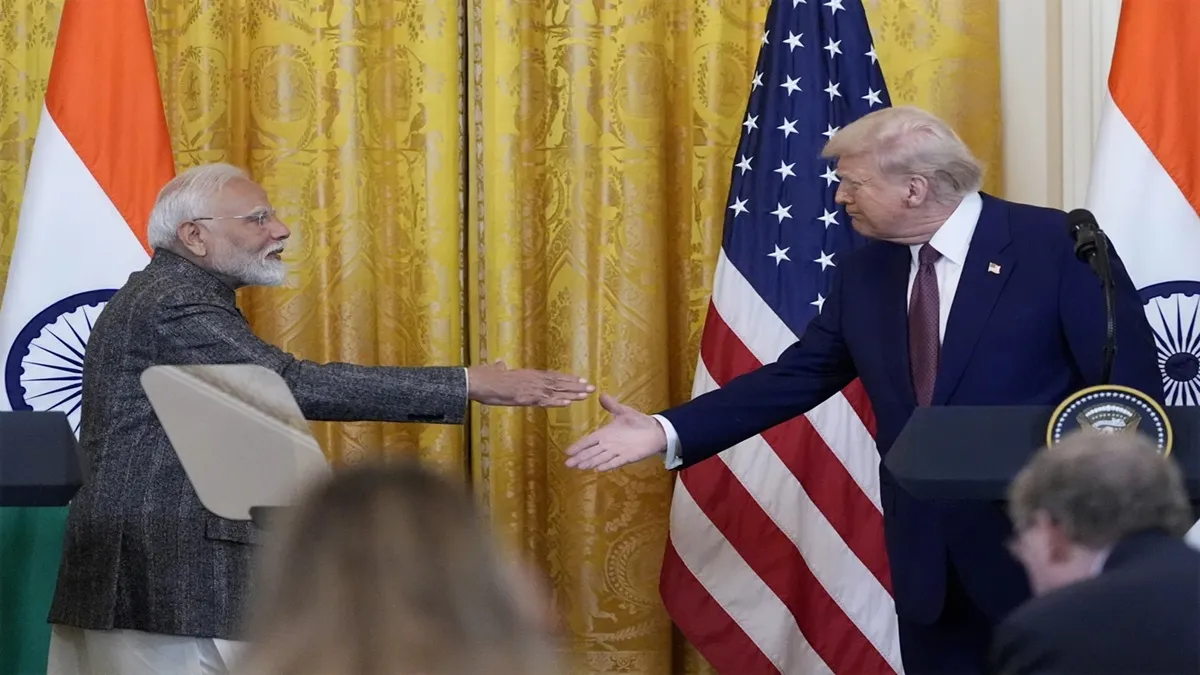
India will send a high-level commerce ministry delegation to Washington next week for the next round of trade negotiations with the US as both sides push to resolve long-standing differences ahead of a fast-approaching US tariff deadline.
The proposed bilateral trade agreement (BTA) which India hopes to finalise in phases has gained urgency after US President Donald Trump extended a suspension of additional duties on Indian goods until August 1, 2025. Any failure to conclude an interim deal before that could see Indian exports once again hit with higher levies including a 26 per cent tariff first announced in April.
The visit also comes amid rising unease in New Delhi over Washington’s recent tariff threats aimed at BRICS countries, a bloc that includes India.
What’s at stake and why it matters
The US remains India’s largest trading partner. In FY24 bilateral goods trade reached USD 191 billion according to Ministry of Commerce data. India’s exports to the US stood at USD 77.5 billion while imports were valued at USD 55.4 billion.
However this trade equation is now at risk due to rising protectionist signals from the US. On April 2, President Trump had announced steep tariffs on several countries including India citing trade imbalances. Although a temporary pause was agreed upon, that suspension ends next month.
Adding to the uncertainty Trump has warned of a 10 per cent tariff on all BRICS economies, accusing the bloc of working against American interests. “Anybody that’s in BRICS is getting a 10 per cent charge pretty soon,” he said on July 8, during a cabinet briefing.
While India has not yet received a formal tariff notification, the possibility of being included in the next tranche of letters is prompting urgency within the Ministry of Commerce.
India is keen to secure tariff concessions and improved market access for its labour-intensive sectors, including textiles, leather, gems and jewellery, marine products, engineering goods, plastics and chemicals. It also wants better access for agricultural exports such as bananas, grapes and oilseeds.
On the other hand, the US is seeking lower duties on industrial goods, automobiles (including electric vehicles), petrochemical products, wines and most controversially, genetically modified (GM) crops and dairy products.
Indian officials have maintained that dairy access is a no-go area. GM food imports are also viewed as politically sensitive, particularly with India’s large base of small and marginal farmers.
India has also raised objections to the US safeguard duty of 25 per cent on automobile imports and 50 per cent tariffs on steel and aluminium arguing they are inconsistent with global trade rules. New Delhi has flagged these concerns at the World Trade Organization and retained the right to impose retaliatory tariffs under WTO norms.
What’s next
The upcoming visit will mark the third time in three months that an Indian delegation has travelled to the US for this purpose. A team led by chief negotiator Rajesh Agrawal who is also Special Secretary in the Department of Commerce concluded the last round of discussions in Washington on July 2.
Trump’s tariff overhang and BRICS complications
India’s trade talks are now being overshadowed by Trump’s latest tariff salvo. In two rounds of notifications since July 7, the US has issued tariff letters to at least 21 countries, including Brazil, Indonesia, South Korea, Japan, South Africa and Malaysia. The rates vary, Brazil faces a 50 per cent tariff, while others are looking at 20 to 35 per cent.
Trump has also declared that countries aligned with “anti-American” BRICS positions will face penalties. India, which participated in the 17th BRICS Summit in Brazil alongside China, Russia and others is now closely watching how the US defines and applies this policy.
No deadline-based deals, only fair ones
Despite the compressed timelines, India has ruled out signing a deal under duress. “We do not enter into any agreement based on deadlines,” Commerce Minister Piyush Goyal said last week. “It has to be properly negotiated, concluded and in the national interest. A deal must be win-win.”
