
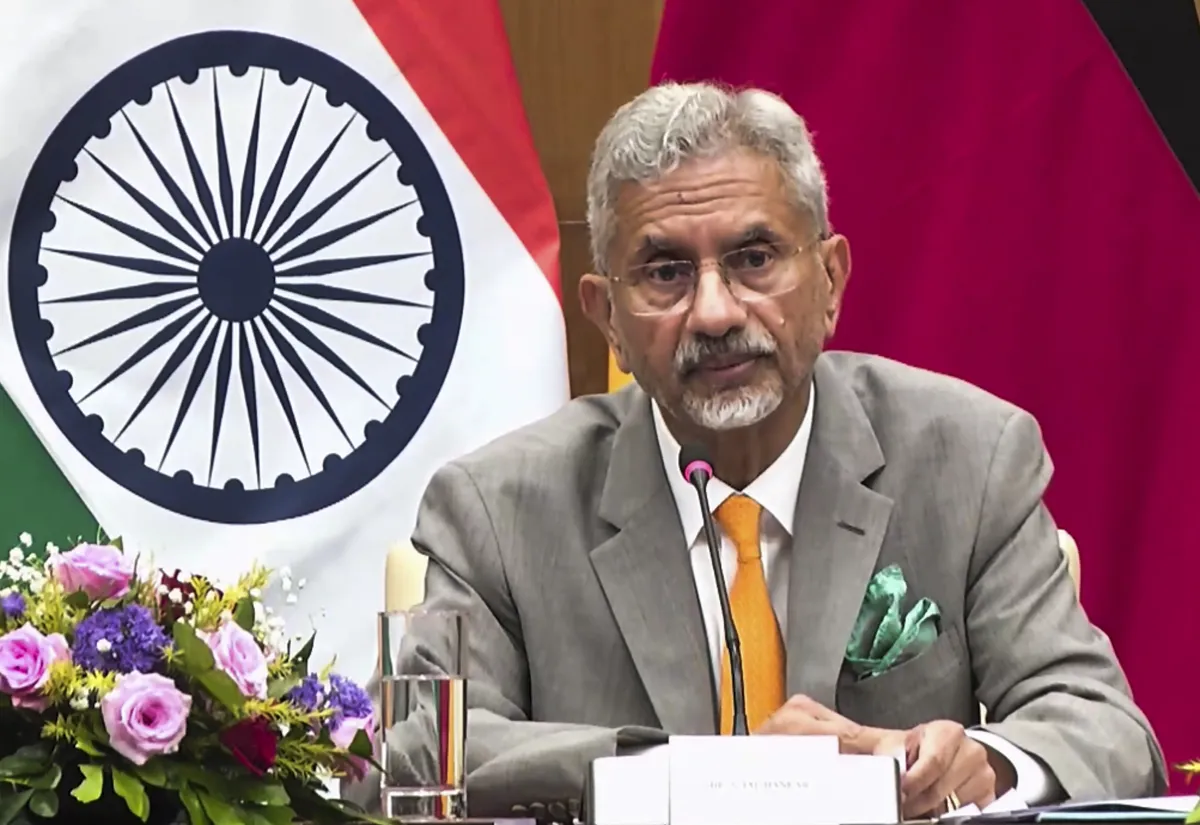
External Affairs Minister Dr S Jaishankar on Monday stressed that economic practices must be fair, transparent and should benefit everyone, as the world seeks a "stable and predictable environment" for trade and investment. He made the remarks while speaking at a virtual BRICS Summit, which was attended by Russian President Vladimir Putin and Chinese President Xi Jinping.
During the Summit, which was convened by Brazilian President Luiz Inacio Lula da Silva, Jaishankar also said that India believes that the foundational principles such as open, fair, transparent and non-discriminatory approach of the international trading system must be protected.
"The world as a collective is seeking a stable and predictable environment for trade and investment. At the same time, it is imperative that economic practices are fair, transparent and to everyone's benefit," Jaishankar said. "When there are multiple disruptions, our objective should be to proof it against such shocks. That means creating more resilient, reliable, redundant and shorter supply chains."
World needs 'constructive, cooperative' approach: Jaishankar
In his address, he also stressed that the world needs a "constructive and cooperative" approach to promote sustainable trade, stressing that raising barriers and complicating transactions will not help anyone. He also urged the BRICS countries to set an example by reviewing trade flows.
"Where India is concerned, some of our biggest deficits are with BRICS partners and we have been pressing for expeditious solutions. We hope that this realisation will be part of the takeaways from today's meeting," he said.
"The international trading system is based on the foundational principles of open, fair, transparent, non-discriminatory, inclusive, equitable and a rules-based approach with special and differential treatment for developing countries," Jaishankar said.
State of world a 'cause of concern': EAM
Jaishankar also said that the "state of the world today is a cause for genuine concern", as he listed the impact of the COVID-19 pandemic, Ukraine conflict and the Israel-Hamas war in the middle east. "In the face of these challenges, the multilateral system appears to be failing the world. That so many serious stresses are being left unaddressed is understandably having consequences for the global order itself," Jaishankar noted.
