
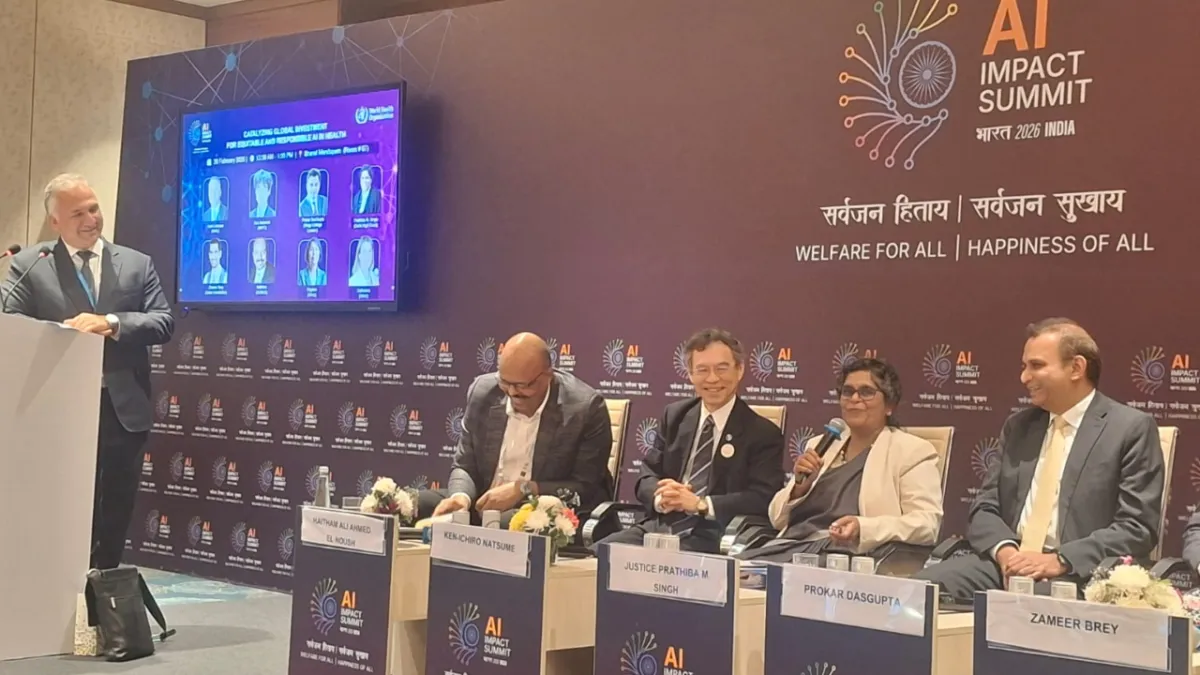
Delhi High Court judge Prathiba Singh has affirmed that intellectual property would require reinventing when it comes to artificial intelligence, stressing that the existing frameworks which were made to reward human creativity, are now being challenged by the growth of AI.
Justice Singh was speaking at the AI Impact Summit 2026 in New Delhi on Friday. She was speaking at a session titled Catalysing Global Investment for Equitable and Responsible AI in Health at Bharat Mandapam, held during a summit organised by the Ministry of Electronics and Information Technology and IndiaAI.
"Do we have to rewrite the TRIPS agreement (The Agreement on Trade-Related Aspects of Intellectual Property Rights)? Do we have to rewrite or renegotiate the WTO treaties? Do we have to re-enact patent laws across countries?" she asked. The judge also pointed to unresolved concerns surrounding inventorship and ownership in cases of AI generated innovation.
"Do we give joint authorship? Do we give joint ownership? What kind of extent of human intervention is needed for a patent to be granted in the area of artificial intelligence?"
Justice Singh further disclosed that she was approached by a World Health Organisation (WHO) team in September 2024 to co-chair the drafting of a global guidance document on legal considerations in AI and health.
"There is no uniform-based document or foundational principles which exist in the context of AI and health," she added.
According to her, the proposed framework centres on legal standards, regulatory oversight and institutional capacity building. "It is so important that we do institution building not on the glittery AI tools...but on the regulatory systems and frameworks that countries need to establish."
Justice Singh underlined major regulatory issues, including data protection, privacy, liability frameworks, patient rights and cross border compliance, emphasising the necessity for consistent global standards.
"There are liability frameworks that need to be looked into…there needs to be some uniform standards that we need to have."
Referring to India's digital public infrastructure model, she suggested the potential development of an India Health Stack to promote innovation under appropriate regulatory supervision. She noted that the National Informatics Centre has already linked thousands of hospitals through a next generation system.
Concluding her address, Justice Singh emphasised that AI in healthcare must remain patient centric and operate with human oversight.
"We need to have a patient centric approach… with human oversight because without human oversight, AI and health will be a failure."
