
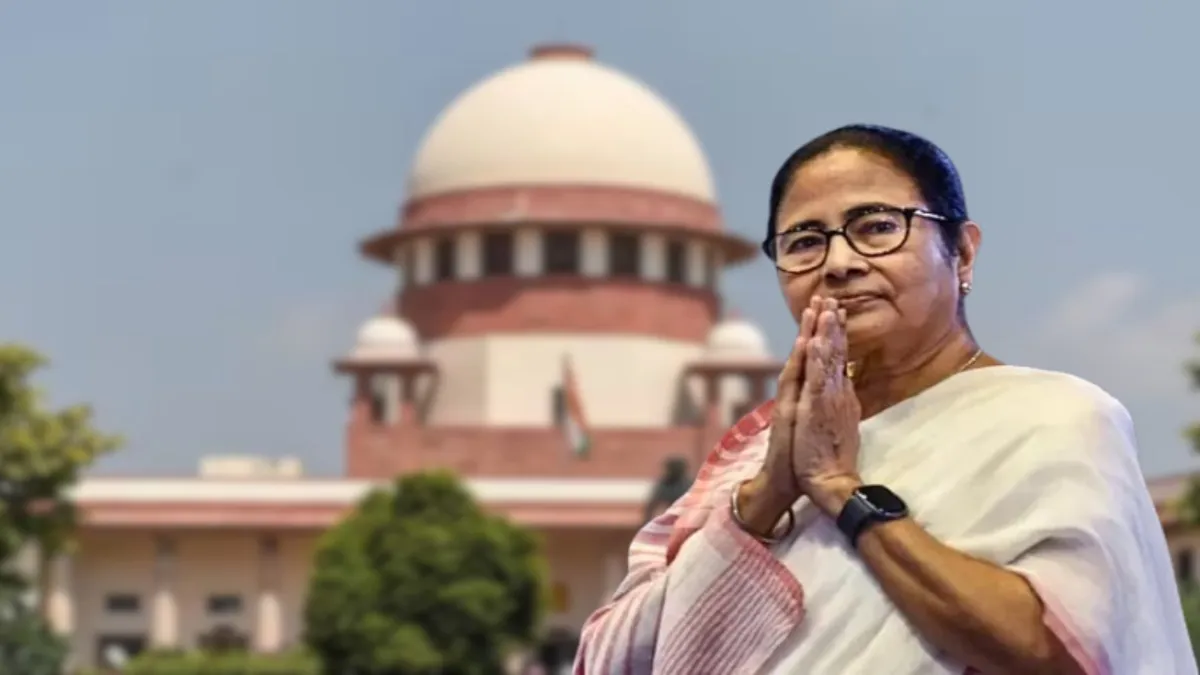
The Supreme Court is set to hear West Bengal Chief Minister Mamata Banerjee's petition challenging the ongoing Special Intensive Revision (SIR) of the voter list in the state on Wednesday. Banerjee, who holds a law degree, is set to personally appear before the court to present her case. As per the information, senior advocate Shyam Divan will appear before the Supreme Court today on behalf of West Bengal Chief Minister Mamata Banerjee. He will present arguments in the court on Banerjee's petition challenging the SIR process. Notably, Mamata Banerjee will also be present in the courtroom during the hearing and is likely to place her submissions before the court as well.
According to Bar and Bench, she completed her legal education at Jogesh Chandra Chaudhuri Law College in Kolkata and last practised as an advocate in 2003. Notably, the Bengal Chief Minister had filed the petition against the SIR in the top court on January 28.
Three petitions listed before the CJI-led bench
As per the Supreme Court website, the bench comprising Chief Justice Surya Kant, Justice Joymalya Bagchi and Justice Vipul M Pancholi will hear three petitions filed by Mostari Banu and Trinamool Congress MPs Derek O'Brien and Dola Sen. Banerjee is expected to be present during this crucial session that will also address connected pleas related to the Special Intensive Revision process. In her petition, she has made the Election Commission of India (ECI) and the Chief Electoral Officer of West Bengal respondents. Earlier, Banerjee had written to the Chief Election Commissioner urging him to halt what she described as an "arbitrary and flawed" voter list revision in the state.
Bengal SIR case
During the hearing on January 19, the Supreme Court laid down several directives regarding the Special Intensive Revision of the electoral roll in West Bengal. The court emphasised that the process must be transparent and should not create difficulties for voters. It instructed the Election Commission to publicly display the names of individuals flagged for "logical discrepancies" at gram panchayat bhavans and block offices. These designated centres will also serve as locations where voters can submit supporting documents or raise formal objections. According to the Election Commission, "logical discrepancies" refer to inconsistencies found while linking voters to the 2002 electoral roll. These include mismatches in the names of parents or unusual age differences between a voter and their parent, such as gaps below 15 years or above 50 years.
Taking cognisance of the scale of the revision, the bench led by the Chief Justice of India noted that nearly 1.25 crore voters in West Bengal had been categorised under "logical discrepancies". In response to these developments, Chief Minister Mamata Banerjee moved the Supreme Court, naming the Election Commission of India and the West Bengal Chief Electoral Officer as respondents in her petition.
ALSO READ: 'Never seen such arrogant…': CM Mamata after meeting CEC over 'irregularities' in Bengal SIR | Video
