
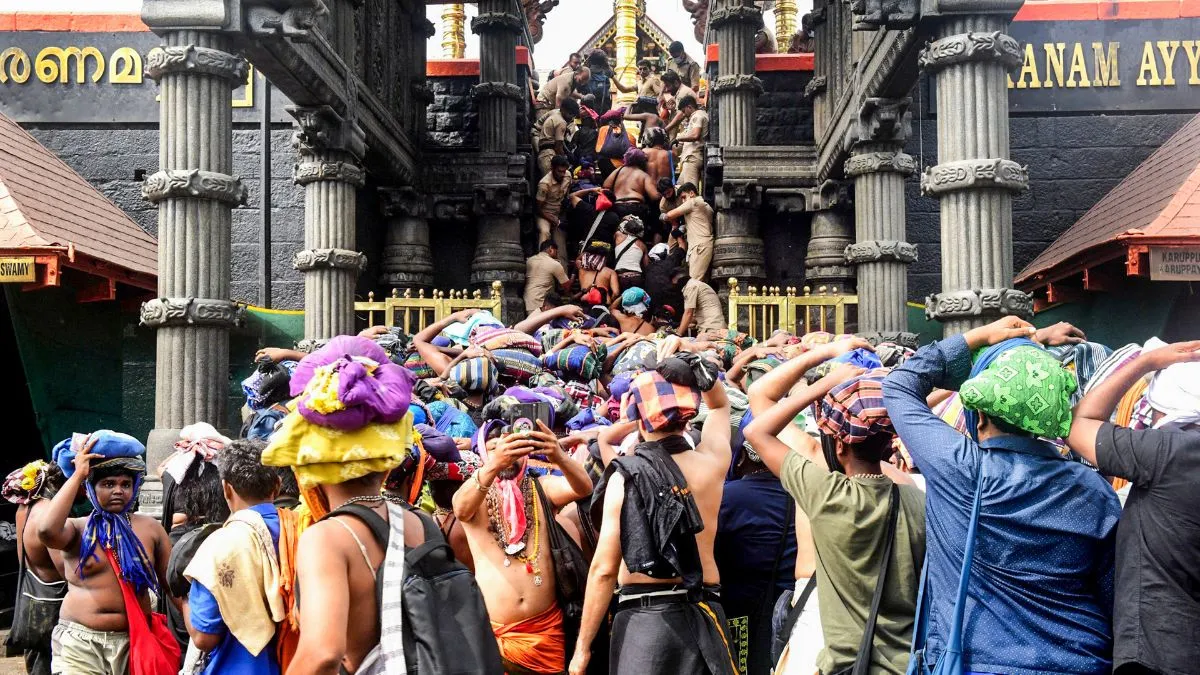
Just ahead of the Kerala elections, the Centre has filed its written submission in the Supreme Court regarding the Sabarimala temple case. The government clarified that the restriction on women aged 10 to 50 entering the temple is not due to notions of impurity or discrimination against women, but is intended to preserve Lord Ayyappa’s “Naishtika Brahmachari” (lifelong celibate) tradition and the temple’s established rituals.
The submission states that allowing women in this age group could alter the core worship practices and the traditional form of the deity, potentially impacting religious pluralism protected under the Constitution.
SC to hear final arguments on women’s entry at Sabarimala
The Supreme Court, led by Chief Justice of India Surya Kant, will begin the final hearing on April 7 in cases concerning women’s entry into religious places, including the Sabarimala temple in Kerala. The hearings will also examine the broader limits of religious freedom across different faiths.
Ahead of the proceedings, the Akhil Bharatiya Sant Samiti has sought permission to intervene, arguing that courts should not decide what constitutes essential religious practices. The organisation, which claims to represent 127 sects of the Sanatan Dharma, including around 18.5 lakh priests and 12 lakh seers, said judges are ‘not equipped’ to act as authorities on matters of faith.
The issue dates back to September 2018, when a five-judge Constitution bench ruled by a 4:1 majority to lift the ban on women aged 10 to 50 entering the Sabarimala shrine. The court had held that the centuries-old practice violated constitutional rights and was therefore illegal.
The upcoming nine-judge bench will revisit these matters, weighing arguments on religious traditions against the principles of equality and non-discrimination.
Sabarimala gold controversy becomes key poll issue
The controversy over the missing gold from the Sabarimala temple has emerged as a major talking point in the ongoing Kerala election campaign. The Congress Party has sharply criticised the ruling Left Democratic Front (LDF) over the issue.
Meanwhile, the Bharatiya Janata Party (BJP) has included in its election manifesto a promise to restructure the Devaswom Board, the body responsible for managing the Sabarimala temple.
Kerala, which has a total of 140 assembly seats, will go to the polls in a single phase on 9 April. The votes will be counted on 4 May.
