
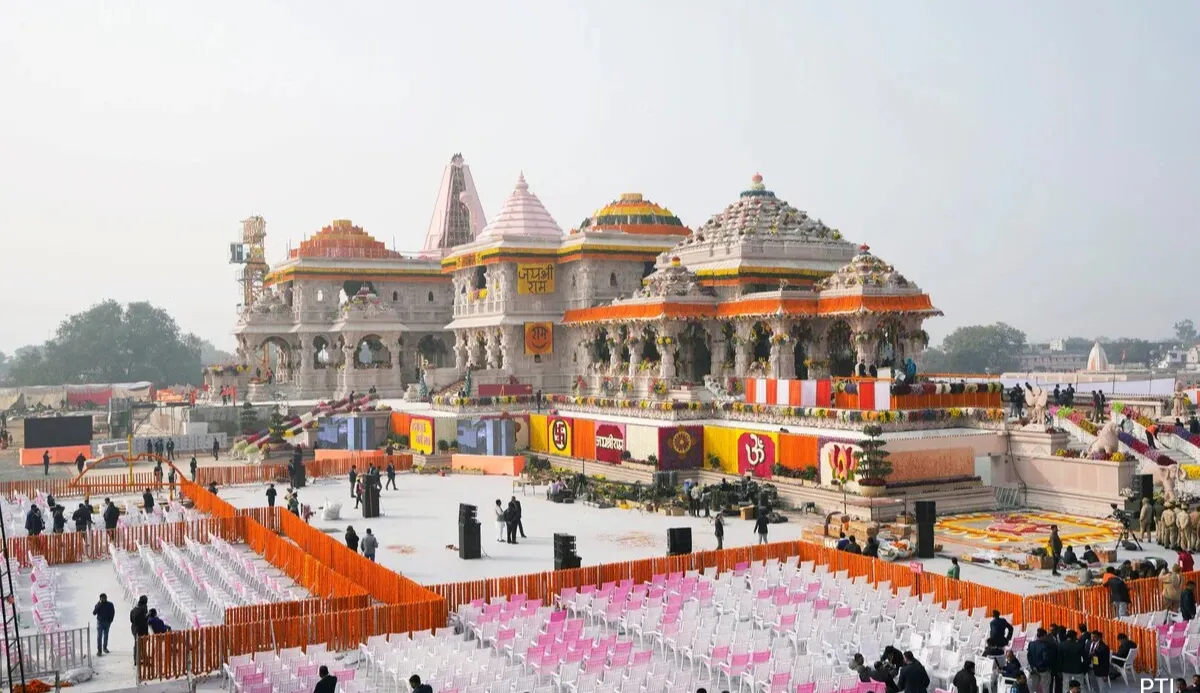
The Ram Mandir in Ayodhya is not just a temple; it is a sacred journey. Inaugurated on January 22, 2024, the grand temple stands at the site believed to be the birthplace of Lord Ram, drawing millions of devotees from across India and the world. While the main sanctum of Ram Lalla remains the heart of devotion, the entire temple complex unfolds like a living spiritual map of the Ramayana, filled with temples, shrines, halls, and symbols that deepen the pilgrim’s experience.
Built with devotion, patience, and precision, the Ram Mandir took five years to complete, with more than 4,000 workers and craftsmen working tirelessly. Experts from CBRI Roorkee, IITs across India, and the Indian Institute of Astrophysics ensured the temple would stand strong against time, weather, and natural calamities. Crafted entirely from Bansi Paharpur sandstone, the three-storey structure rises 161 feet high, stretches 360 feet in length, and contains no iron or steel, preserving its durability for centuries.
The heart of the complex: Main temples
At the centre of the complex stands the Shri Ram Janmabhoomi Temple, where devotees gather for darshan of Ram Lalla in the sanctum sanctorum. This is the spiritual core of the complex, where faith, history, and emotion come together.
Within the main temple is the Ram Darbar Shrine, where Lord Ram is worshipped in his royal form along with Goddess Sita, Lakshman, and Lord Hanuman. Opened to devotees in phases, this shrine reflects Ram as both king and protector, offering a deeper connection to his divine rule.
Six deity temples within the precinct
Surrounding the main temple are six beautifully designed shrines, each dedicated to a major Hindu deity, reminding devotees that the Ram Mandir complex embraces the wider spiritual universe of Sanatan Dharma.
These include temples dedicated to:
- Lord Shiva (Mahadev)
- Lord Ganesh
- Lord Hanuman
- Surya Dev (Sun God)
- Maa Bhagwati (Divine Mother)
- Maa Annapurna, the goddess of nourishment
Each shrine is crowned with traditional flags and pinnacles, adding to the sacred skyline of the complex.
Honouring devotees and sages of the Ramayana
One of the most moving aspects of the Ram Mandir complex is its tribute to the sages and devotees who shaped Lord Ram's journey. Dedicated shrines honour figures whose faith, guidance, and service define the spirit of the Ramayana. Among them are temples dedicated to
- Maharshi Valmiki, the author of the Ramayana
- Maharshi Vashishtha and Maharshi Vishwamitra, Ram’s revered gurus
- Maharshi Agastya, associated with Ram’s years in exile
- Nishadraj, the humble boatman who helped Ram cross the Ganga
- Mata Shabari, remembered for her pure devotion
- Ahalya, whose redemption by Ram symbolises compassion and grace
These shrines remind visitors that devotion, not status, earns a place in the divine story.
Sacred mandapas: Spaces of prayer and culture
The complex also includes several mandapas, or pillared halls, each serving a spiritual and cultural purpose. These include:
- Sabha Mandap, the main gathering hall
- Kirtan Mandap, for devotional singing
- Nritya Mandap, celebrating sacred dance traditions
- Rang Mandap, used for rituals and ceremonies
- Prarthana Mandap, a space dedicated to silent prayer
The walls and pillars of these halls are adorned with sculptures and carvings that narrate scenes from the Ramayana, allowing devotees to experience the epic visually and spiritually.
Symbols of devotion beyond temples
Adding depth to the sacred space are symbolic installations, including statues of Jatayu and the Divine Squirrel. These figures represent sacrifice, service, and unwavering devotion—values that lie at the heart of Lord Ram’s teachings.
Today, the Ram Mandir complex houses around 15 dedicated temples and shrines, including the main temple and subsidiary structures. Some areas continue to open in phases, as guided by the Shri Ram Janmabhoomi Teerth Kshetra Trust.
For devotees, walking through the complex is like stepping into the Ramayana itself, each shrine telling a story, each space inviting reflection. More than a monument, the Ram Mandir stands as a living symbol of faith, art, culture, and collective devotion.
