
The debate surrounding the origins of civilisation has continued for decades, with different theories and interpretations shaping historical understanding. Weighing in on the discussion, maritime historian Nick Collins has put forward his views on the subject.
Collins has challenged the long-standing belief that Mesopotamia is the cradle of civilisation, arguing instead that the Indian subcontinent deserves that distinction. Collins, who is also the author of 'How Maritime Trade and the Indian Subcontinent Shaped the Entire World,' said his conclusions are based on decades of research into maritime trade and ancient history.
Why Nick Collins rejects Mesopotamia as the cradle of civilisation
Collins said he "spent forty years in international shipping, not academia." Because of this, he claimed he had no established historical orthodoxy to defend when he began researching the history of maritime trade.
"I followed the evidence, and it kept arriving in the same place: the Indian subcontinent," he said.
According to Collins, nineteenth-century archaeologists excavated in Mesopotamia because the climate preserved artefacts, biblical sources directed attention there, and the Ottoman Empire permitted excavations. He argued that these factors formed the basis of what later became the accepted narrative of Mesopotamia as the "cradle of civilisation."
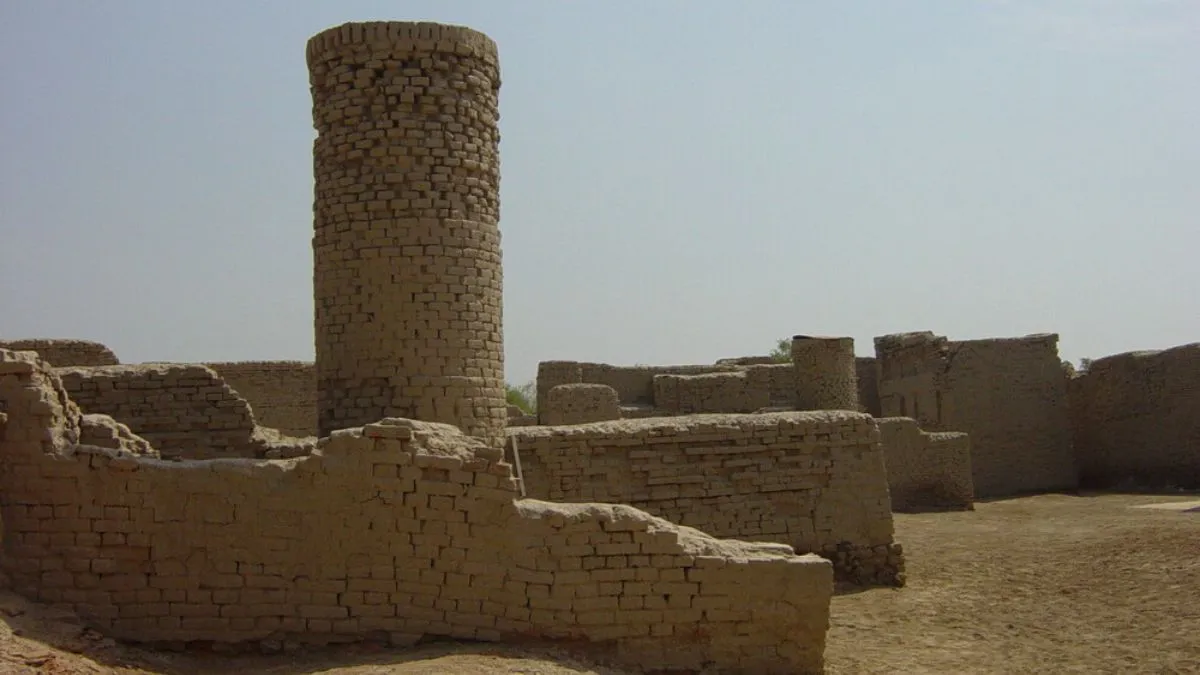
Collins argued that the same level of archaeological rigour was not applied to India. He pointed out that Mohenjo-daro was not discovered until 1922 and argued that by the time the site was uncovered, the Mesopotamian narrative had already become firmly established.
Nick Collins on the scale of ancient Indian civilisation
Collins described what he believes was the largest civilisation of the ancient world. He said there were around three hundred cities, with populations of approximately fifty thousand people in each by 2600 BC.
According to Collins, two-thirds of these cities stood on the banks of the Sarasvati river, which he described as the central and greatest of the seven rivers mentioned in the Rig Veda. He said the river flowed down from the Himalayas before disappearing entirely by 1900 BC.
Collins also referred to Vedic kings, stating that they claimed territory stretching "sea to sea," from Afghanistan to Maharashtra, covering approximately 1.5 million square miles.
He also referred to the ancient site of Lothal, which he described as having a dock built to handle thirty ships of sixty tons each. Collins argued that no comparable facility existed in Europe for another four thousand years. He also claimed that when the structure was first excavated, it was recorded as a bathing pool.
Nick Collins' views on migration and civilisation theories
Collins argued that when the scale of the civilisation became impossible to dismiss, the theory was not corrected but replaced with a different narrative.
According to him, this narrative suggested that pale-skinned nomads from the steppe arrived around 1500 BC and brought civilisation with them. Collins rejected this claim, saying there was no evidence for it, that the chronology did not work, and that the Vedas contained no description of such an invasion.
What Nick Collins said about the 2019 genetic study
Referring to a Harvard-led genetic study published in 2019, Collins said the research revived the claim and that many media reports presented it as confirmation.
However, Collins argued that the same study found that the builders of the ancient cities were indigenous. He also stated that the Sarasvati river described in the Rig Veda had already dried up before the newcomers identified in the study arrived.
According to him, the study found that a small group of men arrived after the Sarasvati had dried up, interbred with the existing population and left a genetic signature. He maintained that this was the extent of the finding.
Collins concluded by arguing that where archaeologists chose to excavate was largely the result of climate and access rather than proof that Mesopotamia was the birthplace of civilisation. He further argued, "The Aryan invasion theory was constructed because an Indian civilisation that owed nothing to Caucasians was a fact the late nineteenth century could not accommodate."
ALSO READ: Beyond Kerala: Why Anand Mahindra wants travellers to discover Karnataka's hidden backwater paradise