
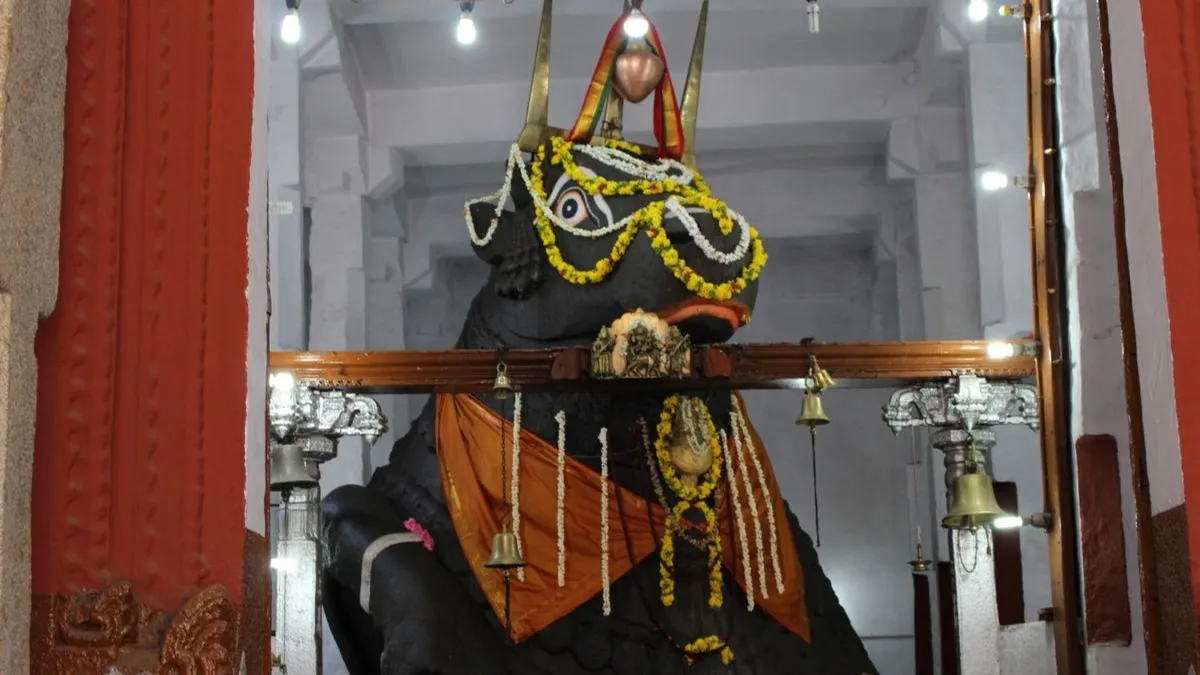
Situated in the leafy, historic streets of Basavanagudi in Bangalore, is Bull Temple (called the Nandi temple), which is dedicated to the sacred bull (Nandi) of Lord Shiva. While considered a temple, Bull Temple is more than that; it is a cultural and structural gem that attracts not only worshipers, but also history enthusiasts and tourists.
The Legend Behind the Temple
One of the most charming stories tied to the Bull Temple tells of a wild bull that used to roam the peanut and groundnut fields of Basavanagudi, destroying the farmers’ crops. Unable to control the beast, the farmers prayed for a solution. According to lore, Lord Shiva guided them to bury a trident (or iron plate) near the bull; when the farmers did so and placed it on the creature’s forehead, the bull transformed into stone and stopped growing.
Overjoyed, the farmers built a temple around the sacred bull, and to this day, they offer their first groundnut harvest to Nandi during a festival called Kadalekayi Parise (or Parishe), usually in November or December.
bengaloorutourism.com
Built by a Visionary — Kempe Gowda’s Legacy
The Bull Temple, as we see it today, was built in 1537 by Kempe Gowda, the legendary founder of Bangalore.
Its architecture bears a strong resemblance to the Vijayanagara style, with its smooth pillars, open halls, and later-added vimana (tower), constructed in the early years of the 20th century.
The Colossal Nandi Statue
The most renowned centrepiece of the temple is a colossal monolithic Nandi, sculpted from a single granite boulder and located within the core of the temple. The bull itself stands roughly 4.6 meters tall and about 6.1 meters (~20 feet) long, making it one of the largest Nandi statues on the planet.
Originally grey in colour, the statue has turned black over centuries as devotees apply charcoal and oil as part of their worship.
There’s even a small iron plate on its head — linked to the legend that this prevents the bull from growing.
Architecture That Tells a Story
The temple’s design is simple yet powerful. The vimana, or the temple tower, is richly decorated with Shaivite motifs and was added in the early 1900s.
Close by lies a Shivalinga (Shiva’s symbolic form) behind Nandi.
Inside the complex, statues of the Sun (Surya) and Moon (Chandra) ride their chariots, adding poetic depth to the shrine.
According to inscriptions, a spring beneath the bull is believed to be the origin of the Vrishabhavathi River, giving spiritual and geographical significance to the site.
Exploring the Surroundings — Bugle Rock and More
Right next to the temple is the Bugle Rock Garden, a quiet, green space built around ancient rock formations.
The rocks here are reportedly 3,000 million years old, making this a geological wonder tucked inside the city.
From the garden, you can also spot a watchtower built by Kempe Gowda, one of the boundary markers he constructed while establishing Bangalore.
Not too far is the lush Lalbagh Botanical Garden, a favourite spot for plant lovers and city dwellers.
Visiting the Temple — Practical Tips
- Timings: The temple is open daily from 6:00 AM to 8:00 PM.
- Entry: Free, there’s no entrance fee.
- How to Reach: Easily accessible by local buses, taxis, or auto-rickshaws. The Bull Temple bus stop is very close by.
- Best Time to Visit: Between June and February, when the weather is relatively pleasant.
Beyond its spiritual side, the temple is a calm nook in a busy city — the kind of place where visitors can sit and reflect, or simply enjoy the quiet strength of Nandi.
ALSO READ: Shri Someshwara Swamy Temple in Bengaluru: History, significance, how to reach and nearby places
