
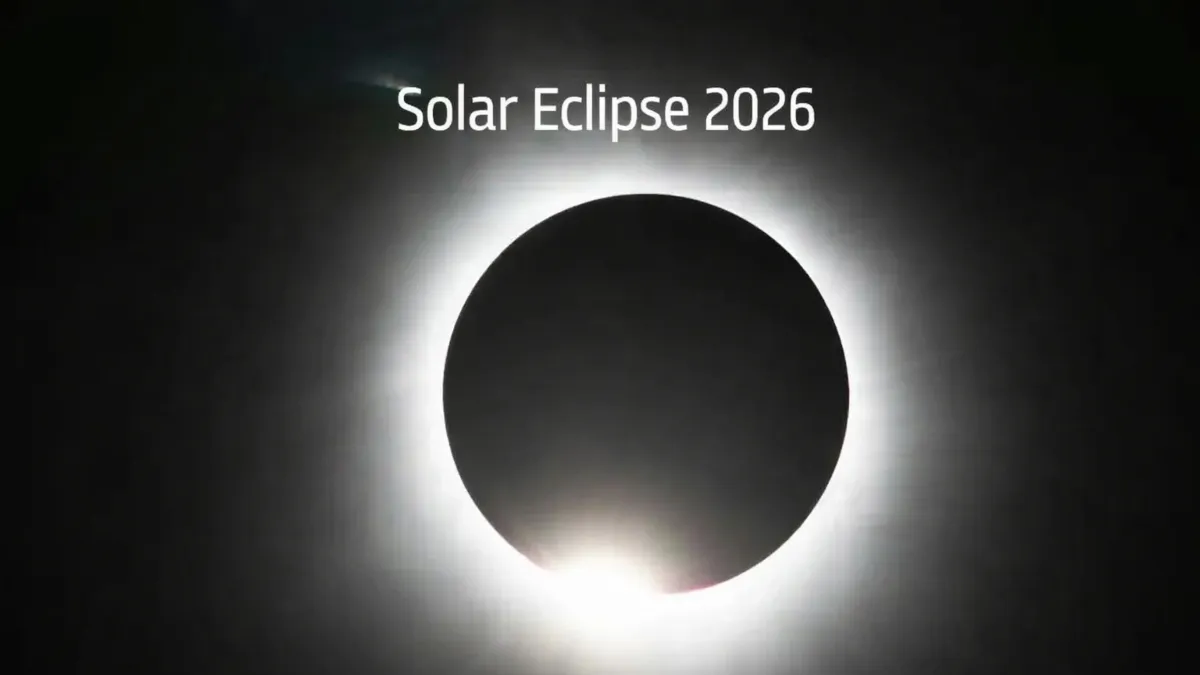
The date of Phalguna Amavasya is February 17, 2026. Everyone is therefore curious as to whether a solar eclipse will take place this Amavasya. Therefore, let us inform you that this final Amavasya in the Hindu calendar will mark the first solar eclipse of the year. This will be an annular solar eclipse, which means that during the eclipse, the sun will seem like a bright ring of fire. Will India be able to see this eclipse, though? Let's investigate.
The first solar eclipse of the year will occur on the Phalguna Amavasya (new moon day) on February 17, 2026. However, this eclipse will not be visible in India, so its religious implications will not be considered here.
Solar Eclipse 2026 Timings
The solar eclipse will begin at 3:26 PM and end at 7:57 PM. This eclipse is not visible in India, so the Sutak period will not be valid.
When and how does a solar eclipse occur?
A solar eclipse occurs when the Moon comes between the Earth and the Sun, blocking either part or all of the Sun's light from reaching Earth. This astronomical event occurs only on the new moon day, but it's important to note that a solar eclipse doesn't occur on every new moon day.
What to do and what not to do during an eclipse?
- Worship is considered prohibited during the eclipse period.
- Food is not eaten.
- Auspicious works are not done.
- Pregnant women are advised to take special precautions during the eclipse period.
- But let us tell you that the eclipse occurring on Phalguna Amavasya 2026 is not visible in India, hence it will not be necessary to follow these rules.
(Disclaimer: The information given here is based on religious beliefs and folk beliefs. There is no scientific evidence for this. India TV does not provide any proof of the truth of any of the things.)
