
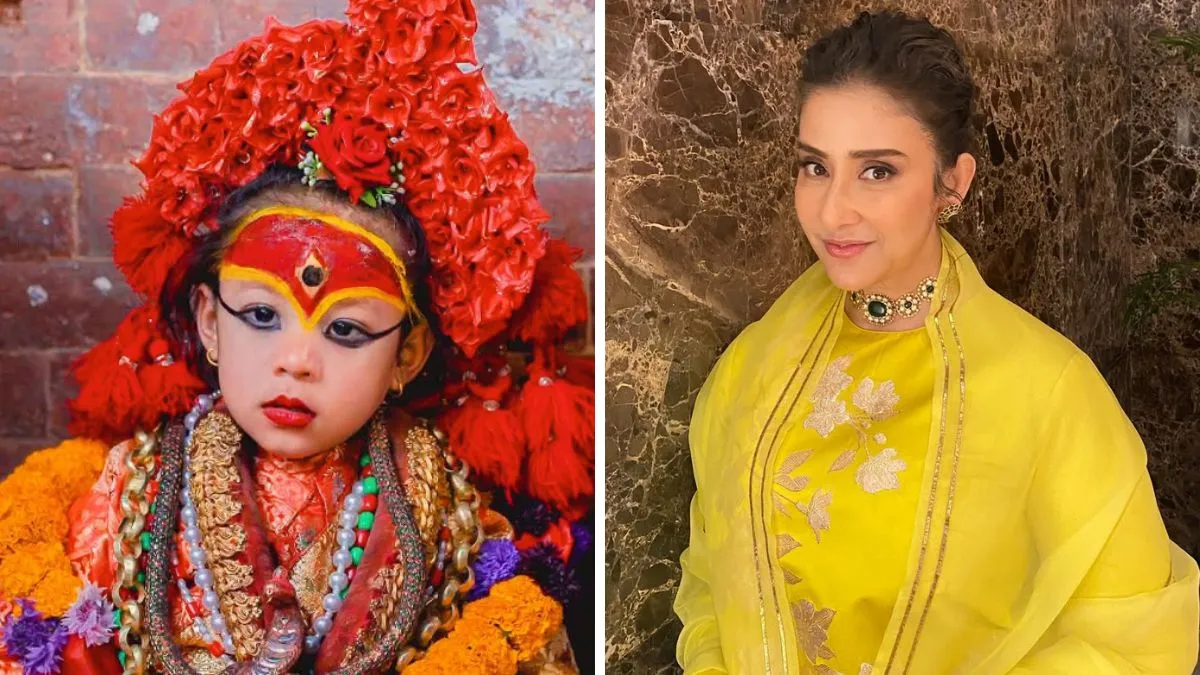
The Kumari Temple does not announce itself loudly. Tucked within Kathmandu’s Durbar Square, it sits quietly, almost watchfully, as life moves around it. When Manisha Koirala recently received Kumari darshan in Nepal, her visit drew attention back to this space, not as a spectacle, but as a pause.
Manisha took to Instagram to share videos from the visit. She penned, "With folded hands and a quiet heart, I received Kumari’s darshan; in that sacred stillness, I offered my faith, my gratitude, and my surrender. May her grace dwell within us and bless our nation with peace, wisdom, and harmony."
Kumari Ghar is not simply another temple on a travel map. It is a place where belief feels intimate and restrained, where devotion is expressed without noise.
Who is the Kumari?
In Nepalese tradition, the Kumari is regarded as the living embodiment of Goddess Taleju, a fierce and protective form of Durga. She is chosen through an ancient and rigorous process from the Newar community, based on spiritual, physical and astrological criteria that have been followed for generations.
Once selected, the Kumari lives a life unlike any other. She does not perform rituals or sermons. Her presence itself is considered sacred. When she reaches puberty, her role ends, and another child is chosen to take her place. It is a belief rooted not in explanation, but in acceptance.
The Kumari Ghar: More than a temple
Architecturally, the Kumari Ghar feels like a relic from another time. The red-brick structure, detailed wooden windows and enclosed courtyard seem designed to hold silence rather than sound.
Visitors are not allowed inside the inner sanctum. They wait. Sometimes for minutes, sometimes longer. If the Kumari appears briefly at a window, it is enough. Even a fleeting glimpse is believed to carry blessings. There are no chants, no announcements, only stillness.
What Kumari Darshan represents
Kumari darshan is less about ritual and more about posture. People arrive with folded hands, lowered voices and a certain humility that feels instinctive rather than instructed.
When Manisha Koirala prayed for peace, wisdom and harmony, it echoed the quiet hopes of countless others who come here. The darshan does not promise outcomes. It offers a moment, brief, restrained, deeply personal.
A tradition rooted in respect and restraint
What sets the Kumari tradition apart is its discipline. The Kumari does not engage with devotees. She does not speak or bless in the conventional sense. There is dignity in that distance.
In a time when spirituality is often broadcast and documented, the Kumari tradition remains deliberately contained. It resists performance. Faith here is not displayed; it is held.
Why the Kumari tradition still matters today
Modern Nepal continues to debate and examine the Kumari tradition, and rightly so. Yet it remains an enduring symbol of cultural identity and continuity. For many, it is not about belief alone, but about heritage.
The Kumari represents a link to the past, to a way of understanding divinity that is communal, symbolic and deeply rooted in history.
A moment of pause, not spectacle. Whether it is a well-known actor or a first-time visitor, the Kumari Ghar tends to quiet people. It asks nothing elaborate. No words. No gestures beyond respect. That is perhaps why moments like Manisha Koirala’s visit resonate. They reflect a softer, inward form of faith, one built on gratitude, stillness and the simple act of showing up.
Also read: Magh Mela 2026: 6 auspicious bathing dates, ending with final snan on Mahashivratri
