
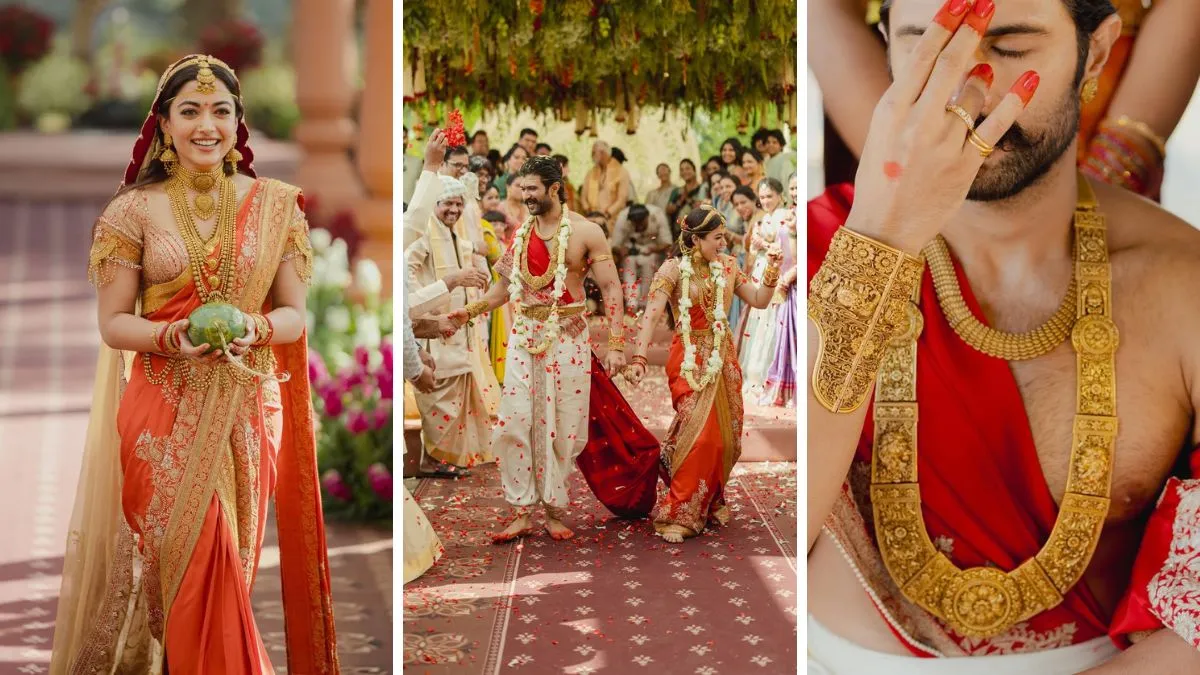
At the Telugu wedding ceremony of Rashmika Mandanna and Vijay Deverakonda, the jewellery did not behave like celebrity styling. It felt deliberate, almost archival. There were no oversized diamonds competing for flash photography or experimental couture pairings.
Instead, the couple leaned into temple gold in its most traditional language. The kind designed to be worn close to the skin, passed between generations and recognised instantly across South Indian households. Every piece appeared chosen for continuity rather than spectacle.
The kasu mala layering that built the silhouette
Rashmika’s jewellery began with structure. The kasu malas were not simply stacked for volume. They were layered in graduated lengths, allowing each row of engraved coins to remain visible against the saree pleats. That spacing matters. When layered incorrectly, coin necklaces collapse into a single mass of gold. Here, each strand retained movement. Traditional kasu designs carry embossed motifs associated with prosperity, but what stood out was the antique finish. Instead of high polish, the gold appeared softly muted, allowing shadows within the carvings to create depth.
It photographed beautifully without looking newly minted.
Temple chokers that prioritised craftsmanship over shine
The choker sat high on the collarbone, exactly where temple jewellery is meant to anchor the face during rituals. Lakshmi motifs dominated the centre panels, but the detailing avoided the overly symmetrical finish seen in contemporary replicas. Slight variations in carving suggested hand finishing rather than machine perfection. Temple jewellery rewards patience. The closer you look, the more detail reveals itself.
Tiny granulation work bordered the motifs, creating texture that caught natural light rather than reflecting it harshly. It allowed the saree’s zari to remain part of the conversation instead of competing against it.
The vaddanam that anchored the movement
Among Telugu bridal ornaments, the vaddanam often determines whether a silhouette feels ceremonial or styled. Rashmika’s waist belt leaned towards sculptural temple work rather than contemporary flexibility. The rigid structure held the saree pleats firmly through movement-heavy rituals, allowing the drape to remain intact as garlands and rice offerings were exchanged.
Close detailing suggested repoussé-style embossing, giving the piece dimension without relying on gemstones.
It acted less like jewellery and more like architecture.
Bangles, sound and ritual rhythm
Her bangles followed traditional stacking logic rather than symmetrical styling. Thicker kadas framed slimmer textured pieces, creating tonal variation instead of uniform shine. During rituals, the soft metallic sound becomes part of the ceremony itself. Jewellery in Telugu weddings is often experienced as much through sound as through sight. That sensory detail is rarely accidental.
Vijay Deverakonda’s restrained gold language
Vijay approached jewellery with restraint. A single temple necklace added ceremonial authority without overwhelming the ivory silk dhoti. Arm cuffs referenced classical South Indian iconography often seen in temple sculpture depictions of warriors and deities. The absence of excessive layering allowed the texture to lead.
It reinforced something often overlooked in groom styling. Gold, when used sparingly, reads as confidence rather than ornamentation.
Why does this jewellery feel different
Many celebrity weddings today prioritise novelty. This ceremony leaned towards familiarity. Antique finishes, sculptural motifs and heirloom proportions suggested pieces chosen for longevity rather than one-time impact. The styling did not attempt reinvention. It is a trusted tradition to hold attention.
And sometimes, that quiet confidence is exactly what makes gold unforgettable.
