
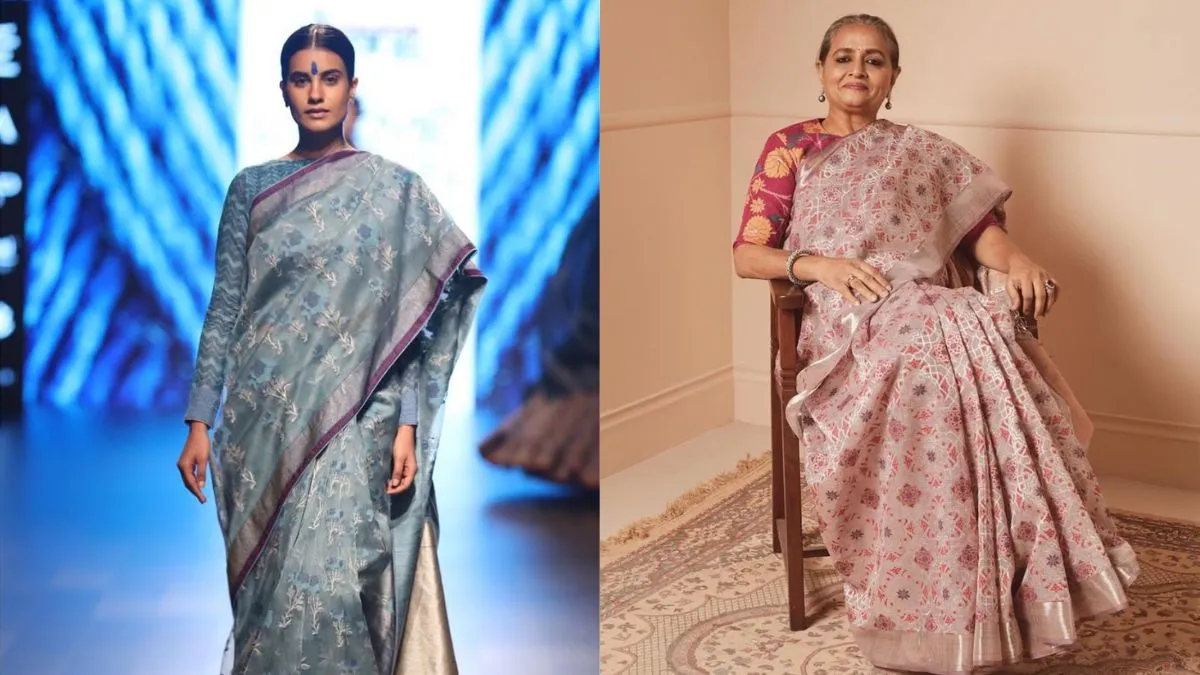
Jamdani, a weaving patten, comes from the Persian word "jam", which means floral and "dani" which means a vase or a container, named after the floral patterns that are seen in Jamdani weaves. The weaving pattern was included in the UNESCO Representative List of Intangible Heritage of Humanity in 2013 and in 2016, it received the GI (Geographical Indication) tag.
What is the Jamdani weave?
Jamdani has a rich cultural and regional history, It originated in Dhaka, which is now part of present-day Bangladesh. Earlier, Dhaka was a producer of textiles in the Indian subcontinent and eventually, it is here where the Jamdani took birth.
The weave of Jamdani is truly magical, and this technique has been passed on from one generation to the other. This is a discontinuous way of weaving wherein the "motifs are inlaid into the fabric by adding a denser thread to fine warp threads by hand. This process is considered the most time intensive and one of the most advanced hand weaving techniques in the world," says designer Gaurang Shah in an interview with Vogue.
The Jamdani is an intensive wave and Jamdani sarees are considered to be extremely valuable. These sarees are also passed on from one generation to other as family heirlooms.
Depending on the intricacy of the design, a Jamdani can take anywhere between six months to three years to be weaved, wherein a pair of weavers weave for nearly 10 hours every day.
When a weaver weaves a Jamdani, they can have 100 to 300 different discontinuous weft threads which they interweave together by hand to create the perfect design.
Why is Jamdani considered a special weave?
Initially, Jamdani was made on cotton muslin since Dhaka was renowned for the production of this fabric. With time, the Jamdani weave has been incorporated in different fabrics, such as silk and more. However, the cotton muslin Jamdani saree continues to be sought after.
While Jamdani was earlier weaved on sarees, today, it's being made for kurtas, dupattas and more. It has also made its way in upholstery.
The weave might have originated in Dhaka, however, today, it is weaved by the weavers in Andhra Pradesh, Maharashtra, Rajasthan and Uttar Pradesh.
ALSO READ: Mekhela Chador: Here's what you need to know about this traditional Assamese outfit
